The Palestinian “Disaster” Image
By Leen Jumah
When the photograph of four-year-old Ali Dawabsheh's charred bedroom went viral in 2015, Palestinian photojournalist Ashraf Amra faced an impossible choice: document the scene where an entire family burned alive in a fatal settler attack, or protect the dignity of the dead. He took the photograph. Three days later, his editor asked him to return and photograph the funeral. This time, he refused.
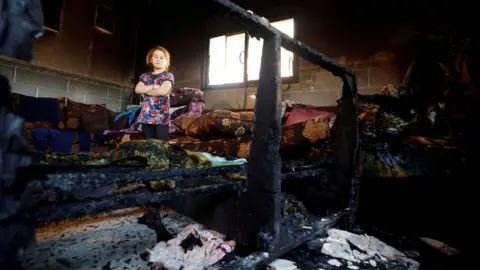
Amra Ashraf (2015)
Palestinian photographers have become the world's most prolific documentarians of their own suffering – and the most conflicted about it. In Gaza alone, over 200 journalists hold press cards. American critic Susan Sontag argued that photographs of disaster risk immunizing viewers through overexposure, transforming atrocity into an aesthetic object. But what happens when the photographers and the photographed are the same people? When the camera is not a colonial instrument wielded by outsiders, but a tool of Palestinian self-representation under occupation?
During the ever-digital age, it's difficult to understand where to draw the line, especially when all aspects of the genocide are being shared online, from Gaza daily routine videos to "what I eat in a day war edition." Is it Palestinian photographers' responsibility to photograph images of wailing mothers and share them? Is it really holding anyone accountable if there are tens of thousands of the same familiar cries of mothers and fathers at their children's graves? Does visibility equal accountability when the images are endless? Palestinian photographers reveal what Sontag could not fully articulate: the ethics of imaging suffering under occupation is not about choosing between dignity and documentation, but about navigating an impossible position where both visibility and invisibility serve structures of colonial violence.
Sontag's "Regarding the Pain of Others" (2003) warns that photographic documentation of atrocity produces a peculiar kind of spectatorship, one that simultaneously acknowledges suffering and maintains a comfortable distance from it. She describes how images of distant wars become consumable, how repeated exposure breeds a dangerous familiarity that mistakes recognition for understanding. The photograph becomes what she calls "a means of making 'real' matters that the privileged and the merely safe might prefer to ignore." Yet Sontag's analysis assumes a fundamental separation between the photographer and the subject, between those who document and those who suffer. Palestinian image-making collapses this distance entirely.
American Anthropologist Lila Abu-Lughod (2025) extends this critique by examining how cultural representation under conditions of domination creates the "pornography of pain", images that simultaneously expose suffering and reproduce the power dynamics that enable it. When privileged audiences consume images of Palestinian death, they often position Palestinians as perpetual victims, as people who only exist in relation to their suffering. Abu-Lughod argues that even well-intentioned documentation can reinforce colonial narratives when the viewer's gaze remains unchanged, when the image confirms rather than challenges preexisting assumptions about who deserves sympathy and who deserves sovereignty.
The Palestinian photographer exists within this paradox. To not photograph is to allow atrocity to occur without witness, to grant permission for the erasure that occupation depends upon. Israel's systematic targeting of Palestinian journalists reveals how threatening Palestinian self-documentation is to the occupation's narrative control. Yet to photograph is to participate in an economy of images where Palestinian humanity is only legible through death, where the price of visibility is the reduction of an entire people to their most traumatic moments.
Amra's refusal to photograph Ali Dawabsheh's funeral represents not abandonment but recognition of this impossible bind. Having documented the crime scene, having created evidence of the attack, he drew a line at transforming private grief into a public spectacle. His refusal acknowledges what the endless stream of images obscures: there is a difference between documentation as evidence and documentation as performance, between making atrocity visible and making it consumable.
The digital age has intensified this dilemma exponentially. Social media platforms have transformed Palestinian photographers into involuntary content creators, their documentation immediately absorbed into algorithmic feeds where images of children's bodies appear between Netflix Ads and bikini pics. The "what I eat in a day" videos from Gaza emerge from this impossible context as an attempt to assert normalcy, to claim humanity beyond suffering, yet inevitably framed by the siege conditions that make a simple meal an act of survival worth documenting.
This proliferation creates what I might like to call “accountability theater”. When a mother's wail becomes one among thousands, when each new massacre produces the same outcry followed by the same inaction, the image loses its capacity to shock precisely because it has succeeded in becoming visible. The problem is not, as Sontag feared, that viewers become numb to distant suffering. The problem is that visibility without consequences is its own form of violence, it forces Palestinians to perform their grief endlessly while offering no transformation of the conditions that produce it.
Abu-Lughod's framework helps explain why this visibility fails. The pornography of pain operates by offering viewers the pleasurable sensation of moral righteousness through sympathy without demanding any structural change. The viewer can feel moved, can even feel outraged, while maintaining the distance that allows occupation to continue.
The image becomes a substitute for action, proof that "something is being done" simply because "something is being seen."
Palestinian photographers understand this trap intimately. They know their images will be consumed by audiences who treat Palestinian death as inevitable, as the tragic but unchangeable backdrop of Middle Eastern politics. They know their documentation will be used selectively, that images of Palestinian suffering circulate freely while images of Palestinian resistance are labeled as terrorist propaganda. They know that no matter how many children they photograph, the phrase "Israel has a right to defend itself" will follow each massacre like punctuation. Yet they continue photographing. Not because they believe visibility alone will end occupation, but because invisibility guarantees its continuation. The choice is not between dignity and documentation, but between different forms of violation. To refuse to photograph is to allow the occupation's preferred narrative of empty lands and absent people. To photograph is to create an archive that refuses erasure even when it cannot yet force accountability.
This is the ethics of imaging under occupation: there are no good choices, only choices made under duress. Amra's photographs of the Dawabsheh home serve as evidence in a legal system that has yet to deliver justice, but they exist nonetheless. They wait, as Palestinian photographers wait, for a future where Palestinian testimony is valued and translates into transformation rather than recognition. The question is not whether Palestinian photographers should stop documenting their reality because they cannot afford to. The question is what responsibilities viewers bear when confronted with this documentation. Sontag and Abu-Lughod both understood that the problem lies not in the image itself but in the structures of power that determine how images are received, interpreted, and acted upon. Until those structures change, Palestinian photographers will continue navigating the impossible space between dignity and documentation, creating an archive of atrocity that demands not just to be seen, but to be answered.
References:
Abu-Lughod, L. (2025). “Revisiting the Awkward Relationship of Feminism and Anthropology” [Lecture]. The Juliet Mitchell Lecture, Cambridge University Corpus Christi College. 15 October.
Sontag, S. (2003). Regarding the Pain of Others. New York: Picador.