DJINNS
by ADEMINU
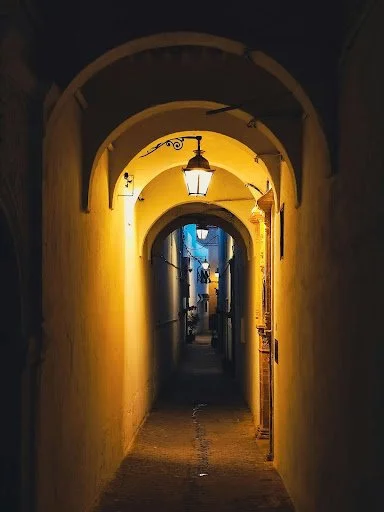
The street I grew up on. This is the same street I used to avoid at night because of the Djinn.
I grew up terrified of the bathroom. Not because of the dark tiles or the smell of bleach, but because everybody whispered that the Jnoun lived there. Every flush was a negotiation with something unseen, every shadow in the corner a threat. You don’t sing or whistle in the bathroom, and you never stay too long with water running — everybody knows that. They told me the djinn like to sit near drains, they slip through faucets, they curl around wells, they hide in places we call home but never control. And yet the French textbooks in school never mentioned them. The textbooks told me about Voltaire and Rousseau, about humanist enlightenment, about the beauty of rational thought — meanwhile, at home, I knew the night itself was alive, I knew the world had a second skin that no philosophy could wash away.
The djinn are not metaphors. They are not fairy tales. They are the reason I never poured hot water without warning the air first. They are the reason I never picked up stones from the ground without whispering bismillah.
Always “bismillah,” always a soft murmur to announce yourself. It was etiquette, almost like knocking before entering someone else’s home. Because every corner of Morocco could belong to them. The field, the mountain, the seashore — none of it was empty. We were never alone.
Morocco’s coasts are crowded with tourists, sunburned bodies and umbrellas. But the sea at night belongs to someone else. Fishermen whispered that certain waves are not natural, that sometimes the water rises because something huge stirs beneath. There are stories of men pulled under by hands that were not human, of voices singing from the black horizon. You cannot convince a fisherman to whistle on the water — it is asking for disaster.
The mountains had their own guardians. Tales of caves where entire Jnoun tribes lived, tribes older than Morocco itself. Shepherds spoke of hearing drums echoing from inside cliffs, of goats vanishing without a sound. There were paths you did not take alone, no matter how bright the sun, because brightness does not matter to them. They live in daylight too.
There were rules about thresholds. Thresholds are not lines — they are lungs, breathing two airs at once and pulling you into the space between worlds. Never stand too long at the doorway, especially after sunset. Doors are weak places, open veins between here and elsewhere. My grandmother would hiss at me if I lingered with one foot inside and one foot outside: “Move, child, don’t let them notice you.” Even now, when I pause too long at a door, I can feel something watching. These rules are the first language of the world that cannot be seen.
Standing too long is not hesitation, it is conversation. The air shifts when you ignore it, like something unseen tilting its head toward you. Growing up in Morocco means learning to walk a tightrope between the worlds, learning that fear can guide, that respect can shield, that presence is not a choice but a way of breathing. Thresholds teach you this before language does — a quickening in the spine, a warning stitched into the air — the kind of lesson you understand with your body long before your mind catches up.
Shoes mattered too. You never left them upside down. An overturned shoe was a provocation — like baring your teeth at them and daring them to strike. I remember older relatives who would stop mid-conversation just to fix a sandal that had tipped the wrong way. You couldn’t ignore it. You couldn’t leave it. A careless shoe was a declaration of war to the Jnoun.
Iron was always sacred. They told us iron burns them, wounds them, keeps them away. My grandmother would slip a small nail into the baby’s pocket before sleep, as if the child’s body were a battlefield. Blacksmiths were whispered to have special protection — how else could they hammer metal all day and not go mad?
Salt too. Always salt. My aunt would scatter it at the threshold of a new house, saying it was to blind them, to keep them spinning in circles. Science said salt was for flavor. We knew better. Salt was for survival.
You think colonialism is the biggest scar, but no, the oldest wound is older than the French, older than the Arabs, older than the Romans — the oldest wound is the one that keeps us looking over our shoulders at night, the wound of sharing space with the invisible. And the irony is that the wound is both refuge and trauma. We inherit fear the way other families inherit land — passed down and lived in. It soothes us and scars us at the same time, because growing up with the djinn means growing up inside a world that holds you and haunts you in the same breath.
And that’s exactly why they slip past every empire that tried to tame us. The djinn do not care about borders, they do not care about passports, they move faster than the World Bank and the IMF, they slip into wells and houses and children’s dreams. They are the true empire here.
The French taught us Descartes, “I think therefore I am,” but my grandmother taught me “don’t stand at the threshold after sunset, or you’ll invite them in.” Tell me which one is truer. Tell me which one has actually kept me alive.
And yes, I laughed when Netflix tried to make horror movies about demons — Hollywood demons are jokes, red latex faces, cheap jump scares. Our Jnoun are not entertainment, they are everywhere.
At the lilas, when the drums rolled like a heartbeat, women screamed and laughed at the same time, whipping their hair around, and I could feel the jinn in them. I saw a woman’s blood rise from her mouth to her forehead as she smiled at me, her pupils wide and fixed in a way that didn’t belong to her. Another woman let hot candle wax drip onto her arms when Mimoun came in. The drops burned her skin, and she didn’t flinch. She just smiled, like it wasn’t hers. That’s why we never build a house without slaughtering a sheep first. That’s why the hammam is not just steam but exorcism, why wells are never innocent but black-eyed mouths swallowing children whole.
When I was little, they said a girl down the street was taken. Taken meaning her body was still here but her eyes were not, her laugh was too wide, her hands shook with a rhythm nobody taught her. And everyone knew it was Jnoun. They didn’t call psychiatrists, they called fqihs with incense and verses. I learned early that sanity itself was fragile, that possession was always waiting.
Possession was the nightmare we all carried. Not Hollywood spinning heads, not priests with crosses — no, ours was quieter and more brutal. A girl speaking in voices not her own. A boy refusing food, saying it was poisoned by unseen hands. Families whispering about how a child became “strange” after playing near a well. And what could you do? Hospitals had no cure for djinn. You needed incense, verses, salted water, a fqih with steady lungs to recite until the voice broke and the body returned.
I remember weddings where the music grew too wild, the drumming too heavy, and someone would whisper: “Careful, they like to dance too.” The night would tilt then, everyone suddenly aware that we were not the only guests. Even joy was never safe from them.
But there was also respect. Not just fear. Jnoun were terrifying, yes, but they were also neighbors. Some stories said they had families just like ours, markets hidden inside forests, palaces made of fire. Children asked: do djinn go to school? Do they pray? Do they fall in love? The adults never answered clearly. They smiled in a way that said: stop asking, some knowledge is dangerous.
When I think of my childhood, I realize I was raised not just by family, but by rules of the unseen. They shaped how I moved, how I ate, how I slept. They taught me caution, humility, and awe. Fear was not just fear — it was education. We learned that the world is never only what it seems. That every action ripples into another realm. That arrogance is punished, respect is rewarded.
Not all Jnoun were enemies. Some were said to protect. Some were bound to saints, to shrines, to holy places. Pilgrims carried offerings — candles, bread, coins — to appease the unseen. Shrines across Morocco are thick with this double devotion: part to God, part to those who live alongside God’s creation. Colonial maps marked shrines as “superstition centers,” but what did they know? They couldn’t see the other half of the city glowing at night.
There was also a strange intimacy. People invoked them for love, for power, for healing. Women burned herbs to call upon them when abandoned by lovers. Men sought them for strength, bargaining in the dark with promises and offerings. Entire traditions of music — Gnawa, Aissawa — grew out of this negotiation, this rhythm of summoning and soothing, of dancing until bodies opened like doors. Europeans came and filmed it, called it “trance music,” as if it were just art, as if it wasn’t a covenant with the unseen.
Colonialism reached for our language, our money, our borders, but it never touched the air above our heads, the shadows in the corners, the invisible crowds moving through streets and homes. The Jnoun survived. Our rules survived. And when someone heard footsteps in an empty room, rationalism shattered like glass on stone.
The French came with books, rulers, charts and microscopes, with a promise that logic could replace fear. Schools lined with desks, classrooms where the walls whispered Voltaire and Rousseau, where children were taught to think in diagrams and to ignore what their mothers murmured at the thresholds. Science was their armor, secularism their weapon, a quiet invasion meant to make us doubt what we had lived with for centuries. They built laboratories in Rabat and Casablanca, and somewhere in those white-walled rooms, they imagined we would forget the warnings about thresholds, the rules whispered over water, the teeth of the wells. And yet. Teachers still avoided marking exams alone at night. Doctors still whispered Quranic verses over the mouths of sick children. Mothers tucked threads and coins and amulets into pockets, into sleeves, into the corners of the home.
Sometimes I think Morocco is a country inside a country. The daylight Morocco, with its cafes and scooters and protests and exams; and the night Morocco, where shadows breathe, where graves glow, where the wind itself is heavy with whispers. And sometimes I think: maybe the djinn are the truest archive of us. They hold what textbooks erased. They guard the stories the French tried to scrub. You can outlaw Amazigh in classrooms, but you cannot outlaw the shiver people feel when they pass an abandoned lot at night. You cannot outlaw the silence that falls when someone starts telling a jinn story after midnight. That silence is resistance, that silence is memory.
Even today, Morocco hums with tension. We scroll TikTok with one hand while clutching threads around our wrists with the other. We study chemistry and memorize formulas, but we don’t whistle after dark. We learn English grammar, but nails stay uncut at night. Some people laugh at the old ways, call them superstition, call them backwards, and others reject the new ways, scoff at screens and satellites and clocks. All of it exists at once. It is messy, loud, stubborn, and alive.
This is not backwardness, not a contradiction meant to be solved — it is multiplicity. Morocco is the push and the pull, the friction, the clash of worlds vibrating in the same street. Morocco is satellite dishes blinking above salt circles, exam papers weighed down by incense smoke, Wi-Fi signals tangled with whispered prayers. Morocco is the ordinary brushing up against the impossible, the modern sparring with the unseen, and the living learning to navigate both at once.
And maybe this is why Morocco feels eternal. Dynasties rise, borders shift, empires collapse, but the djinn remain.
Even today, when someone feels a presence, they reach for keys, for a knife, for anything sharp. Presence is knowing that every step, every word, every careless tilt of a head resonates in a room you cannot see, that the world you walk through is listening and remembering. Presence is hearing the drumbeats in a street at midnight and knowing they are calling for more than feet; it is smelling incense in a courtyard and realizing it carries whispers older than any textbook. It is living awake inside two worlds at once — the one you touch, and the one that touches you back. To be present is to honor both, to walk lightly but aware, to know that fear and reverence are strands of the same pulse, and that everything ordinary hums with the memory of the invisible.
Sometimes I think this belief is Morocco’s deepest philosophy: the certainty that life is layered, that reality is porous, that we are not alone.
And so when outsiders ask me what Morocco is, I want to tell them: Morocco is not couscous, not camels, not sunsets. Morocco is salt at the threshold, iron in the pocket, shoes flipped the right way. Morocco is the hush after midnight, the refusal to whistle, the way our grandmothers warned us without explanation. Morocco is a country that knows too much to laugh at the unseen.
Maybe this is why I still hesitate before mirrors. Maybe this is why I never sing in the shower. Maybe this is why, no matter how modern the city looks, I know there is another city breathing just beneath it. Because Morocco is not one country. It is two. And the second one — the djinn’s Morocco —will outlive us all.