Under the Tree: Finding Each Other at the Margins of COP30
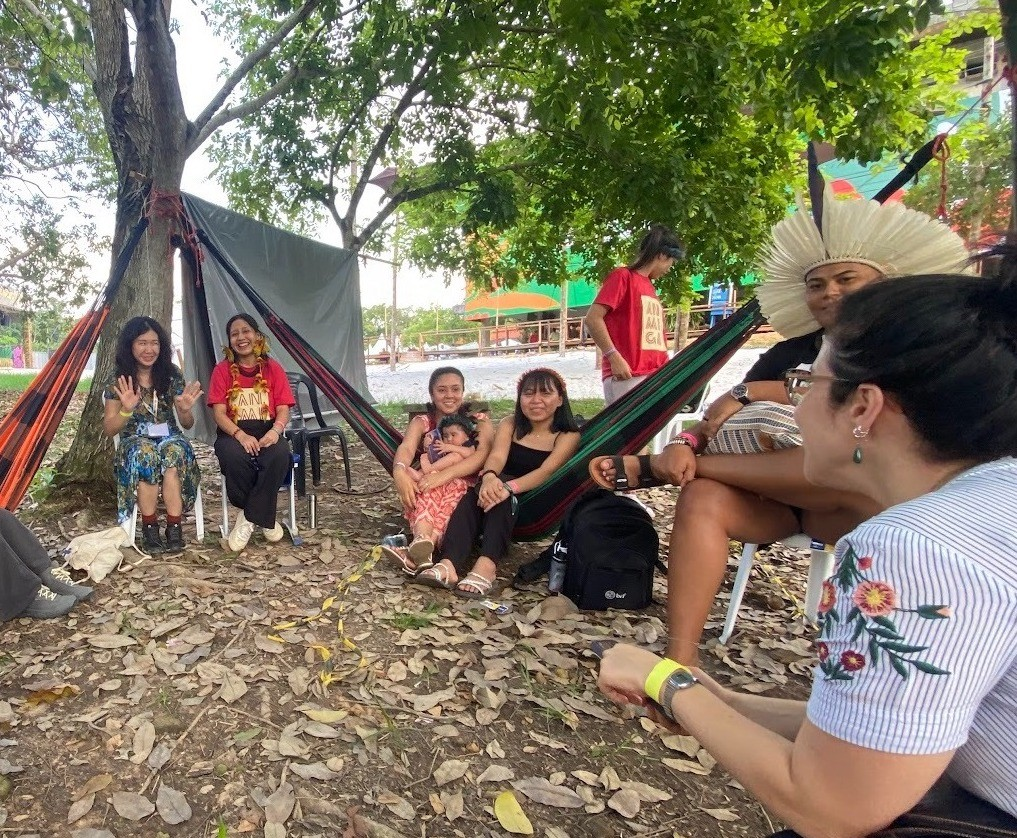
Under the trees where Taiwanese civil society groups and ANMIGA met to exchange knowledge and experience.
By Siuchieh Sandra Tai
In November 2025, I boarded a flight from London to Belém, Brazil, for COP30, carrying a contradictory feeling that felt heavier than my luggage. I was burning fossil fuels to fly halfway across the world to a climate conference held in a venue built by clearing forests and constructing a new highway through the Amazon—the very ecosystem we would gather to discuss protecting. The conference sponsors included fossil fuel companies. Major emitters were already boycotting the negotiations. I came as a master's student in Culture, Justice, and Environment at LSE's Anthropology Department, researching how Taiwanese NGOs build presence and legitimacy in international climate spaces despite Taiwan’s diplomatic exclusion. But the contradiction gnawed at me: were we all just participating in an elaborate performance?
The flight itself became my first fieldnote. Somewhere over the Atlantic, our plane made an emergency landing in Spain's Canary Islands. I looked around, expecting panic. Instead, passengers calmly continued working on their PowerPoint presentations—all climate-related. In that suspended moment between crisis and continuation, I understood something visceral: we've learned to witness catastrophe while performing normalcy. Most passengers knew the earth had breached 1.5°C. We knew the absurdities we were flying into. Yet here we were, finishing our PowerPoints, performing our small parts in what many dismiss as theatre.
Being Taiwanese at COP: The Impossible Geography
My Taiwanese fellow civil society actors and I moved carefully through these spaces. Before entering any official venue, someone would remind us: "Don't say 'Taiwanese' or 'Taiwan national' until we're home."
This creates strange cognitive dissonance. Taiwan is a robust democracy with 23 million people, our own government, and five direct presidential elections. As the world's biggest semiconductor producer and an island nation vulnerable to intensifying typhoons, our climate actions matter globally. Yet we are systematically excluded from signing the Paris Agreement or participating in COP negotiations—blocked by our larger neighbor across the Taiwan Strait—a country that has never governed Taiwan yet claims sovereignty over it.
Our knowledge is welcomed. Gender, Indigenous knowledge systems, climate resilience—our specialties sit squarely in the official agenda. But our political existence as a "sovereign” must remain unspoken. We participate in panels, network with partners, contribute expertise, all while performing strategic invisibility about nationhood.
Taiwan is contributing but not enjoying rights to participate, receive equal information, and have our work recognised. Though not a Paris signatory, Taiwan has its own climate strategy, net-zero goals for 2050, and provides climate adaptation support to our diplomatic allies—small island states like Tuvalu, Palau, the Marshall Islands, among the most vulnerable to climate change.
The organisation I primarily followed, Taiwan Green Energy for Charity Association, connects corporate donations with social welfare organisations and Indigenous communities to install solar panels, enabling energy autonomy and income generation. Recently they've trained mothers as energy auditors and young women as climate activists, some of whom attended COP. It's practical work reflecting a clear belief: climate action should centre those typically underrepresented.
With help from North American civil society organisations who understood Taiwan’s predicament, we secured Blue Zone badges and co-hosted an official side event on youth, women, and indigenous leadership in climate solutions. The title positioned Taiwan as a contributor to solutions, not a supplicant begging for recognition.
Who Responded: A Pattern Emerges
Months before COP, this group reached out worldwide to civil society organisations and climate-gender practitioners. It was predominantly Indigenous peoples' organisations from Latin America and Southeast Asia who replied eagerly. Especially Indigenous women's groups. And grassroots organisations working in mountains and forests, far from capitals.
Perhaps they recognised in each other something unspoken: shared marginality. Those working from peripheries—geographically, politically, epistemologically—seemed to understand instinctively what it meant to navigate spaces not designed for us. To claim legitimacy without formal recognition. To insist on being seen despite structures of erasure.
Mexican Mountains: Where Climate Meets Cartel Violence
The group I followed and I met the team from Alianza Juvenil por la Sostenibilidad (AJUVES) at a crowded restaurant near the Green Zone – where civil society actors gathered to advocate and network. They work on mountain biodiversity conservation in Mexico.
One young woman lived in a town controlled by the world's largest drug cartel. She mentioned this casually. There's a curfew every night.
"People back home ask me why I do this work," she said. Her smile was bitter. "They say: 'Climate? That's such an apolitical issue. So disconnected from the violence and death on our streets every day.'"
She looked directly at me. "But they're wrong. They're intimately connected. Industrial agriculture, land privatisation—these created the poverty that feeds the drug trade."
Alfonso, AJUVES's founder, leaned forward. "But how do you talk about climate to people already impoverished by these structures? When people don't know where tomorrow's meal is coming from, how can they care about something that seems so distant?" When I spoke with Alfonso again after the conference, he was more explicit about the danger. The cartels themselves are major drivers of environmental destruction—deforestation, wildlife trafficking, land use changes, oil spills. Mexico is among the most dangerous countries in the world for environmental defenders.
Their words at dinner cut through every abstraction I'd brought with me. Climate crisis is never separate from the material conditions of daily life—it is caused by, weaves through, and amplifies land dispossessions and extractions that treat both land and people as disposable. Industrial monocultures don't just emit carbon; they concentrate wealth and power in ways that fuel organised crime. Environmental defenders aren't just protecting forests; they're challenging the same economic systems that determine who eats and who starves, who lives safely and who faces cartel control.
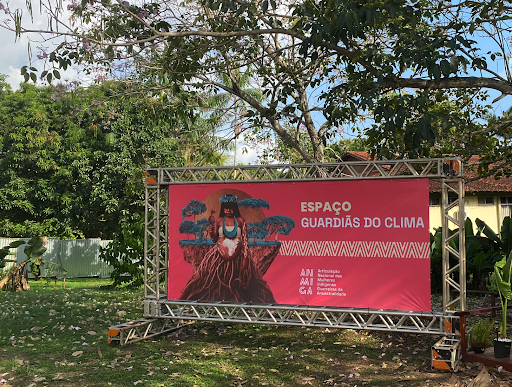
"A space for climate guardianship"—a backdrop poster of ANMIGA at the federal university hosting the "COP village," which housed a dedicated camp for Indigenous peoples
Under the Tree: Meeting ANMIGA
The most transformative encounter happened at a state university partnering with COP. The organisation I was following had arranged to meet ANMIGA—The National Articulation of Indigenous Women Warriors of Ancestry—a coalition of Indigenous women from Brazil's seven biomes.
"This is the best meeting room," someone said when we arrived, gesturing to a large tree. Everyone sat beneath it. Two mothers at the circle's edge held infants, occasionally interjecting—reminding me of the organisation’s approach, creating spaces where mothers can participate with their children.
Four ANMIGA members introduced themselves, each from radically different ecological and cultural worlds: Sandy Yusuro, Satere-Mawe from Amazonas rainforest. Eline Pureza, Pankararu from Pernambuco's dry Caatinga forest. Jynhpo Kaingang from Rio Grande do Sul's southern forests. Samara Vatxun, Xokleng from Santa Catarina's Atlantic Forest fragments.
Each introduction followed a pattern I hadn't seen elsewhere at COP. First, their name in their native language. Then tribal affiliation—some tribes still unrecognised by the Brazilian state. Then their biome, the ecosystem they're part of. Then the specific oppressions they've experienced. Then the rights they're fighting for.
Name, collective, environment, struggle—presented as inseparable parts of being.
These identities are profoundly political. Not cultural artifacts to preserve in museums, but living political and material positions forged through invasion, colonisation, land theft, systematic erasure of languages and relationships with land.
Sitting there, I wondered: Does gender carry similar weight? Does being from Taiwan—a nation that cannot speak its name—constitute a similar political ontology? Women, Indigenous peoples, those from unrecognised nations like Taiwan—we're all more vulnerable to climate change, yet refuse victimhood. We know what it means to speak truths power doesn't want to hear. What binds us isn't shared victimisation but shared refusal—a collective insistence on speaking from positions that dominant orders work hard to silence. When Indigenous women introduce themselves through biome and struggle, when Taiwanese NGOs create space despite diplomatic non-existence, we're doing similar work: asserting political ontologies that challenge how power defines legitimacy. Gender and sovereignty aren't separate axes of exclusion that occasionally intersect; they're mutually constituted through the same logics that determine whose climate knowledge counts, whose land claims are legal, and whose futures are grievable.
"How do you see this year's COP?" we asked. "Which groups are being included, excluded?"
"Fortunately," Sandy said, "under Minister Sonia Guajajara's leadership, we have more participation than ever. But realistically? Only about 15% of Indigenous peoples can enter the Blue Zone. Most of our exchange, storytelling, resistance—it happens in Green Zones and outside. But the few who get into the Blue Zone? They convene with us out here. They carry our voices in."
After our conversation, they invited us to visit the ancestral house multiple tribal groups had built together on campus. Women asked us to remove shoes and socks. "Feel the earth," someone said. I felt mud, cool and damp, beneath my feet.
Inside sat five majés—healers who use medicinal plants and prayer for both body and spirit. They birth the community's children. "We also heal land," the lawyer told me through translation.
Then women shamans began singing and drumming. "We came to Belém to tell our story..."
They sang for us, but not for us—I understood this somehow. Our presence occasioned this moment, but they sang to themselves, to each other, to something beyond all of us. Articulating a relationship with land through sound.
As the lawyer translated, I noticed friction—not failures exactly, but productive gaps. The women spoke of healing bodies, minds, and lands literally, not metaphorically. The translator would pause, try different words, approximate. Some things remained untranslatable. Maybe that's not a problem. Maybe that incompleteness keeps something open that perfect understanding would close.
The Third Space
President Lula called this the "Indigenous COP." 2,500 Indigenous participants attended, a historic breakthrough. Yet contradictions multiplied. The summit nearly collapsed before delivering a final agreement. Adaptation funding tripled to $120 billion annually, yet delayed until 2035. All nations agreed to a Just Transition Mechanism—a victory civil society celebrated, yet without attached funding. Fossil fuels weren't mentioned in the key decision. Despite COP being sited in the Amazon, no significant deforestation measures made it into the agreement.
Meanwhile, Brazil simultaneously proclaimed Indigenous participation while drilling for oil at the Amazon's mouth.
Yet amid these contradictions—breakthroughs and disappointments, visibility and erasure—something else was taking shape.
Under the tree at the ancestral house, women in slippers listened to shamans sing. ANMIGA members shared their own agenda—not one handed down from negotiation halls, but emerging from seven biomes, multiple struggles, collective refusal. A third kind of space kept opening. Not the centre. Not the periphery trying to get in. Something else entirely—self-defined, mutual, third space rooted in both place and solidarity—might be where real solutions grow.
What brought us together—Taiwanese climate activists and Indigenous midwife-shamans, Mexican youth defending mountains amid cartel violence—wasn't sameness. It was recognition of each other's struggles, visions, refusal to accept the world as given.
The conversation under that tree wasn't about demanding inclusion. It was about exchanging knowledge between people who'd already done the work—created movements, preserved ecosystems, kept communities alive despite everything designed to erase them.
Reflection: Incantations at the End of the World
Flying home, I kept thinking about that emergency landing. About passengers calmly finishing PowerPoints while crises unfolded around them. About performing normalcy amid catastrophe.
Many dismiss COP as mere theatre. But I left Belém convinced performance is precisely the point.
Stefan Aykut and his co-researchers (2021) call this "incantatory governance." Contemporary climate politics relies fundamentally on performative dimensions—signals, narratives, ritualised moments designed to align actors' expectations toward low-carbon futures.
What I witnessed under that tree, Marisol de la Cadena (2015) would call "alter-politics"—politics that exceeds state recognition, rooted in excess, partial connections, careful negotiation with earth-beings. What I witnessed was people performing desired worlds into being. When Mexican youth protect mountain biodiversity amid violence. When Indigenous women sing land relationships. When negotiators fight to include "human rights," "gender," "care" in official texts. When Taiwanese activists navigate the impossible geography of being present yet unnamed.
These performances create normative orders, declaring what worlds we desire.
Climate crisis is fundamentally entangled with identity—our names, genders, lands, bodies, visions of what worlds should become. Not identity as division, but identity as ground from which we recognise each other, discover profound interconnection, speak desired worlds into being. The Amazon made this tangible: defending rivers is defending ourselves. Struggles for recognition are struggles for humanity's heart.
We perform for each other. And in that performance—incomplete, contested, contradictory—we find courage to continue.
An earlier version of this piece was published in LSE Activism, Influence and Change Programme. The current version includes edits made with The Argonaut’s editorial team.
Bibliography
Aykut, S.C., Morena, E. and Foyer, J. (2021). ‘Incantatory’ governance: global climate politics’ performative turn and its wider significance for global politics. International Politics, 58(4), pp.519–40.
de la Cadena , M. (2015). Earth beings: ecologies of practice across Andean worlds. Durham: Duke University Press.