The Intimacy of Self-Censorship in Wartime Russia
Moscow
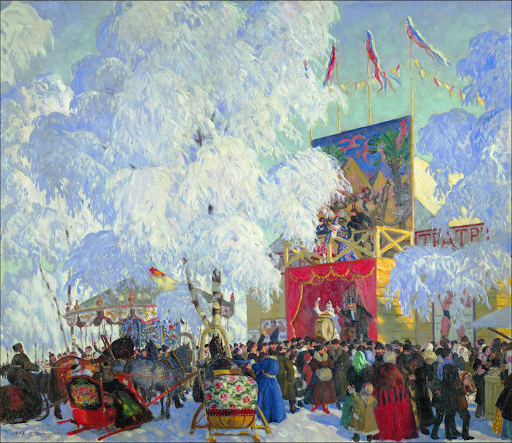
“Snow Booths” 1917. Boris Kustodiev.
During the winter holidays, I went back to visit my family in Moscow, Russia. As the capital, my home city has become the main visual ‘front’ of distracting the public from the horrors of war and decay of the country. Not a dime is spared from lavishing and glamourizing the sumptuous charade. The Christmas market on the Red Square feels especially decadent, as it is filled to the brim with extravagant decorations, cascades of scintillating lights, and excessive amounts of food stalls.
Towering pines are drenched in hues of blood-red and emerald green, with the winks of golden baubles matching the beat of the light installations that straddle the adjoining streets. String lights and velvet ribbons snake up the lamp-posts, which already seem to be struggling under the weight of gargantuan gold bells. There is also the glittering mass of spinning carousels, shrieking children, twirling ice-skaters with plumed red cheeks, sugary doughnuts and wafts of mulled wine – it’s undeniably charming, yet it feels like a glutted circus of delight and gavaged pleasure.
The market’s festivities feel especially dissonant, coquettish even, for it hums at the edges of the fortified Kremlin – the citadel where Mr Putin and his cronies continue to enact their insatiable appetite for imperial conquest, dropping bombs and annihilating cities, perpetuating unfathomable crimes of humanity.
It’s a disgustingly sobering thought, and it’s the only one I seem to have as I navigate my way through the plush crowd, showing my visiting friend the wooing ‘delights’ of Moscow, witnessing the city lure her into the temporary entrapment of distraction.
I do not mean to be a Scrooge. I know well enough by now that clutching your fists in silent fury weathers down the body, and that critique without action can turn into a goop of disincentivised noise. But my arms continue to ache. Because underneath the tickling glee of the market’s festivities is the understanding that this sensorial feast goes hand in hand with the intensifying strategy of an ‘information war’ – whereby one is not to question the government’s actions, nor the swelling ranks of graves with the protruding Russian flag stabbed into them.
In this sense, war requires an ideology, but it also requires distraction. As the focal point for internal tourism, and the nest of Russia’s bureaucratic elite, Moscow has become a beauty pageant of consumption and glitz. And at its rotten core, it is infused with a ‘propaganda of unreality’ (Pomerantsev 2019), that lives not so much through the administration of a single truth, but the idea that one can never know the truth – so why not souse in the ‘skazka’ (fairy tale) a little longer?
Every time I visit, it seems that the reality of war flies further and further away, to some nether abstract plane of uncontrollable forces. Some seem to be happy to bask in the distraction the city offers them, many rejoice in the ‘out of sight, out of mind’ state of indifference. In Arendt’s (1963) hauntingly precise formulations, this uncritical conformity shushes critique before it can even articulate itself, and creates the environment for the most potent forms of control. Muscovites are becoming purposefully politically ambivalent, in accordance with the danger of being associated with politics at all.
In our current censorship regime, where you can get prosecuted up to 15 years for voicing the word ‘war’ and not a ‘special military operation’, fear gathers so thickly that even the most banal conversations are conducted in euphemisms and Aesopian code. The word ‘war’ is no longer uttered in public, even allusions to the ‘current situation’ or the simple ‘since 2022’ is spoken with risk.
We swirl ourselves into a dance of self-censorship, which gets choreographed into a wider insidious paralysis of collective conformity and hush-hush. Moscow, with its gluttonous beauty and pristine facade, made me schizophrenic and meek.
Two days later, I was getting aboard a night train heading South, away from the fairy tale and towards the part of Russia where the war stops being abstract.
Train to Rostov-on-Don.
When you slide open the door of your carriage, and are about to meet a stranger with whom you will be sharing a 4 square meter room for 19 hours, you naturally visualize all sorts of unfavorable characteristics which your roommate could have. They could be loud, rude, leering, unnervingly silent – or worse, openly pro-war.
Vladislav, my roommate for the journey, seemed neither of those things. He looked to be in his late-20s, very tall and broad-shouldered, dressed in all black, in a t-shirt of some metal band. I was slightly intimidated. Once we awkwardly navigated the small room and set up our bedding, we took off our shoes and settled in. For some strange reason, it was his mismatched socks (one was red and the other striped), completely at odds with his whole demeanor, that spurred me into beginning a conversation.
We discussed where we’re from, where we’re going and why, what we do and if we like it – the usual exchanges and friendly pleasantries. He reminisced about international student life, having studied in China himself, and told some funny stories about his mandatory military service when he was 18. This made me ask about how he’s avoiding getting mobilized, a safe enough question, to which he answered that he gets by, for now, due to the Kazakhstan residency he got when ‘SVO’ (special military operation) began.
This made me pause. Here I was thinking that given his overseas perspective, and age, he wouldn’t support the war. Why would he say ‘SVO’ and not ‘war’? In our little toasty shoe-box car, with the snow storm raging outside and the warbling hum of the train machinery filling up the quiet, I felt more ‘safe’ than usual to speak out – if it came to it – without the lacquered layer of self-censorship.
Did he not feel the same? Did I not read him correctly? Did I not ‘sniff’ out his stance well enough? I internally cringed, feeling the weight of the unsaid befog our communication channel.
Michael Taussig (1992), in considering the ‘war of silencing’, writes that “it is this presence of the unsaid which makes the simplest of public-space talk arresting in this age of terror” (p.27). In a context where nouns can incriminate, small talk is never small. I clearly overestimated how far our cabin insulated us from the scrutiny and self-censorship of ‘public space’.
The ‘unsaid’ here becomes much more palpable, pulsing even, a viscerally felt veil of fog. Like a zig-zagging wave, you meander between wanting to conceal and wanting to reveal. And this attunement to the self, suddenly makes conscious the conventions through which sense-making occurs, within wider omnipresent mediations of power.
In my moral stupor, I turned on the little TV hanging above the bed. A war movie lit the screen, a clear effort of state television to glamorize the war and fetishize notions of ‘patriotism’ and sacrifice. The next channel I flipped to showed another, older war movie. If I flipped again, I knew I would find the main news channel – the gibberish they spout there muffled through the adjoining wall from our neighbour’s cabin.
I sighed, deflated, having forgotten how pervasive the media is. Vlad didn’t seem at all surprised. “They’re obsessed,” he murmured.
I didn’t answer right away. The TV kept pushing its bright, heroic images into our dark little room. The ‘they’ in question was clear of course. I probed further. “Obsessed with war?”
Vlad scoffed, an abrupt sound that didn’t quite reach laughter. “With selling it,” he said. “With making it mean something.”
At last, as if deciding he could open up, he turned onto his side, propping his head on his hand, while the other found a loose string on the bedding and began to fidget with it, winding and unwinding it around his finger.
He flicked his eyes to me, appraising, then began telling me about the guys he grew up with: some ‘plucked off’ to the front, and one who went willingly. He painfully laughed at the absurdity of the ‘death contract’, of getting paid 400,000 rubles as a federal signing bonus – equivalent to £3870. In Moscow this sum is nothing. In Vladislav’s home town, it’s enough to pay off debts and support your family, reflective of the wider reality that the war becomes the ‘easiest’ way to get out of poverty.
I nodded, and felt that we had crossed an invisible threshold – where, in a shared recognition of danger, we could both, for a little while, speak more plainly.
With four years of war, many Russians have retreated their worries and despairs into the interior realm. When there is little to no outlet for speaking freely, very big feelings get vacuum-sealed into very small places.
To reach each other across that sealed interiority, you have to partake in a subtler, more attuned form of communication: a peculiar dance of ‘sniffing’ each other out that, if anything, resembles flirting. You circle, probe, and test the words and intonations of your interlocutor. As a mutual assessment of danger, this implicit communication becomes almost intimate in its restraint and simultaneous fixation.
Anthropologically speaking, that visceral fear becomes a strangely powerful tool of producing knowledge. Despair and mourning can be critical pathways through which to connect and collectively ponder in a repressive, totalizing environment. It makes you sensitive to non-explicit expression, and the minute details of how a stranger carries their self-censorship becomes charged with meaning. Rather than emerging through detached analysis alone, knowledge here is produced through hesitation, indirection, and the felt pressure surrounding what remains unsaid.
Why wouldn’t the war be the most poignant and textured point of contact, when it pervades every ordinary hour, pressed into a knife-sharp grief, blunted by containment? In a perverse way, I recycled my dance of self-censorship into an ethnographic method.
Once that door opened, we kept passing things through it, trading fragments of our experiences and thoughts.
I shared how in Rostov, the city I was going to, with its proximity to the Ukrainian border and abundance of military hospitals, there are more and more men with missing limbs or eyes – how many, lost to alcoholism and addiction, prowl the city on wooden crutches, inevitably severely traumatised, looking for a reprieve.
He admitted how desensitized he had become: to the body-camera footage of soldiers posted online, the endless churn of men killing and trying not to be killed, to the news of yet another of ‘their’ residential neighbourhood turned to rubble. I had the sense that what troubled him most was not only the violence itself, but how ordinary it had begun to feel.
He spoke of his apathy shamefully, perhaps embarrassed even, his words sounded raw from disuse.
Listening to him, I found myself thinking back to Moscow. I still felt the obscenity of that spectacle, albeit even more sharply than before. But it no longer appeared to me as a simple facade, neatly opposed to the war’s reality. Perhaps, it was one expression of the same confused, overburdened emotional life the war had produced.
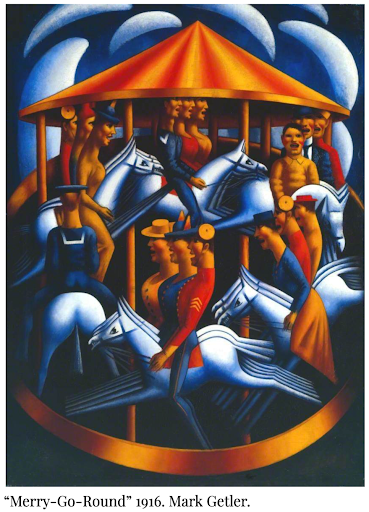
I was no longer sure where, in a city like Moscow, distraction ended and psychic survival began. I thought of the ghastly riders in Mark Gertler’s ‘Merry-Go-Round’, stuck in a churn of grotesque gaiety and terror. Painted as a condemnation of the First World War, his carousel becomes a metaphor for war’s remorseless machinery, trapping soldiers and civilians alike in an endless cycle of violence (Tate 1988).
Ultimately, what the journey offered to me was not clarity, exactly, but a subjectivity disciplined by fear and grief. There is nothing comprehensible about the war. It reorganizes not only the future, but memory, language, and the scale on which feeling itself becomes possible. Sometimes, the only clarity it offers is the bleak one produced by despair.
And yet, this despair can act as a powerful form of attunement, compelling you to stay with the fragile traces of care that survive under repression. It may be why confiding in a stranger felt so intimate. For a moment, the unsayable acquired unassuming company, and dissent no longer seemed condemned to remain a private hallucination.