Anthropology in the Anthropocene?
By Zoey England
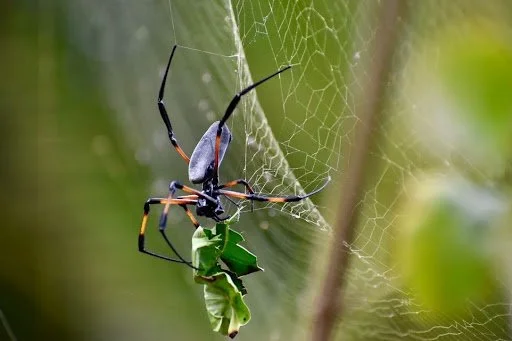
A Red-legged Golden Orb-weaver tends to their web. 05 July 2022 in Mauritius. Zoey England
Consider two kinds of webs: The first is a spider's, woven from silk with threads radiating from a central hub. Each strand is tensioned against each other, providing structural support through intricate geometric patterns. They’re a means to entrap the next meal, but also a tool for protection, shelter, courtship, and communication– a way of making the invisible visible, of catching what passes through the air otherwise unnoticed.
The second is a string figure: built between two pairs of hands, passed back and forth, where the slightest shift in tension or angle produces an entirely different pattern. Drop a strand, and the whole thing collapses.
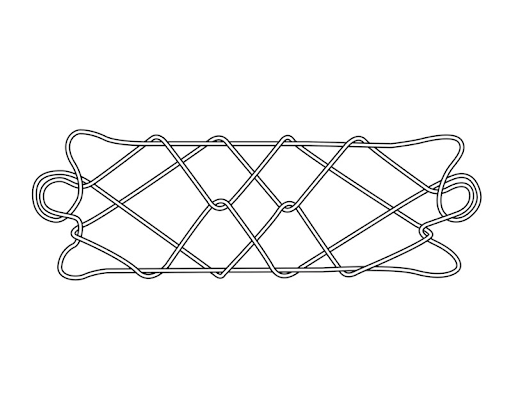
I am not a classically-trained anthropologist. But I have been spending time lately in the realm of anthropological thinking, and I keep returning to these two images as a way of understanding why our public conversations about the Anthropocene are failing. The world we have made is a spider's web, yet the way we talk, the questions we ask, the policies we create, and the science we do is all framed in terms of dropped strings.
The Anthropocene is not a problem of isolated causes and clean effects. It is a web in the spider's sense: every strand is load-bearing, every rumble felt across the whole. Climate change, biodiversity collapse, soil degradation, ocean acidification are not parallel crises happening to a passive Earth. They are entanglements between human actions and non-human systems, between industrial histories and present-day actions, between the policy choices of governments and the saltwater now swallowing coastlines. In her 2016 book, Donna Haraway calls this "staying with the trouble"–dwelling inside ambiguity (and to an extent, complexity) rather than trying to steer from the outside– and insists that such entanglement can only be faced collectively, through shared creation.
Public discourse rarely does this. Instead, it oscillates between two failure modes. The first is individualisation: the problem is your flight, your steak, your plastic bag. This is not wrong exactly, but it is radically incomplete, with the convenient side effect of obscuring the systemic processes– extractive industries, subsidised fossil fuels, regulatory capture – that dwarf any individual's carbon footprint. The web shakes, but we stare at a single thread and call it the problem.
A similar story can be told for polarisation, the second failure mode. Climate "debates" often look like disputes about facts, when they are more accurately disputes about who gets to hold which part of the string. When ‘science’ becomes negotiable, when the same dataset produces opposite conclusions depending on who is reading it and why, we are no longer in an epistemological argument. We are in a political one, dressed in the language of evidence.
This is where anthropological thinking offers something distinctive. As a discipline, Anthropology's methodological habits are built for deployment on this terrain. Longitudinal analysis resists the short-termism that makes climate policy so difficult, asking not what is happening now, but what has been changing across generations, and why. Gathering knowledge through community embeddedness means engaging with people rather than about them. This dramatically changes what you find and how you are permitted to interpret it. And perhaps most importantly, anthropology takes non-human actors seriously– not metaphorically, but analytically. Rivers, animals, weather systems, soils: these are not the backdrop against which human drama unfolds. They are strands in the web. They have tension. They pull back.
At a recent talk, the anthropologist Hans Steinmüller made the point that simplicity and complexity depend on perspective. His concern is more centered in the social domain, rather than the Anthropocene entanglements Haraway has in mind, but I believe the observation holds across both registers. The Anthropocene looks manageable, perhaps even solvable, from a spreadsheet. But it can simultaneously look like the end of a world if you are standing in a community whose relationship with land, water, and season has been torn apart within a single lifetime. Anthropological thinking does not resolve that gap. But like the spider, it maps the whole web rather than mistaking one corner of it for the full picture.
I want to be careful not to romanticise a discipline. Anthropologists hold no monopoly on relational thinking. What I am arguing is that certain habits — slowness, embeddedness, comfort with entanglement, willingness to let non-human actors into the frame — are exactly what is missing from the loud, fast, polarised forums where the Anthropocene is constructed.
The spider builds alone. But the string figure only works with more than one pair of hands. We need both: the web's ruthless, structural honesty about how everything connects, and the string game's insistence that knowledge is not intended to be a solitary sport. Ideas are supposed to be passed between people, shared and shaped by whomever might be holding it.
Bibliography
Bassolas, A., Massachs, J., Cozzo, E., Vicens, J. (2025). Multifaceted polarization and information reliability in climate change discussions on social media platforms. Royal Society Open Science, 12 (11). https://doi.org/10.1098/rsos.241974
Haraway, D. J. (2016). Staying with the Trouble: Making Kin in the Chthulucene. Duke University Press. https://doi.org/10.2307/j.ctv11cw25q
Miller, J. (2024). String figures: our shared history of play, culture, and mathematics. Blog Post. From https://royalsociety.org/blog/2024/12/string-figures-our-shared-history-of-play-culture-and-mathematics/
Steinmüller, H. (05 March 2026). Complexity and complicity in social anthropology. Inaugural lecture. Accessible from https://www.lse.ac.uk/lse-player/complexity-and-complicity-in-social-anthropology