By Han Zheng
La Zerda ou les chants de l'oubli by Assia Djebar is a poetic film essay using various Algerian colonial archives. Djebar wished to “make of my camera this eye of the veiled woman” (Ellerson, 2021), addressing multiple themes such as gender, post-colonialism and memory. I will take the position to argue that this film resists colonialism by offering a new narrative of the memories, reclaiming agency for the oppressed, and disconnecting music from images to deliver opacity.
La Zerda refers to a North African ritual held in honour of the ancestors, as a symbol of collective memory and cultural tradition. This film aims to bring it back to life from past memories, while the ritual is to honour the ancestor, who represents the past memories themselves. Therefore, I contend that La Zerda was included in the title and film to highlight the importance of finding out past memories and, more importantly, to celebrate them. The images and clips taken in colonial era have existed over the years, but under the colonial gaze, as they were taken in specific angles, with the cameraperson deciding which kind of scenes would be included and which ones would not. There is barely any scene in which the people being shoot stared back to the camera or reacted in other types of documentaries, suggesting an unequal position between the cameraperson and those being shoot. This is ultimately an inequality between the coloniser and the colonised: the former is believed to be scientific enough to speak for the latter, as the latter is considered not to have enough knowledge or ability to do so (Said, 1978).
In the film, Djebar celebrates the Algerian history by voicing over the past and reclaim their own equality of the new world. In this way, the Algerian society is presented differently from when the clips were taken. For example, the Algerian women who used to be seen as silenced and invisible are now voicing over, singing and narrating over their oppressed past. Such types of changes can challenge an Oriental assumption that the Orient is always the same frozen society (Said, 1978). By giving a voice to female, it also challenges colonialism itself. Colonial expansion has always been gendered. From Colombian time, the exploration of exotic lands was portrayed as man exploring a feminine “virgin land” (McClintock, 1995). Females were oppressed by patriarchy in Algerian society; meanwhile females shared commonalities with the colonised, both of whom was oppressed, silenced, mysterious and veiled either by males or by the Western world.
However, this does not mean a complete separation from colonial influence. In one scene, children’s voices sang La Marseillaise, the national anthem of France. The following scene where the Algerian teacher taught them French in school also shows a sudden reminder of French existence among Algerian footages. These two scenes represent, from my perspective, not only the colonial authority of French government over Algeria, but also haunting memory of French colonisation for Algerians. I borrow the word “haunting” from hauntology, meaning something that is unable to be forgotten or simply wiped away, but haunts the whole time (Good, 2019). Haunting memory of French colonisation, similarly, is something so integrated into Algerian history that it cannot be forgotten or avoided even when looking back to the colonial archives.
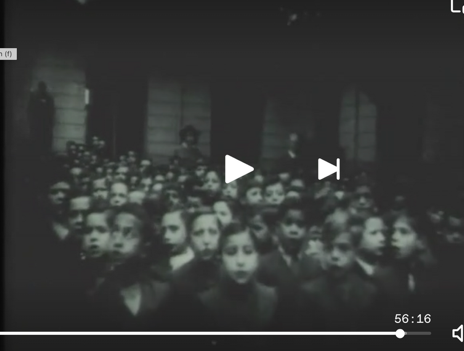
Still from La Zerda ou les chants de l’oubli (Djebar, 1983).
Djebar did not deny the colonial ghost but offered disconnection as a response. In the film, there are multiple scenes of deliberate disconnection between the music and images. Songs solely sung by people without instrumental music recur in the whole film yet not meaningfully connected with the images themselves. For instance, the women’s voices sing angry songs with faster rhythm and rising voice level, while the images simply showed group photos of males standing together or the single photo of one male. At first glance, this might be confusing as there is no connection between the music and the photos. Why were the women angry and why were they singing an angry song? Who were these males? Why were they gathering? Questions like these could not be answered. This is the part where the film struck me the most, as I felt delivery of emotions from both the music and the images.
I contend that the disconnection was deliberately made in order to illustrate a sense of opacity, as a rejection to be understood. Opacity refers to respect “irreducible singularity” and non-understandable differences (Glissant, 1997). As discussed above, the cameraperson had discursive power over the archives. For instance, the photos taken by Nicolas Tikhomiroff during France-Algeria war are captioned with descriptions written by him, instead of any local Algerians. I am not suggesting that he made up anything. The issue is, by the cameraman captioning, the photos were changed from something being open to interpretations to something as objective truth, not to be questioned. This is just as what Glissant (ibid.) criticised, that the West tried to make the Other able to be interpreted but under the Western framework. However, the disconnection between music and image in the film breaks such framed meaning of photos. Even for photos of males, women’s song can be their background. The inner logic of this choice is not explained in the film, and it does not need to, as opacity is delivered in this way. With opacity, Djebar refuses the Algerian past to be reduced and put into a Western colonial framework, but presents the world as it was. As part of the Third Cinema Movement, this film has achieved the goal of this movement, to challenge the post-colonial “System”, the Western cultural authority (Solanas and Getino, 1970), which included the framework imposed onto other cultures.
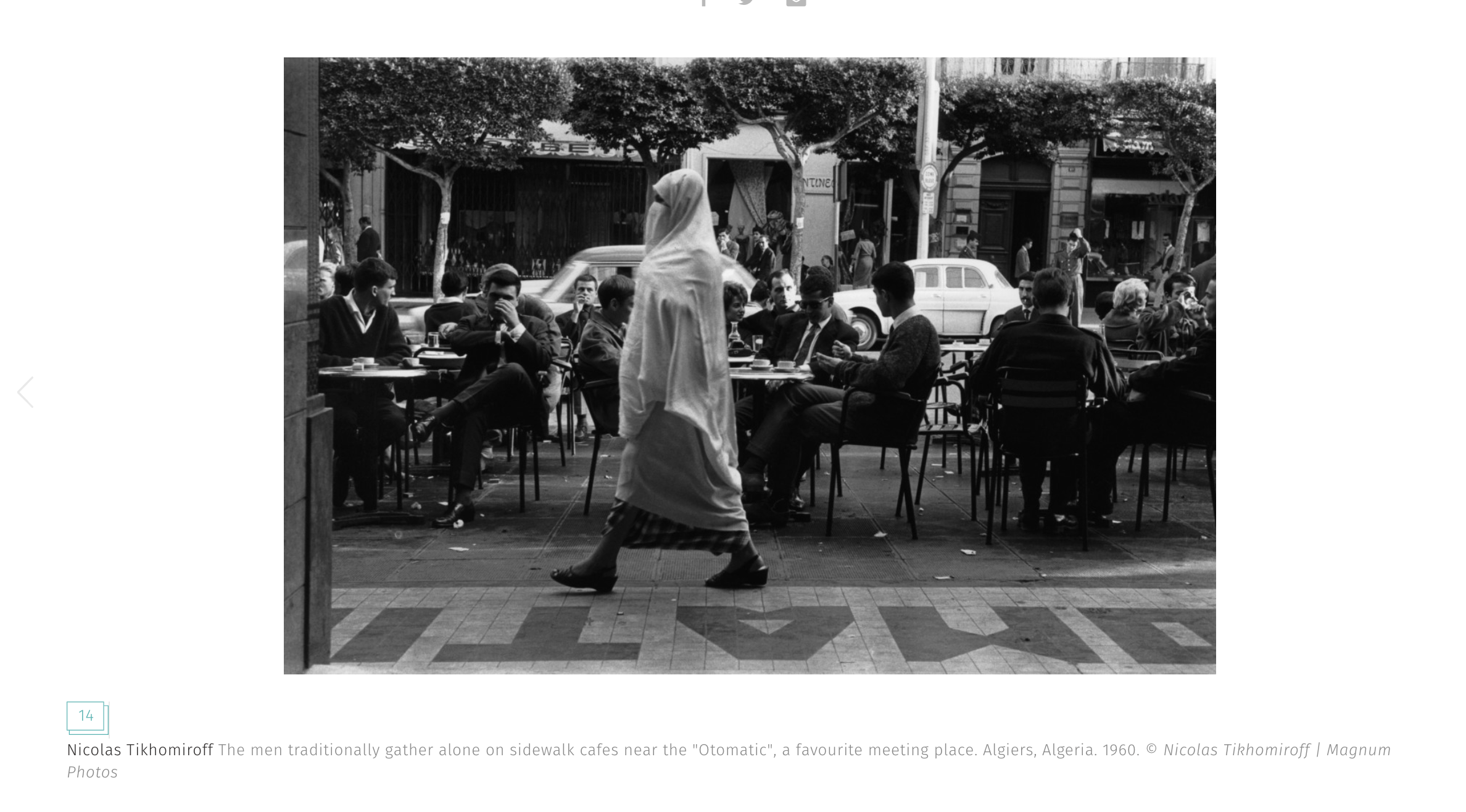
Photograph by Nicolas Tikhomiroff, reproduced in La Zerda ou les chants de l’oubli (Tikhomiroff, 2024).
In conclusion, this film has reclaimed the past from the colonisers to Algerians. For me, this film has reinforced my knowledge on colonisation in the African continent. This film made me realise how life was muted in colonisation, how people took back their voice in African creativity, and how much colonial influence is left today.
Reference
Djebar, A. (Director). (1983). La Zerda ou les chants de l’oubli .
Ellerson, B. (2021, August 19). Algerian Women in Cinema, Visual Media and Screen Culture. Blogspot.com. https://africanwomenincinema.blogspot.com/2021/08/algerian-women-in-cinema-visual-media.html
Glissant, É. (1997). Poetics of Relation. Ann Arbor Univ. Of Michigan Press.
Good, B. J. (2019). Hauntology: Theorizing the Spectral in Psychological Anthropology. Ethos, 47(4), 411–426. https://doi.org/10.1111/etho.12260
McClintock, A. (1995). Imperial Leather: Race, Gender and Sexuality in the Colonial Contest. Routledge.
Said, E. W. (1978). Orientalism. Pantheon Books.
Solanas, F., & Getino, O. (1970). Toward a third cinema. Cinéaste, 4(3), 1-10.
Tikhomiroff, N. (2024). The Algerian War • Nicolas Tikhomiroff • Magnum Photos Magnum Photos. Magnum Photos. https://www.magnumphotos.com/newsroom/nicolas-tikhomiroff-the-algerian-war/