Reading the Ocean
By Raisah Khan
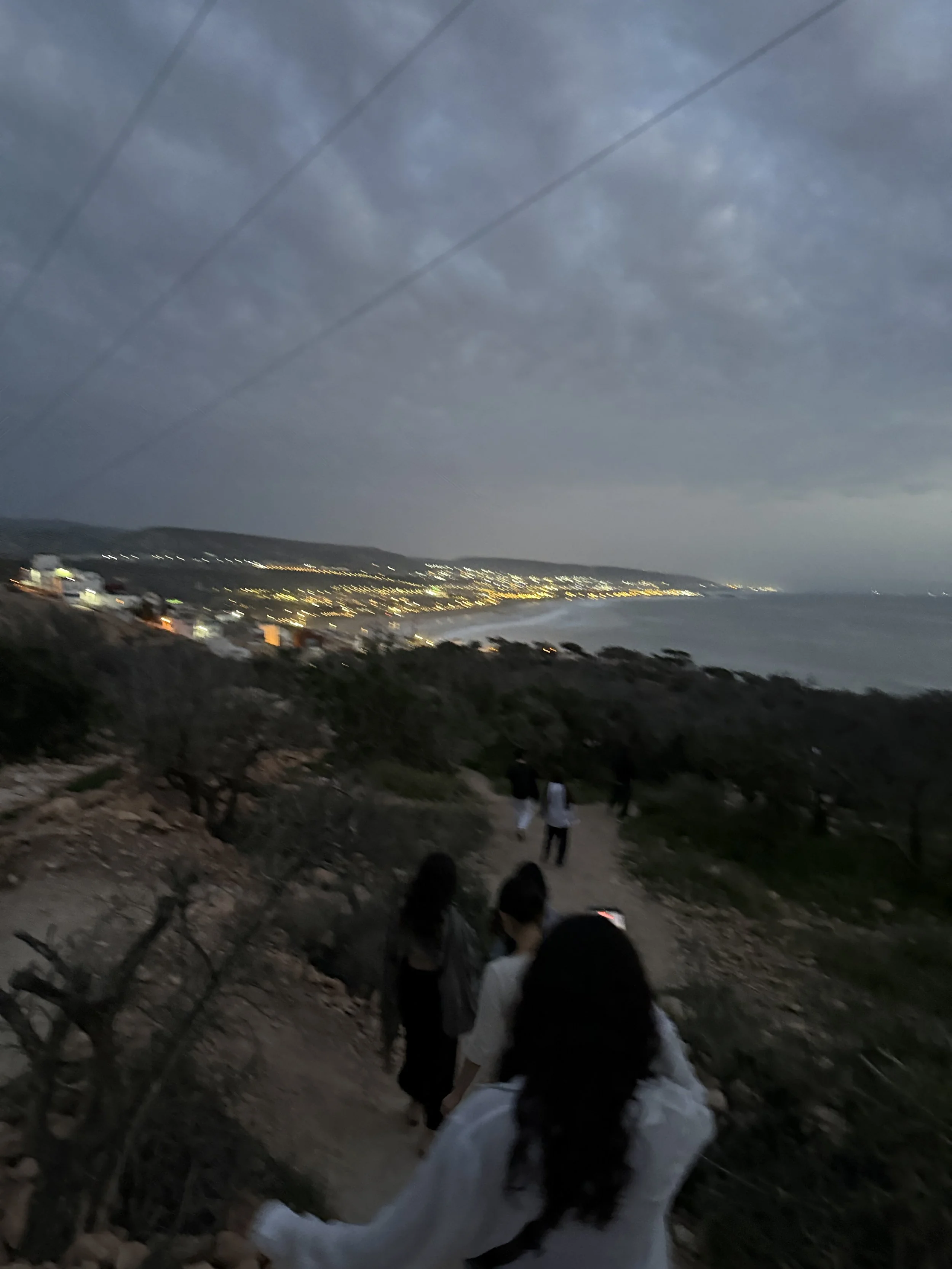
The first breath of fresh air in over a month came after I stepped off the plane with my carry-on in hand and looked across the hills into the long stretch of green as the sun set. The tranquility that had eluded me finally came to rest in my heart, and my world became cohesive. The unrest I had experienced from both studying and living the Anthropocene was washed over with the reassurance of Earth’s divine Creator.
When people experience a crisis of faith, tumultuous life events and epiphanies often come in tandem. I will never forget when I first read The Color Purple by Alice Walker, and, despite being rooted in a different religion, reminded me where mine came from. “I think it pisses God off if you walk by the color purple in a field somewhere and don't notice it.”¹
The same words echo in my brain as I stand atop Skate Park Taghazout on the Atlantic coast in Morocco and I look out into the ocean. Watching the sun set, I break my fast with my date, generously gifted from a kind shopowner, and take a sip of freshly-squeezed orange juice. This is inevitably God’s (SWT) domain – the Heavens and the Earth.
The Islamic environmentalism that I have always lived with and continue to grow into I now understand as an ontology. Regardless of trying to tease apart the sources of different things, I will always have to think about the bigger picture. This does not just mean the Earth, but something larger. I am driven to consider the Book of Nature: the written Quran vs. the cosmic Quran². In the written Quran, the Heavens are described as lush meadows and flowing rivers—we learn that nature is paradisiacal because it resembles paradise. Paradise comes first. I see divine words in the Ocean.
My academic life in the most urban city I have ever lived in, London, contrasted with my two-day trip to Taghazout, in a Muslim country where I saw the ocean every way I turned. Thinking about studying the idea of cosmology, and the discomfort that may come with doing so, versus feeling it. How humanity fits into this, how the River Thames is polluted, and the constant rain. How we believe in fate but also responsibility. The fatigue of being in the machine. Being outside the “West.”
For us, sound can mean something different³. Sounds can be of conflict, nature, and prayer.
On my way out I say Salam to the cats and dogs (fellow Muslims). When I receive news of a windstorm, and consequently our flight cancellation, I am pleased by my steady heart.
When Muslims prostrate in prayer, they touch their head to the ground, and that is considered the closest point to God (SWT). In this position, you are touching the Earth, from where you came⁴.
¹ Rather than reading this as a jarring statement, I viewed it as a reference to God’s (SWT) love for humanity and beauty that has been granted to us.
² Concepts from presentation by Dr. Munjed M. Murad at a religious community center. “Heaven, Humanity, and the Natural Environment”
³ Inspired by Gisa Weszkalnys’ exhibition “Sensing the Energy Transition” at the London School of Economics, I sought to explain alternative registers of climate change beyond the physical—in this case, the spiritual. Furthermore, in thinking about the exhibition’s focus on sound, I considered what sound may be for different communities, including many members of the global Muslim community where sound can be associated with displacement, violence, and war. At the same time, sound is associated with the sounds of prayer or the sounds of nature, which we enmesh ourselves within.
⁴ Donna Haraway’s coined term “Chthulucene” highlights the multispecies assemblages and kinship that characterize our planet. To build upon this thought process, I hope to highlight an alternative framework in Islam that similarly recognizes the intrinsic connection between humans and nature. In the religious tradition, it is taught that humans are created from the same clay as the Earth.