
Both sides of the big beat
Both sides of the big beat
by Dimitris Markantonakis

The beat is the most important element of the West African musical tradition; the Gods spoke through the drums, which made them the most prominent of all instruments. The tribe encircled them, as they danced to their rhythm (Stearns 1970: 3). Drumming, as we know it, is essentially an African concept; Gene Krupa, his fan Keith Moon, and all subsequent drummers, pounded on European instruments, using West African ideas. These have travelled throughout the globe ever since (ibid: 14-15).
Hard bop is a jazz style which emphasizes simpler melodic lines, strongly rooted in gospel and spiritual music. Art Blakey was one of its drumming pioneers; leader of the Jazz Messengers, a legendary ensemble that included the who’s who of jazz. Respectively, fellow drummer Tony Allen was a forefather of Afrobeat; a West African fusion of regional traditional music, with soul, jazz, and funk. Allen always looked upon Blakey as his idol.
Tony Allen’s A Tribute to Art Blakey and the Jazz Messengers was released in 2017 with little fanfare. Everything, from the cover design to the label, and the title, suggests that this EP considers itself a tribute album; it vastly underestimates itself, for it is more than that.
In concert, Allen addressed the audience as a modest fan, rather than an established master; he is thankful and very happy of the opportunity to pay tribute to his musical idol, whose repertoire is difficult, even for legends. “Allen is an Afrobeat guy. Tonight I will show my jazz side (...), the way we can fuse things together, which has been my way of life” (Allen 2016). This album reveals both sides of Tony Allen; Afrobeat, and jazz. These are not at all mutually exclusive.
Moanin’ is fragmented and intersected with Miles Davis’ So What, which further alludes to the uncanny connection between both pieces; Miles lifted his idea from Bobby Timmons perhaps? As a joke, try to whistle the melody of Moanin’ above Why Don’t You Do Right, a Timmons’ favourite, and then So What above both. In Allen’s version, the 4/4 swing is played in double time, while the melody is fragmented and halted; this achieves an 8/4 feeling, that moves back and forth the music line.
This beat is the greatest addition to Blakey’s music. Traditional African music is polyrhythmic, meaning multiple rhythms are played seperately at the same time, combining 3/4, 6/8 and 4/4 time signatures; that would be a simultaneous performance of a waltz, a blues, and a swing; the singing, clapping, and heavy stomping of both audience and musicians, further complexify (Stearns 1970: 4). Afrobeat incorporated this traditional element. Therefore, instead of Blakey’s straightforward 4/4 heavy swing, Allen applies African polyrhythmy to the hard bop idiom, leading to impressive results, and an altogether fresher take to the Messenger’s book.
Which takes us to Politely. Therein, Bill Hardman’s simple yet elegant blues theme is elevated; deconstructed and broken down into several pieces. The straightforward 4/4 swing is fragmented into a complex 6/8 blues, which creates a sense of movement through the chord changes. Compare it with Blakey’s own live performance from the Club St Germain. The extended solos from Bobby Timmons and Jymie Merritt, combined with the marvelous interplay between musicians and audience, add nice touches. Allen instead utilizes a constantly alternating tempo; below a steady bassline, and minimalistic piano arpeggios. The two latter create the impression of heavy rain and thunder, while the tom and cymbal hits sound as if shuffling earth, and piercing lighting strokes. Rather than the tranquil, swaggering politeness Hardman originally intended, Allen’s arrangement creates an even darker sense of urgency, almost apocalyptic. My personal highlight of the album.
Dizzy Gillespie’s main melody of Night in Tunisia is broken into repeatable parts, and performed as a series of disjointed riffs. This creates a strong rhythmic feeling, which places the beat into the foreground. I can imagine someone dancing to the tune, on a sidewalk, after hours. This gives the impression that every single instrument is soloing; not merely the leads, but the entire rhythm section as well, especially the drums. Multiple melodic layers are created, above and below the main theme. For instance, the bass maintains a steady riffing beat, with the piano chromatically improvising around it; the soprano solos through the changes, while the drums shuffle, reshuffle and improvise constantly below; never to merely confine themselves in plain timekeeping, nor to play twice the same line.
According to Leonard Feather’s liner notes (1958), the name of Benny Golson’s Drum Thunder Suite derives from its dramatic use of mallets, which suggest thunder. There is more to it than that. Chango was the Yoruban God of Thunder, known as Shango in Trinidad; he was worshiped by his own secret cult of musicians, to whom they dedicated their rhythms. In Trinidad, Haiti, and Cuba, Shango was mostly favored by drummers (Stearns 1970: 28-29). The composition of the Drum Thunder Suite, resembles the development of one of these cults, through the ages. It is divided in three movements; Drum Thunder, Cry a Blue Tear, and Harlem’s Disciples. Drum Thunder represents the early secret meetings, as they took place amongst the African slaves of the Caribbean; the drumming is heavy, raw and emphasized. Cry a Blue Tear moves us to the early jazz orchestras of the United States. The paradiddles resemble the early rudimentary technique, as the full drum set had yet to fledge; the strong Latin element, nuances the earlier calypso influences of the idiom. We are essentially in the South, as the African chants are juxtaposed with work songs, Cajun, and Caribbean music. Finally, Harlem’s Disciples is upbeat and mellow; the melody is funky reflecting the state of jazz in 1958; the drumming is still heavy, yet more nuanced. We now listen to modern jazz, from its Messengers. From the secret slave meetings to the late-hour club sessions, music and culture persist.
In his own take, Allen twisted the above concept inside out, to Africanize Blakey’s tribute to Africa. The drumming is even heavier; the wind instruments are loud and dissonant, resembling both animal cries and Balkan fanfares. The strong bass beat is modern. The movements are not separated, as in the original arrangement, but juxtaposed, to demonstrate the circularity of musical culture; steady flow and a strong continuity. This contrasts the fragmented melodies of all previous pieces.
Paired with a Parisian ensemble, a little larger than Blakey’s usual formations, yet more familiar with his own, Allen takes the sense of Africanism, omnipresent in all of Blakey’s work, to Africanize it even further. This album is a tribute from one master to another, of a kind that deserves its own tribute altogether. Viewing it as a mere tribute, would diminish its status; it is something new, altogether larger, and unalike all that preceded. In the same manner the impressionist painters payed tribute to their old idols, while innovating, Allen breaths fresh air to jazz; one in which tradition and modernism are fused and blurred, conforming to neither. According to a Greek song, all that is old needs to be burned, for the prettiest bud to blossom; the fusion would be that burning. Such is perhaps the route onwards.
References
Allen, Tony. (2016) Tribute to Art Blakey. Live concert recorded on the 16th of February 2016 from the Maison des Arts de Creteil, for the Festival Sons d’hiver. Retrieved in 2020 from YouTube.
Feather, Leonard. (1958) Liner Notes in the LP Art Blakey And The Jazz Messangers. BLP-4003. Blue Note.
Stearns, Marshall W. (1970) The Story of Jazz. Oxford University Press, 1970.

Global Fusion Sounds of the Decade
Benedict Croft makes us discover five global fusion sounds: St Germain, Oumou Sangare, Lokkhi Terra and Shikor Bangladesh All Stars, Ravid Kahalani, and Anoushka Shankar. Enjoy!
by Benedict Croft
You can listen to the full playlist on Spotify while reading the article.
St Germain – St Germain
After a lengthy break from music, the French house and nu jazz producer Ludovic Navarre returns to the scene with this refreshing project fusing Malian instrumentalists with deep French house grooves. The track ‘Sittin’ Here’ leads with the powerful Wassoulou vocalist Nahawa Doumbia and Griot guitarist Guimba Kouyate who transcend Navarre’s energetic percussive samples underlined with silky sub-bass riffs to create an overall sound that is subtle yet deeply funky, a sound rarely achieved by global house producers. The most impressive instrumentalism occurs in ‘Hanky Panky’ between ngoni players Sadio Kone and Guimba Kouyate who are able to merge individually complex melodies together creating a texture that appears initially intimidating but that settles into a rich groove pushed forward by recurrent jazz rhythms. Navarre in St Germain demonstrates his ability to create an organic sound by knowing when to take a step back and allow the instrumentalists to simply play, producing the tracks around their musical input to the extent where deep house appears as the natural ally of traditional Malian music.

Mogoya – Oumou Sangare
Wassoulou pioneer Oumou Sangare educates the global music scene in Mogoya, creating roots music that sounds intrinsically contemporary. It is hard to tire of the syncopated funk beats which reference the pop Malian rhythms of the 1980s and 1990s, which Sangare herself helped develop, in a fresh and highly energetic reinterpretation. In true Wassoulou style, Mogoya is a dance music album at its heart, brushed with refreshing electronic elements enabling the production of a later remixed album in 2018 which saw the likes of Natureboy Flako, St Germain and Tony Allen turn their hand to Sangare’s music. This modern sound is best exhibited in ‘Kamelemba’ where delicately reverbed vocals are interspersed with vintage synth harmonies and occasional sampling, all whilst the traditional instruments of the ngoni and calabash lay an irresistible acoustic groove. Sangare is not one to shy away from the political and this album is testament to that, with her songs discussing themes surrounding the global refugee crisis and the current tense political situation in Mali. Mogoya reaches out for unity through dynamic musical collaborations and pointed social critique to create a work that feels, in every sense, contemporary.

Banglarasta – Lokkhi Terra and Shikor Bangladesh All Stars
Banglarasta is the outcome of the world music collective Lokkhi Terra, led by Kishon Khan, combining with Bengali and Baul folk group the Shikor Bangladesh All Stars to produce some of the most interesting global fusion sounds of the decade. Put simply, this project combines heavy dub reggae with the classic folk instrumentation of West Bengal and Bangladesh. In ‘Shaddho Ki Re Amar’ the khol drum and taal cymbals set a traditional rhythmic cycle with characteristic dotara melodies accenting Bangla vocals, whilst deep bass lines, skanking guitars and tight horn riffs push the folk sounds into roots reggae. This short EP exhibits a blend barely explored anywhere else and makes you question why Bengali folk as a musical tradition is so untouched by the global fusion scene.

Yemen Blues – Ravid Kahalani
Ravid Kahalani, the founder of Yemen blues, is an Israeli musician with Yemenite parents, living between New York and Tel Aviv, known now for his creative integration of sounds from numerous traditions including Yemenite folk, Jazz, Afrobeat and Middle Eastern takht. This album announced Kahalani onto the scene, with critics unable to satisfactorily place its musical origins or influences in a way that allowed it to transcend genre, surely the ultimate aim of any fusion music. Kahalani sings in Yemeni Arabic alongside Ahmed Alshaiba, a Muslim Yemenite oud player making Yemen Blues more than simply a musical collaboration but a cross cultural exploration between Jewish and Islamic traditions. In ‘Jat Mahibathi’, Alshaiba opens with a dūlāb that references typical takht traditions, yet, this is instantly confused by the entry of the darbuka percussion, which, although sounding intrinsically Arabic, feels rhythmically more North African. Then enters Kahalani’s distinctive vocals which provide great intensity through dramatic pitch changes and layered voices which are softened only by brass and flute lines that eventually break out into a trumpet solo, giving the piece an overall jazz-like feel. Yemen Blues is by no means limited to this sound however, with tracks such as ‘Trape La Verite’ referencing folk styles that could be heard from the Scottish Highlands to the Sarawat Mountains of Yemen. It is this diversity which creates a work, that, despite drawing on numerous ancient musical traditions, sounds entirely unique.

Land of Gold – Anoushka Shankar
After a few years of Shankar re-exploring the roots of her music, Land of Gold signalled the return of the electronic and dub-influenced sitar-playing that originally positioned her as a key innovator in the global fusion scene. Shankar’s release of the Home in 2015 was a showcase of her virtuoso ability and deep understanding of traditional Indian raag. This appears to have inspired Land of Gold, which exhibits her most impressive instrumentalism yet. ‘Crossing The Rubicon’ is able to combine pop-like sitar hooks with dynamic passages of intense improvisation contrasted with the warm tones of the hang played by Manu Delago. Later in the track, Shankar opens the floor to shehnai player Sanjeev Shankar who, backed with aggressive drum samples, constructs a haunting war cry that is still able produce a distinctively South Indian sound. The entirety of Land of Gold is deeply political with every track crying out against injustice, often simply through instrumentals and occasionally enhanced with spoken and sampled vocals such as in ‘Remain The Sea’ and ‘Dissolving Boundaries’ which feel almost cinematic and demand sincere reflection. Shankar is an artist at the height of her craft, able to integrate tradition, progression and politics in a way that feels entirely natural and necessary to her sound and, consequently, places her as a giant in her field.


Dehumanising the dead
Dehumanising the dead
by Annie Thomlinson

If you have seen at least one London bus this academic year, you must have seen an advert for the Body Worlds exhibition. But did you know that all of the bodies displayed are real life dead people?
Last year I read an article by Tony Walter about the exhibition and about how it had revolutionised the way that we approach the dead. Body Worlds takes the bodies out of the coffins and graves where they are hidden from display and places them at the centre of our attention through the process of plasticination - a preservation technique which replaces the water in the body with a polymer. Walter’s article, written shortly after the first exhibition in London premiered, highlights the controversy associated with this revolutionary way of dealing with the dead; after all ‘the corpse has been identified by anthropologists for almost a century as a problematic object, generating repulsion, awe, symbolism, and ritual’ (Walter:2004 613). However, articles about the current exhibition placed a lot less emphasis on the ethics and cultural understanding of using dead bodies and where they mentioned that the plasticinates were real humans, the focus was more about how it made the exhibition quirky and unusual.
I attended the exhibition a couple of weeks ago to experience it myself and I found that this amoral position on the ethics of displaying dead bodies really came through at the exhibition. Apart from a sign at the beginning which acknowledged that all of the body parts on display were donations from anonymous dead people, the history of the plasticinates lives was not mentioned and the only reference made to the lifestyle of the donors was in reference to their body composition. For example, where there was a very fatty set of organs, reference was made to the fact that these organs had belonged to someone who had lived an unhealthy lifestyle, using their history to make a scientific educational point.
This dehumanisation of the body can also be seen in the terms used by Von Hagens. He refers to the preserved bodies as plasticinates, rendering them material objects rather than formerly living beings. The bodies are also taken apart in such a way which, whilst maintaining the human form, makes them less complete. For example, there was a plasticinate called the ‘split jumper’ where the plasticinate had been put into the splits and the body had been taken apart in such a way that even the penis was cut in half. This manipulation of the body is testament to the deconception of the plasticinate from the person it had belonged to. The idea of mutilating the genitals of a dead body would be considered deeply disrespectful if it was done to an ordinary dead body, yet the dehumanisation of the body through the plasticination process allows it to be done without complaint. In his article, Walter refers to Hertz’s distinction between wet and dry remains of dead bodies. Hertz argued that whilst the wet remains of a body are the object of mourning, the dry remains are not. The plasticination process makes the bodies hard and rigid so they lose the fleshiness associated with the living, making them dry remains, disassociated with life and, therefore, taking away the aspect of mourning. I wholeheartedly agree with this argument. As a particularly squeamish person myself, unable to stay in class during dissections at biology classes in high school, I did not have the same reaction to the plasticinates. The plastic texture of the bodies made it extremely difficult to imagine that they were once living beings.
If you’re intrigued by this discussion, I would absolutely recommend attending the exhibition. It is not only incredibly informative about the human body - just you wait until you see how small a uterus is- but also from an anthropological perspective it presents an entirely new and unfamiliar approach to death which can only be fully understood when you come face to face with a plasticinate.

«After Sight» - Benode Behari Mukherjee at the David Zwirner Gallery
«After Sight» - Benode Behari Mukherjee at the David Zwirner Gallery
by Benedict Croft

David Zwirner presents Europe’s first ever solo exhibition of Kolkata- born artist Benode Behari Mukherjee, who studied and taught at Rabindranath Tagore’s famous Kala Bhavana art school in Santiniketan, West Bengal. Mukherjee was born in 1904 with a serious eye condition that in 1956 led to his complete loss of sight, pushing him to explore new artistic fields – most notably that of collage and sculpture. It is on these later works that Zwirner’s exhibition focuses.
Inspired deeply by his own environment and Indian folk traditions, Mukherjee followed in the tradition of his Kala Bhavan mentors, allowing for the collaboration between cross-cultural modernism and indigenous styles. His loss of sight, however, freed his work further from realist constraints, allowing it to be constructed purely by his inner vision and memory. Techniques such as collage allowed Mukherjee to understand shapes and dimensions through touch, with colour being dictated purely by memory.
A collage of the two figures, constructed in 1959, displays Mukherjee’s continued desire to represent his external world, doing this through harsh yet vibrant geometric forms that are given depth through definite lines, which act as a form of counterpoint. Although some of his later works move closer to the complete abstract – with external objects defined through a multitude of singular shapes that evoke the collages of Matisse and paintings of Arp – they remain grounded in Mukherjee’s environmental reality. The collection consists of depictions of forms that are often deemed prosaic, such as cats, goats, and household objects; yet the dynamic use of colour re-energises such subjects, presenting them as no less than crucial forms. Mukherjee’s work, however, is nuanced, with these works not attempting to force a realist interpretation, but instead allowing for powerful insights into his inner vision.
It is, to some extent, difficult to enjoy Mukherjee’s charming pieces, which were once so loved by the villagers and locals of Santiniketan, in the elite setting of the David Zwirner gallery – a white-washed, high- ceilinged, Georgian townhouse in central London – where they seem to act in compete contradiction to their surroundings. Nonetheless, although they appear small, their brilliance dominates the space, bringing warmth and colour to the heart of Mayfair.


The Unstickler
A poem by Catherine Fu
by Catherine Fu
People’s patterns feel like rules:
The same motivations, reactions, expressions.
Rules that no one sees yet all are trapped in.
That dogma. How boring.
In my search for excitement I got lost
In this world where conventions rule morality;
Where very few share that vision
Of courage, freedom and compassion.
Snap out of it! I screamed
Silently, I chose loneliness over conformity,
Boldness over serenity.
I chose to be free - and being free means never quite belonging.
‘Chill’, someone told me,
‘You have too much intensity.
Life is about the little things,
So kick back your feet, and stop this search for meaning.’
I smiled, and said nothing.
I want to be normal. I want to fit in.
But being normal can mean being blind,
Judgmental, unthinking, and unkind.
Don’t get me wrong: I, too, laugh
At banter, memes and sarcastic humour.
But no one’s face is seen through this screen
And all of us are in danger.




Beyond the Physical Realm
A new poem contribution by Radwa Ahmed.
by Radwa Ahmed
No friends or foes, not even me
We were all but one entity
Halos are visible, tangible is envy
Warmth and chill are equally seen
The once simple figures
And the millions hidden in between
All too overwhelming, I ween
We’re back to where children wean
Or is it “when” I mean?
Space-time has never been so fragile
Birds in the sky never this agile
Thin air has never been so thin
What does it mean when you skin
My face, then, gently stroke my chin?
My eyes are wide open
The veil has been removed
My soul is to million pieces broken
But my body has never moved
I can hear you, all too clear
I can hear us, all our fears
I am here, trying to heal
Here to fathom what’s been concealed
My voices personified
Proving that we’re unified
I seek shelter
From the truth
I try to bring silence
I try to call truce
But it’s too late now
I have to listen
To let it all in
I never knew I was so limited
But now I’m so infinite
God help me take this in
Why is my vessel so thin?
So fearful, I spin
In circles, between
The realms, my friends
Say this is how it’s always been
But to me it’s only how it begins
Are these hallucinations
Or was this reality all along?
If this is mere imagination;
Why does it feel like I belong?
To something bigger,
Some system of a sort
This journey was the trigger
To days of teleport
Time is a construct, anyway
Yet I’m still counting the hours away,
Keeping track of passing days
Places are not real
I listen to my music
I want it to conceal,
Make me forget I’m human,
Drown out how I feel
Existence is now a Rubik
A mystery to reveal
Its weight is on my shoulders
I’m Sisyphus with a boulder
This story is getting older
The weight just made me kneel
I’m not satisfied
I’m only terrified
And I feel like I’m a sin
Now, this is how it’s always been
No women, no men
No now, no then
It’s all a metaphor
The physical realm is an anchor
Reality checks don’t work on me
I only want to set my soul free
Though yesterday I didn’t believe
Soul even existed, I didn’t see
I didn’t allow myself to hear
Now surrounded by my fear
I surrender
I submit
The colors are beautiful, I admit
I cannot look away
This never-ending day,
This abysmal array
Is showing me the way
This reality is here to stay.

Cradle
Regina Legarte: "Cradle is a poem I wrote in a poetry workshop organised by Lacuna Literary Magazine. It is about family.
by Regina Legarte
I am someone’s daughter, but
my mother is the universe.
I am not an only child—
my family is unbroken.
My siblings are called Orion, Leo,
Andromeda, Lyra.
Sometimes we collide, and we
apologise through light.
This is how it has been all my life.
Anak, my mother calls to me.
I am not an only child.
I dream in English, but my tongue
remembers my mother’s language.

"El Etnógrafo": A Film Review
A film review of "El Etnógrafo" by Agustin Diz, a professor of the Department of Anthropology at LSE.
by Agustin Diz
El Etnógrafo. 2012. 89 minutes. Ulises Rosell and Pablo Rey. Fortunato Films. Buenos Aires, Argentina.

Source: IMDb
Set in the Gran Chaco region, a vast semi-arid plain that occupies a large swath of territory at the heart of South America, El Etnógrafo (The Ethnographer) is a recent award-winning documentary that captures the harsh beauty of one of the continent’s least known regions. The documentary – which takes its title from a short story by Jorge Luis Borges – provides an evocative portrait of the life of indigenous Wichí communities in the north west of Argentina and captures the pressure that encroaching extractive interests are increasingly placing upon Wichí settlements.
As its title suggests, however, the film is primarily a character study whose protagonist is a man by the name of John Palmer. Palmer, now in his sixties, is an Oxford trained anthropologist who has worked with indigenous Wichí communities for decades. Having conducted doctoral fieldwork in the 70s under the supervision of Peter Rivière, Palmer completed his dissertation in the 1990s and returned to the Chaco region of north-western Argentina where he married Tojweya, a Wichí woman. Somewhat distanced from academic anthropology, Palmer, who received the Royal Anthropological Institute’s Lucy Mair medal in 2009, currently dedicates himself to activist work on the Wichí’s behalf.
In beautifully captured scenes of domesticity, the documentary captures the complex, multicultural lives of Palmer, Tojweya, and their five children. Perhaps the most memorable of these is the family’s visit to Tojweya’s birthplace; here the unforgiving environment of the Chaco contrasts with the warmth of family life and is bound together by powerful images of the muddy Pilcomayo river. The scenes of Palmer and Tojweya’s family lives are often touching and their rambunctious children provide an endearing source of comic relief throughout the film. At various points in the film, Palmer and Tojweya reflect upon the cultural complexities of their lives together which include issues like family finance, distance from extended kin networks, and even infant naming practices.
The heart of El Etnógrafo, however, is made up of various scenes in which Palmer enacts the role of activist-anthropologist in a Sisyphean struggle for indigenous rights. Several of these show Palmer confronting loggers and oil workers who are operating within Wichí territory and drafting police reports to denounce these encroachments. In one fascinating scene, Palmer and a group of Wichí leaders meet with the representatives of a Chinese oil company that is operating on Wichí land. Particularly interesting are the ways in which company representatives appeal to the ‘chain-of-command’ within the company and avoid taking responsibility for the company’s actions. Far from the air-conditioned offices where big decisions are made, the film’s focus on the micro-tactics of both the Wichí and the company representatives illustrate the processes through which politics and extraction interact in the day-to-day of an extractive frontier. However, as Palmer himself admits at one point, from the Wichí’s perspective the whole struggle is more of a ‘one step forward and five steps back’ kind of affair.
The most poignant and controversial of Palmer’s activist involvements concerns the case of Qa’tu, a Wichí a man who has been accused of raping and impregnating an under-aged girl from his settlement. To its credit, the documentary does not straightforwardly absolve Qa’tu. Instead, it hints at the cultural nuances and misunderstandings at play. Through Palmer and Qa’tu’s relatives, the film sheds light on Wichí marriage customs and also on the complexity of the Wichí’s engagements with bureaucracy, health services, and the justice system. As a viewer, one feels that perhaps this case might have merited some deeper analysis. In particular, questions of potential gender asymmetries among the Wichí are not explored even though these seem to be at play in the few scenes where we are able to see Wichí politics unfold at the local level.
From an anthropological perspective, the emphasis on Palmer’s mediating role often seems overemphasised and uncritical. Indeed, rarely do the documentary’s Wichí protagonists speak without Palmer being present and, in the confrontation scenes, the anthropologist does practically all of the talking. This is not a critique of Palmer, but rather of the way in which his actions are represented in the film. In some ways, the overemphasis on Palmer’s role is slightly ironic given the fact in the story that lends its name to the film, Borges writes that, although the story ‘has only one protagonist,’ ‘in all stories there are myriad protagonists, visible and invisible, alive and dead.’ Perhaps the filmmakers could have heeded this advice and crafted a more polyvocal portrait of life in the Chaco.
Indeed, the authorial presence of the filmmakers is pushed deep into the background. The film is not guided by a narrative thread, but seems to flit from scene to scene, gracefully introducing new characters and situations without ever quite linking them up explicitly. Coupled with the soft-spoken tone of most scenes, the documentary often becomes an almost dream-like, but not quite nightmarish, portrait of life in the Chaco. In an aesthetic sense, this impressionistic kind of story telling is, I think, one of the film’s strengths. However, for a more activist or even anthropological audience, it may seem slightly disengaged or insufficiently contextualised. For instance, historical, political, and economic issues are hinted at throughout, but they are never presented in an explicit account that might help to situate the life of the people on the screen.
Overall, however, El Etnógrafo provides an engrossing introduction to South America’s Gran Chaco. Throughout, it captures the cultural and politico-economic complexities of Wichí lives in the region. Although as anthropologists we might lament the lack of other, particularly Wichí, voices, the documentary is essentially meant as an exploration of John Palmer’s life. As such, it raises interesting questions concerning the politics of representation as well as insights regarding the role of anthropology and anthropologists beyond the ivory tower. Thought-provoking and beautifully filmed, El Etnógrafo is well worth a watch.

Ingmar Bergman’s “The Seventh Seal” (1957)
A movie that triumphs in its depiction of humanity’s relationship to death.
by Nathalia Joukova Edholm
Source: senseofcinema.com
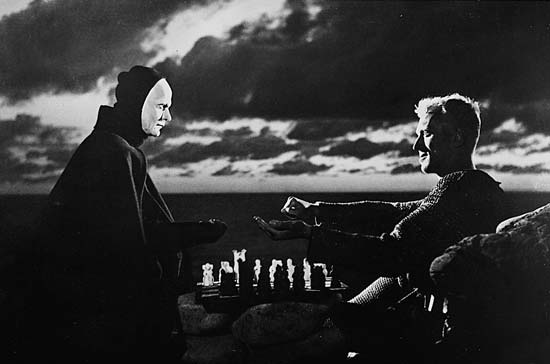
In honour of the Swedish filmmaker Ingmar Bergman’s 100th anniversary, we will look deeper into one of his most iconic films, The Seventh Seal (Det Sjunde Inseglet), a movie that triumphs in its depiction of humanity’s relationship to death in a time when it is a most intimate component of our lives.
“Who are you?”
“I am Death /…/ Are you ready?”
“My body is ready, but I am not”
So goes the famous dialogue between the knight Antonius Block and Death himself, a dialogue so well remembered even 61 years after its premiere. It is not surprising, since few scenes so directly confront the universal fear of death—we are never quite ready for it. Nevertheless, it has been, and will presumably continue to be, an inevitable part of life. Many anthropologists have considered the role death plays in life. Our very own Bronislaw Malinowski in “Magic, Science and Religion” emphasises rituals that mend the social disorder in events of death, where the body is purified in order to foster an idea of an immortal spirit. Some thinkers such as Ernest Becker and Zygmunt Bauman go even further by claiming that the universal human fear of death is one of our strongest inner drives. In order to escape death, we subconsciously try to immortalise ourselves through genealogical procreation, the making of art, and the following of religious faith. Human life seems, ironically, to be intimately connected to death. So, how does human life and thought react as death takes enormous and arguably unnatural proportions, such as of the Black Plague in the middle ages?
'Bad death' is the opposite of an expected 'good death'. Survivors left in despair, hopeless in the face of evil. The Plague, estimated to have killed 30-60% of Europe’s population in a matter of decades, could probably count as its archetype. As the film begins, the main character Antonius Block, a knight returning from the crusades, encounters Death who has come to take him away. Antonius, reflecting the human tendency to elude death, challenges Death to a chess match in order to postpone the inevitable. During the match, he experiences a crisis of faith in God, a fact that makes death even more daunting. “Is it so terribly inconceivable to comprehend God with one's senses? Why does he hide in a cloud of half-promises and unseen miracles?”. The loss of faith, presumably a result from his experiences in the crusades, makes death seem devoid of meaning and substance. Echoing the futility of life, he confesses to Death: “we must make an idol out of fear, and call it God.”
Not all characters in the film adopt the same defeatist view of death. On the contrary, the role of religion grows alongside that of death. Monks speak of the sins of men that initially brought the Plague as a punishment from God (the HIV epidemic, anyone?). Cults of people reenact the suffering of Jesus through whipping themselves—and as such, society and meaning are reconstructed as physical suffering, that still seems less painful than a meaningless existence. Other characters, such as the macho squire Jöns, adopt an arguably nihilist and hedonistic worldview. Jöns dismisses love as nothing more than worldly lust and proceeds to ask for the bottle after observing painted murals depicting death, doing so in a desperate effort to forget its lurking presence. Finally, a farmer (who some would regard as simple) comments, regarding the Judgment Day: “if it is as they say one can only take care of one’s house and live happily as long as one stands on one’s bare legs.”
Bergman’s fluency in black comedy is displayed throughout the film and reveals itself in the best light in one particular scene. An actor, encountering Death, attempts to negotiate: “I haven’t got time… my performance [tomorrow]… is there no exemption for actors?”. Presenting morbid matters through humorous dialogues, the audience is allowed to playfully reflect over the often suppressed knowledge of one’s own mortality and what it does to oneself. As the Church painter said to Jöns: “Why should one always make people happy? It might be a good idea to scare them once in a while.”