
Anthropology in the Anthropocene?
The Anthropocene is not a set of parallel problems with clean solutions — it is a dense web of entanglements between human choices and non-human systems, industrial histories and present-day consequences. As this piece argues, anthropological ways of thinking offer something the loud, fast forums of public debate consistently lack: a map of the whole web, not just the corner we find most convenient, created in community.
By Zoey England

A Red-legged Golden Orb-weaver tends to their web. 05 July 2022 in Mauritius. Zoey England
Consider two kinds of webs: The first is a spider's, woven from silk with threads radiating from a central hub. Each strand is tensioned against each other, providing structural support through intricate geometric patterns. They’re a means to entrap the next meal, but also a tool for protection, shelter, courtship, and communication– a way of making the invisible visible, of catching what passes through the air otherwise unnoticed.
The second is a string figure: built between two pairs of hands, passed back and forth, where the slightest shift in tension or angle produces an entirely different pattern. Drop a strand, and the whole thing collapses.

I am not a classically-trained anthropologist. But I have been spending time lately in the realm of anthropological thinking, and I keep returning to these two images as a way of understanding why our public conversations about the Anthropocene are failing. The world we have made is a spider's web, yet the way we talk, the questions we ask, the policies we create, and the science we do is all framed in terms of dropped strings.
The Anthropocene is not a problem of isolated causes and clean effects. It is a web in the spider's sense: every strand is load-bearing, every rumble felt across the whole. Climate change, biodiversity collapse, soil degradation, ocean acidification are not parallel crises happening to a passive Earth. They are entanglements between human actions and non-human systems, between industrial histories and present-day actions, between the policy choices of governments and the saltwater now swallowing coastlines. In her 2016 book, Donna Haraway calls this "staying with the trouble"–dwelling inside ambiguity (and to an extent, complexity) rather than trying to steer from the outside– and insists that such entanglement can only be faced collectively, through shared creation.
Public discourse rarely does this. Instead, it oscillates between two failure modes. The first is individualisation: the problem is your flight, your steak, your plastic bag. This is not wrong exactly, but it is radically incomplete, with the convenient side effect of obscuring the systemic processes– extractive industries, subsidised fossil fuels, regulatory capture – that dwarf any individual's carbon footprint. The web shakes, but we stare at a single thread and call it the problem.
A similar story can be told for polarisation, the second failure mode. Climate "debates" often look like disputes about facts, when they are more accurately disputes about who gets to hold which part of the string. When ‘science’ becomes negotiable, when the same dataset produces opposite conclusions depending on who is reading it and why, we are no longer in an epistemological argument. We are in a political one, dressed in the language of evidence.
This is where anthropological thinking offers something distinctive. As a discipline, Anthropology's methodological habits are built for deployment on this terrain. Longitudinal analysis resists the short-termism that makes climate policy so difficult, asking not what is happening now, but what has been changing across generations, and why. Gathering knowledge through community embeddedness means engaging with people rather than about them. This dramatically changes what you find and how you are permitted to interpret it. And perhaps most importantly, anthropology takes non-human actors seriously– not metaphorically, but analytically. Rivers, animals, weather systems, soils: these are not the backdrop against which human drama unfolds. They are strands in the web. They have tension. They pull back.
At a recent talk, the anthropologist Hans Steinmüller made the point that simplicity and complexity depend on perspective. His concern is more centered in the social domain, rather than the Anthropocene entanglements Haraway has in mind, but I believe the observation holds across both registers. The Anthropocene looks manageable, perhaps even solvable, from a spreadsheet. But it can simultaneously look like the end of a world if you are standing in a community whose relationship with land, water, and season has been torn apart within a single lifetime. Anthropological thinking does not resolve that gap. But like the spider, it maps the whole web rather than mistaking one corner of it for the full picture.
I want to be careful not to romanticise a discipline. Anthropologists hold no monopoly on relational thinking. What I am arguing is that certain habits — slowness, embeddedness, comfort with entanglement, willingness to let non-human actors into the frame — are exactly what is missing from the loud, fast, polarised forums where the Anthropocene is constructed.
The spider builds alone. But the string figure only works with more than one pair of hands. We need both: the web's ruthless, structural honesty about how everything connects, and the string game's insistence that knowledge is not intended to be a solitary sport. Ideas are supposed to be passed between people, shared and shaped by whomever might be holding it.
Bibliography
Bassolas, A., Massachs, J., Cozzo, E., Vicens, J. (2025). Multifaceted polarization and information reliability in climate change discussions on social media platforms. Royal Society Open Science, 12 (11). https://doi.org/10.1098/rsos.241974
Haraway, D. J. (2016). Staying with the Trouble: Making Kin in the Chthulucene. Duke University Press. https://doi.org/10.2307/j.ctv11cw25q
Miller, J. (2024). String figures: our shared history of play, culture, and mathematics. Blog Post. From https://royalsociety.org/blog/2024/12/string-figures-our-shared-history-of-play-culture-and-mathematics/
Steinmüller, H. (05 March 2026). Complexity and complicity in social anthropology. Inaugural lecture. Accessible from https://www.lse.ac.uk/lse-player/complexity-and-complicity-in-social-anthropology
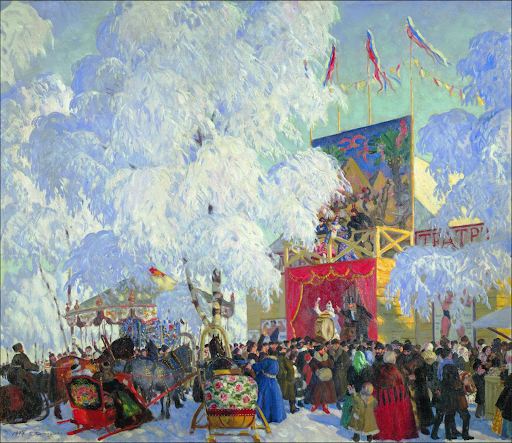
The Intimacy of Self-Censorship in Wartime Russia
The piece traces how Moscow’s lavish holiday spectacle and pervasive self‑censorship operate as a ‘propaganda of unreality’, distancing citizens from the war while saturating everyday life with fear and silence. Through an ethnographic vignette of a 19‑hour train ride and a cautious conversation with a stranger, the author shows how war‑time despair and the “unsaid” become tools of anthropological attunement, enabling subtle forms of mutual recognition and fragile dissent under repression.
Moscow
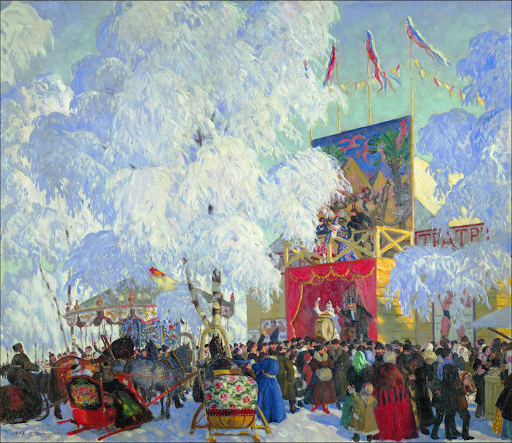
“Snow Booths” 1917. Boris Kustodiev.
During the winter holidays, I went back to visit my family in Moscow, Russia. As the capital, my home city has become the main visual ‘front’ of distracting the public from the horrors of war and decay of the country. Not a dime is spared from lavishing and glamourizing the sumptuous charade. The Christmas market on the Red Square feels especially decadent, as it is filled to the brim with extravagant decorations, cascades of scintillating lights, and excessive amounts of food stalls.
Towering pines are drenched in hues of blood-red and emerald green, with the winks of golden baubles matching the beat of the light installations that straddle the adjoining streets. String lights and velvet ribbons snake up the lamp-posts, which already seem to be struggling under the weight of gargantuan gold bells. There is also the glittering mass of spinning carousels, shrieking children, twirling ice-skaters with plumed red cheeks, sugary doughnuts and wafts of mulled wine – it’s undeniably charming, yet it feels like a glutted circus of delight and gavaged pleasure.
The market’s festivities feel especially dissonant, coquettish even, for it hums at the edges of the fortified Kremlin – the citadel where Mr Putin and his cronies continue to enact their insatiable appetite for imperial conquest, dropping bombs and annihilating cities, perpetuating unfathomable crimes of humanity.
It’s a disgustingly sobering thought, and it’s the only one I seem to have as I navigate my way through the plush crowd, showing my visiting friend the wooing ‘delights’ of Moscow, witnessing the city lure her into the temporary entrapment of distraction.
I do not mean to be a Scrooge. I know well enough by now that clutching your fists in silent fury weathers down the body, and that critique without action can turn into a goop of disincentivised noise. But my arms continue to ache. Because underneath the tickling glee of the market’s festivities is the understanding that this sensorial feast goes hand in hand with the intensifying strategy of an ‘information war’ – whereby one is not to question the government’s actions, nor the swelling ranks of graves with the protruding Russian flag stabbed into them.
In this sense, war requires an ideology, but it also requires distraction. As the focal point for internal tourism, and the nest of Russia’s bureaucratic elite, Moscow has become a beauty pageant of consumption and glitz. And at its rotten core, it is infused with a ‘propaganda of unreality’ (Pomerantsev 2019), that lives not so much through the administration of a single truth, but the idea that one can never know the truth – so why not souse in the ‘skazka’ (fairy tale) a little longer?
Every time I visit, it seems that the reality of war flies further and further away, to some nether abstract plane of uncontrollable forces. Some seem to be happy to bask in the distraction the city offers them, many rejoice in the ‘out of sight, out of mind’ state of indifference. In Arendt’s (1963) hauntingly precise formulations, this uncritical conformity shushes critique before it can even articulate itself, and creates the environment for the most potent forms of control. Muscovites are becoming purposefully politically ambivalent, in accordance with the danger of being associated with politics at all.
In our current censorship regime, where you can get prosecuted up to 15 years for voicing the word ‘war’ and not a ‘special military operation’, fear gathers so thickly that even the most banal conversations are conducted in euphemisms and Aesopian code. The word ‘war’ is no longer uttered in public, even allusions to the ‘current situation’ or the simple ‘since 2022’ is spoken with risk.
We swirl ourselves into a dance of self-censorship, which gets choreographed into a wider insidious paralysis of collective conformity and hush-hush. Moscow, with its gluttonous beauty and pristine facade, made me schizophrenic and meek.
Two days later, I was getting aboard a night train heading South, away from the fairy tale and towards the part of Russia where the war stops being abstract.
Train to Rostov-on-Don.
When you slide open the door of your carriage, and are about to meet a stranger with whom you will be sharing a 4 square meter room for 19 hours, you naturally visualize all sorts of unfavorable characteristics which your roommate could have. They could be loud, rude, leering, unnervingly silent – or worse, openly pro-war.
Vladislav, my roommate for the journey, seemed neither of those things. He looked to be in his late-20s, very tall and broad-shouldered, dressed in all black, in a t-shirt of some metal band. I was slightly intimidated. Once we awkwardly navigated the small room and set up our bedding, we took off our shoes and settled in. For some strange reason, it was his mismatched socks (one was red and the other striped), completely at odds with his whole demeanor, that spurred me into beginning a conversation.
We discussed where we’re from, where we’re going and why, what we do and if we like it – the usual exchanges and friendly pleasantries. He reminisced about international student life, having studied in China himself, and told some funny stories about his mandatory military service when he was 18. This made me ask about how he’s avoiding getting mobilized, a safe enough question, to which he answered that he gets by, for now, due to the Kazakhstan residency he got when ‘SVO’ (special military operation) began.
This made me pause. Here I was thinking that given his overseas perspective, and age, he wouldn’t support the war. Why would he say ‘SVO’ and not ‘war’? In our little toasty shoe-box car, with the snow storm raging outside and the warbling hum of the train machinery filling up the quiet, I felt more ‘safe’ than usual to speak out – if it came to it – without the lacquered layer of self-censorship.
Did he not feel the same? Did I not read him correctly? Did I not ‘sniff’ out his stance well enough? I internally cringed, feeling the weight of the unsaid befog our communication channel.
Michael Taussig (1992), in considering the ‘war of silencing’, writes that “it is this presence of the unsaid which makes the simplest of public-space talk arresting in this age of terror” (p.27). In a context where nouns can incriminate, small talk is never small. I clearly overestimated how far our cabin insulated us from the scrutiny and self-censorship of ‘public space’.
The ‘unsaid’ here becomes much more palpable, pulsing even, a viscerally felt veil of fog. Like a zig-zagging wave, you meander between wanting to conceal and wanting to reveal. And this attunement to the self, suddenly makes conscious the conventions through which sense-making occurs, within wider omnipresent mediations of power.
In my moral stupor, I turned on the little TV hanging above the bed. A war movie lit the screen, a clear effort of state television to glamorize the war and fetishize notions of ‘patriotism’ and sacrifice. The next channel I flipped to showed another, older war movie. If I flipped again, I knew I would find the main news channel – the gibberish they spout there muffled through the adjoining wall from our neighbour’s cabin.
I sighed, deflated, having forgotten how pervasive the media is. Vlad didn’t seem at all surprised. “They’re obsessed,” he murmured.
I didn’t answer right away. The TV kept pushing its bright, heroic images into our dark little room. The ‘they’ in question was clear of course. I probed further. “Obsessed with war?”
Vlad scoffed, an abrupt sound that didn’t quite reach laughter. “With selling it,” he said. “With making it mean something.”
At last, as if deciding he could open up, he turned onto his side, propping his head on his hand, while the other found a loose string on the bedding and began to fidget with it, winding and unwinding it around his finger.
He flicked his eyes to me, appraising, then began telling me about the guys he grew up with: some ‘plucked off’ to the front, and one who went willingly. He painfully laughed at the absurdity of the ‘death contract’, of getting paid 400,000 rubles as a federal signing bonus – equivalent to £3870. In Moscow this sum is nothing. In Vladislav’s home town, it’s enough to pay off debts and support your family, reflective of the wider reality that the war becomes the ‘easiest’ way to get out of poverty.
I nodded, and felt that we had crossed an invisible threshold – where, in a shared recognition of danger, we could both, for a little while, speak more plainly.
With four years of war, many Russians have retreated their worries and despairs into the interior realm. When there is little to no outlet for speaking freely, very big feelings get vacuum-sealed into very small places.
To reach each other across that sealed interiority, you have to partake in a subtler, more attuned form of communication: a peculiar dance of ‘sniffing’ each other out that, if anything, resembles flirting. You circle, probe, and test the words and intonations of your interlocutor. As a mutual assessment of danger, this implicit communication becomes almost intimate in its restraint and simultaneous fixation.
Anthropologically speaking, that visceral fear becomes a strangely powerful tool of producing knowledge. Despair and mourning can be critical pathways through which to connect and collectively ponder in a repressive, totalizing environment. It makes you sensitive to non-explicit expression, and the minute details of how a stranger carries their self-censorship becomes charged with meaning. Rather than emerging through detached analysis alone, knowledge here is produced through hesitation, indirection, and the felt pressure surrounding what remains unsaid.
Why wouldn’t the war be the most poignant and textured point of contact, when it pervades every ordinary hour, pressed into a knife-sharp grief, blunted by containment? In a perverse way, I recycled my dance of self-censorship into an ethnographic method.
Once that door opened, we kept passing things through it, trading fragments of our experiences and thoughts.
I shared how in Rostov, the city I was going to, with its proximity to the Ukrainian border and abundance of military hospitals, there are more and more men with missing limbs or eyes – how many, lost to alcoholism and addiction, prowl the city on wooden crutches, inevitably severely traumatised, looking for a reprieve.
He admitted how desensitized he had become: to the body-camera footage of soldiers posted online, the endless churn of men killing and trying not to be killed, to the news of yet another of ‘their’ residential neighbourhood turned to rubble. I had the sense that what troubled him most was not only the violence itself, but how ordinary it had begun to feel.
He spoke of his apathy shamefully, perhaps embarrassed even, his words sounded raw from disuse.
Listening to him, I found myself thinking back to Moscow. I still felt the obscenity of that spectacle, albeit even more sharply than before. But it no longer appeared to me as a simple facade, neatly opposed to the war’s reality. Perhaps, it was one expression of the same confused, overburdened emotional life the war had produced.
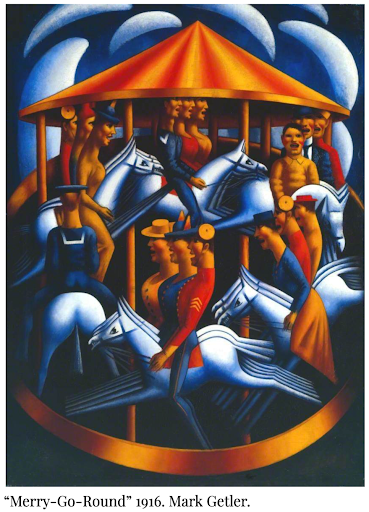
I was no longer sure where, in a city like Moscow, distraction ended and psychic survival began. I thought of the ghastly riders in Mark Gertler’s ‘Merry-Go-Round’, stuck in a churn of grotesque gaiety and terror. Painted as a condemnation of the First World War, his carousel becomes a metaphor for war’s remorseless machinery, trapping soldiers and civilians alike in an endless cycle of violence (Tate 1988).
Ultimately, what the journey offered to me was not clarity, exactly, but a subjectivity disciplined by fear and grief. There is nothing comprehensible about the war. It reorganizes not only the future, but memory, language, and the scale on which feeling itself becomes possible. Sometimes, the only clarity it offers is the bleak one produced by despair.
And yet, this despair can act as a powerful form of attunement, compelling you to stay with the fragile traces of care that survive under repression. It may be why confiding in a stranger felt so intimate. For a moment, the unsayable acquired unassuming company, and dissent no longer seemed condemned to remain a private hallucination.
Whose peace, whose history? Reflections from two museum visits in Seoul: the War and Women’s Human Rights Museum and the War Memorial of Korea
This reflection on two museum visits in Seoul, South Korea considers the notions of “peace” and “sacrifice” in different narratives of history. The intimate and confrontational War and Women’s Human Rights Museum focuses on the halmonis who suffered under Japanese military sexual slavery in WWII. Encompassing historically marginalised women’s bodies and voices and Vietnamese victims of sexual abuses perpetrated by Korean soldiers, the museum disrupts patriarchal and nationalist discourses. By contrast, the monumental War Memorial of Korea covers a broad military history of centuries of wars on the Korean peninsula, highlighting heroic values and Korea’s nationhood. Looking into diverging discourses in museum spaces and the relationship between materiality and memory, this piece reflects various ways of understanding violence, hope, peace and solidarity in the long shadow of conflict.
By Elise Lee
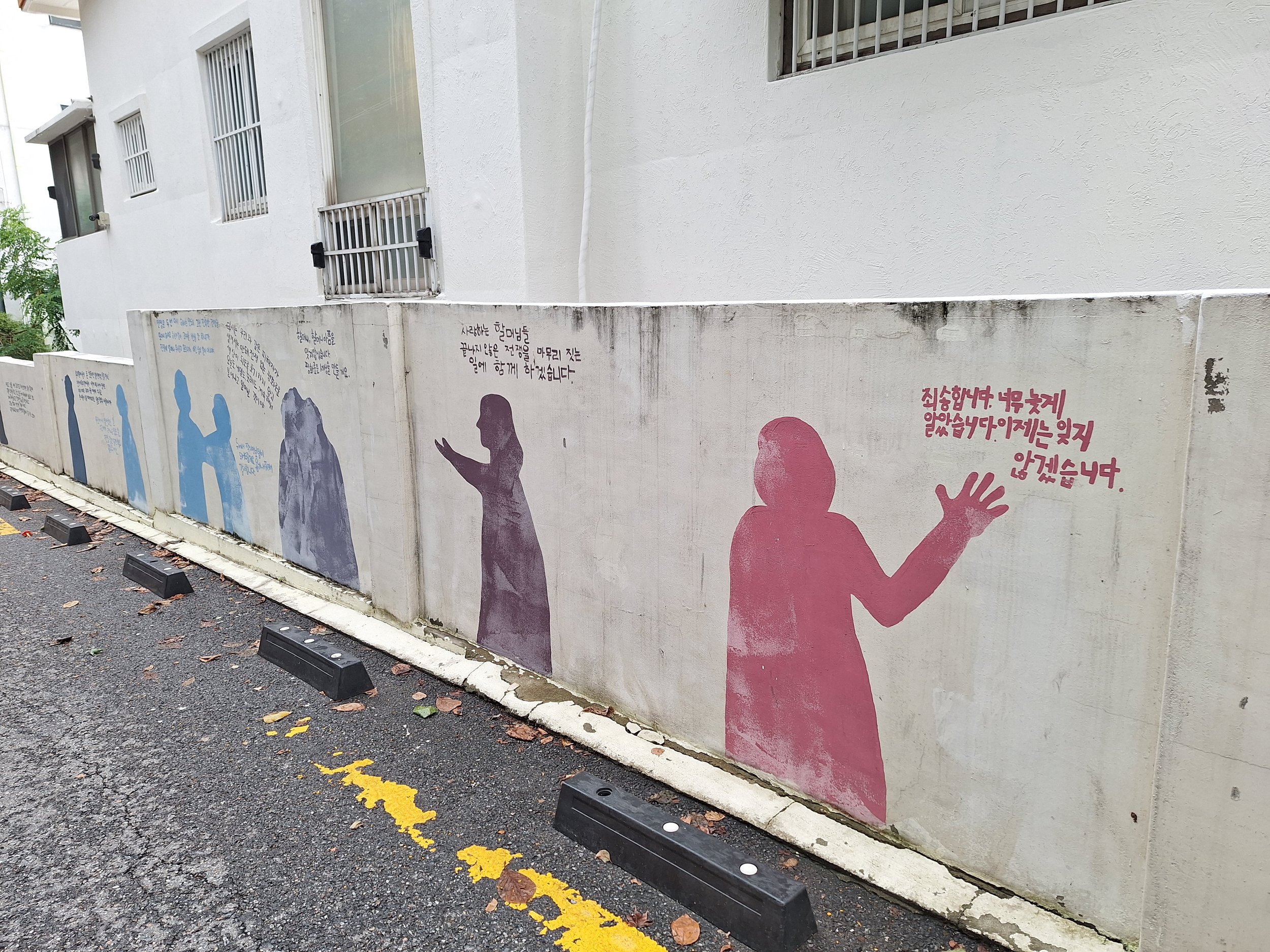
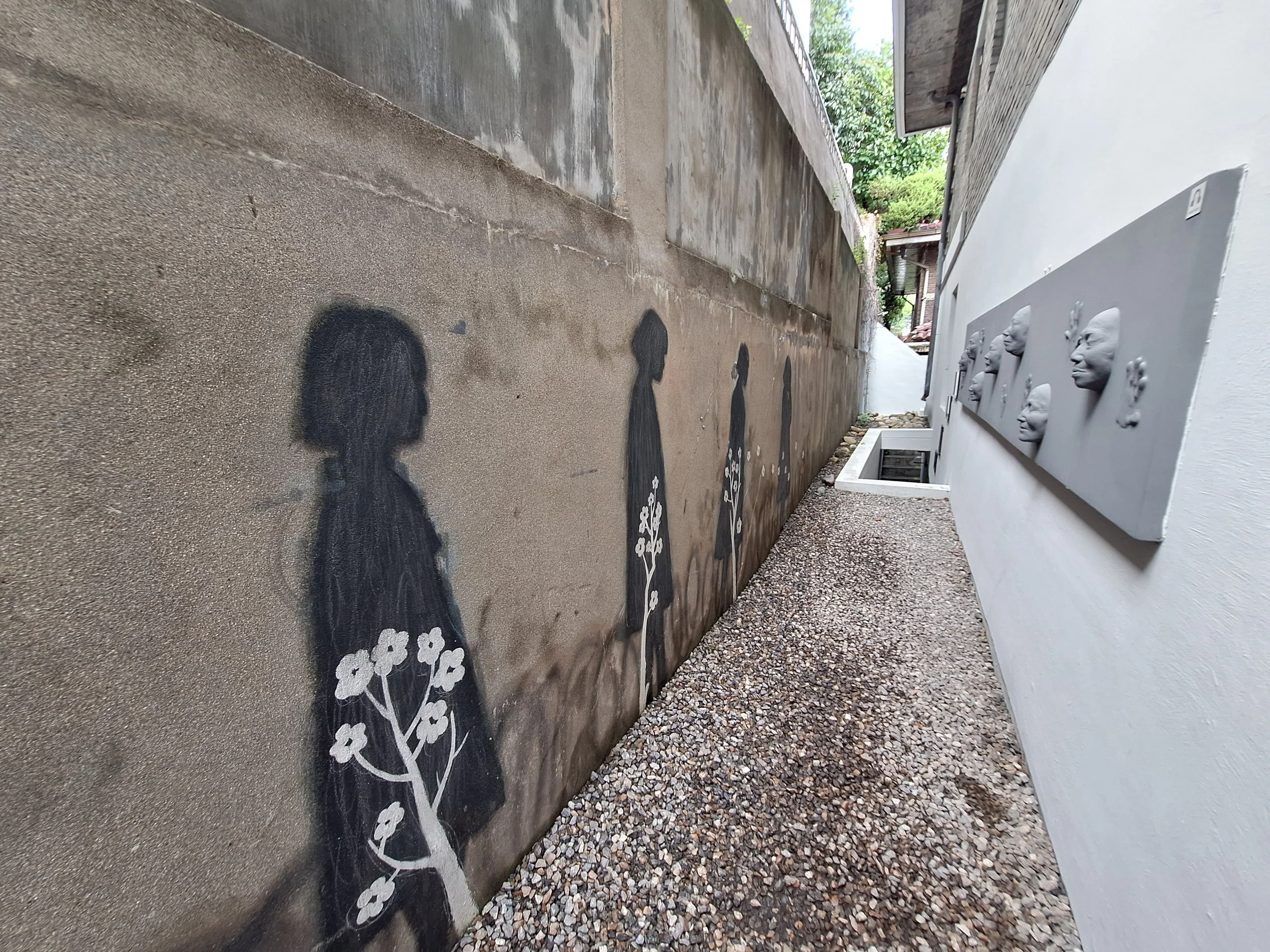
Paintings I saw on my way to the War and Women’s Human Rights Museum
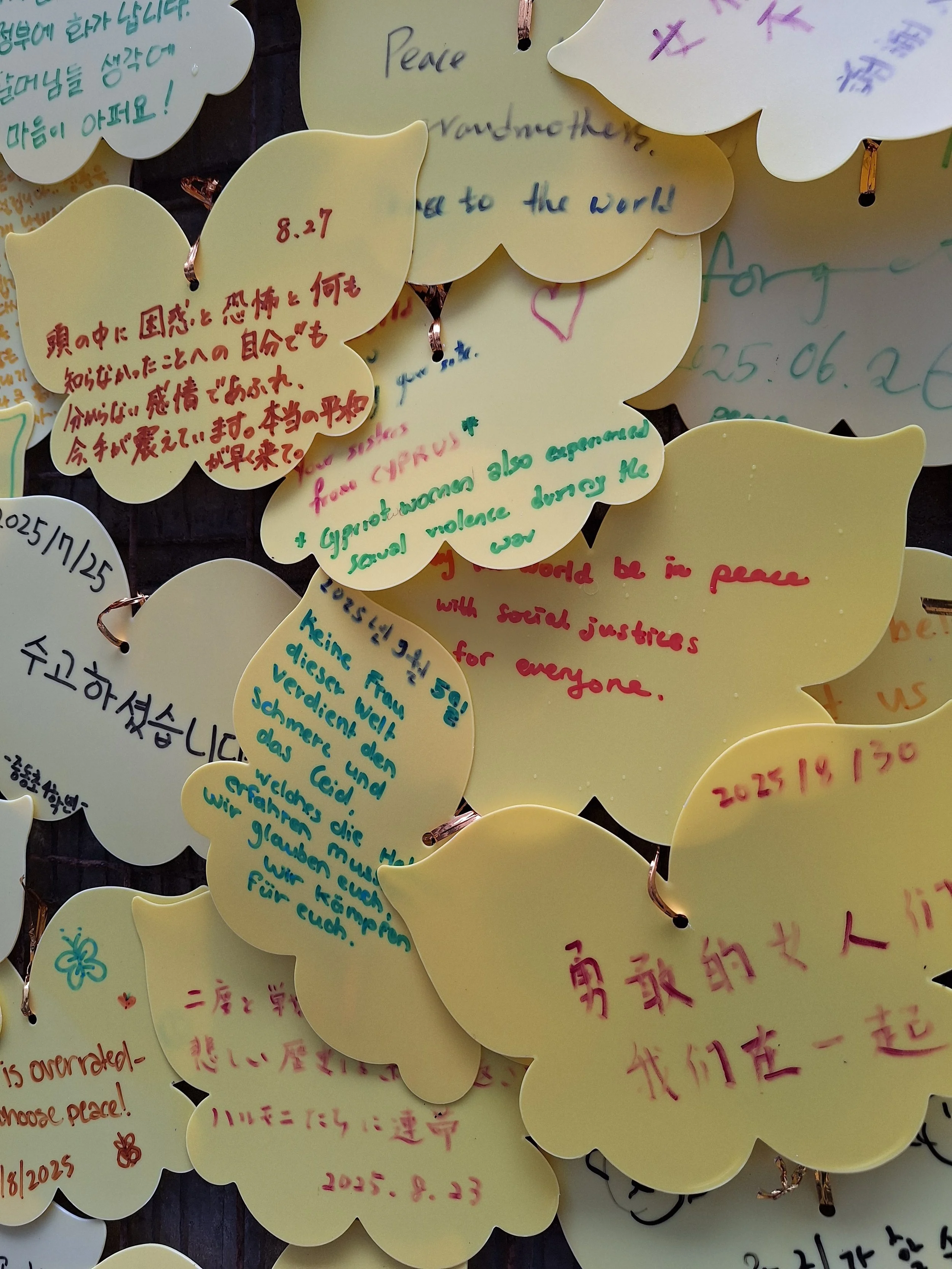
While travelling in Seoul on a rainy day, I walked uphill toward the War and Women’s Human Rights Museum. The street was quiet, unlike the crowded, spectacular tourist routes I had followed over the past few days. Following the paintings on the sides of the street, I arrived at a grey brick facade, covered with yellow butterfly notes bearing visitors’ messages of solidarity. Not monumental but intimate, the three-storey house unfolds a painful and long-silenced history of sexual slavery.
The visit raised questions which resurfaced a week later, when I visited another museum, the War Memorial of Korea. Whose history is being told here, and toward what vision of peace? How can hope, resilience and solidarity be cultivated while carrying historical trauma? Two museums, two memories. Both speak of war, violence and “peace”. Yet they imagine different moral worlds: one intimate, feminist, unsettling but reassuring; the other monumental, military, nationalist and masculine.
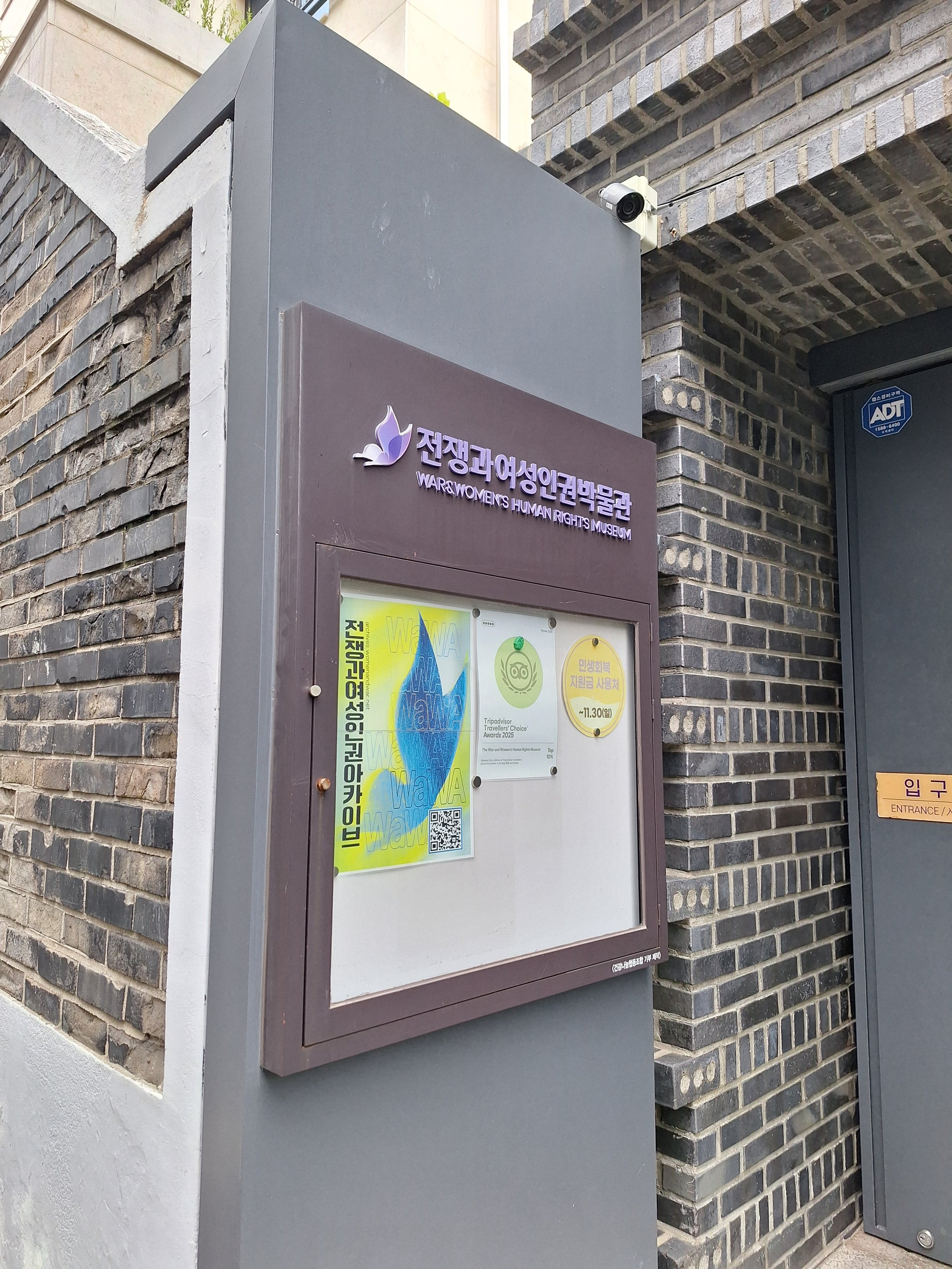
The entrance of the War and Women's Human Rights Museum
The War and Women’s Human Rights Museum
As I opened the door, the small reception area was dark and quiet. A middle-aged woman behind the reception desk greeted me in Korean. Noticing my hesitation, she slowed her speech, shifting gently between Korean and English. When I told her I spoke “only a little Korean” as a foreigner, she smiled and replied gwaenchanh-ayo (it’s okay), patiently explaining the ticket price, audio guide and exhibition route. Then, she introduced the face printed on the ticket–the late Kim Bok-dong, one of the most prominent survivor-activists of Japanese military sexual slavery in WWII. She was referred to, alongside other victims, as halmoni (grandmother), a Korean kinship term with dignity and agency, instead of “comfort women”, a Japanese bureaucratic colonial category that reduced them to instruments of sexual exploitation in WWII.
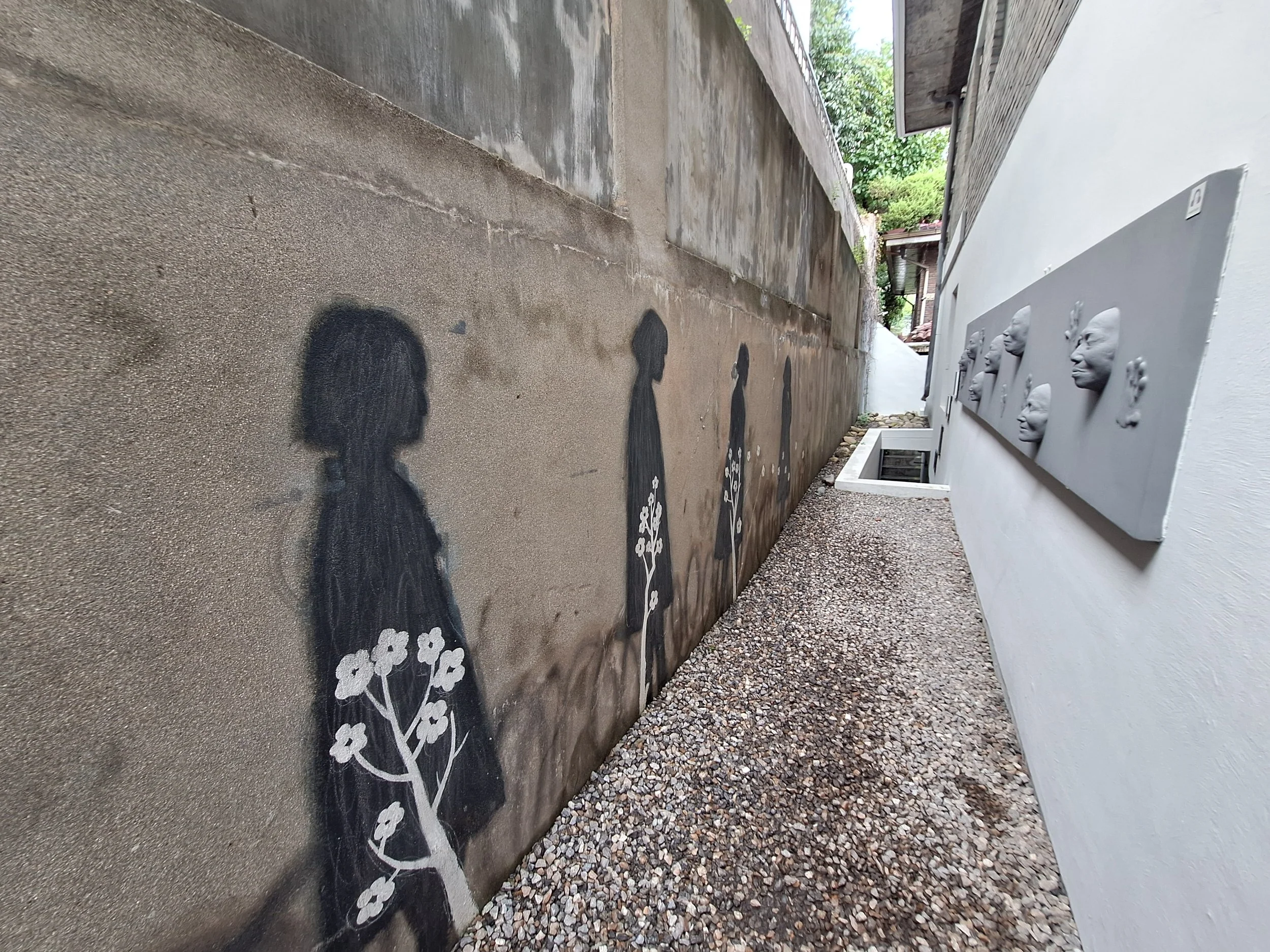
The exhibition begins with a narrow gravel walkway that leads downwards. The crunch of stones underfoot, accompanied by the sound of gunfire, and the closeness of the walls create a bodily sense of confinement, ushering visitors into the halmonis’ suffering. Drawings made by survivors hang along the walls, guiding me deeper into the dimly lit basement where videos of the halmonis’ testimonies are played. In this dark, cramped space, I encountered the halmonis’ voices, their isolation and endurance and the heavy weight of history.
The next section opens into a brighter room displaying historical documents that reveal the scale and systematic organisation of Japanese military sexual slavery. It also traces the halmonis’ decades of activism: their struggle to break the silence, to demand accountability from the Japanese state, and to build solidarity in transnational movements against military sexual violence with those in Afghanistan, Iraq, Congo and elsewhere.
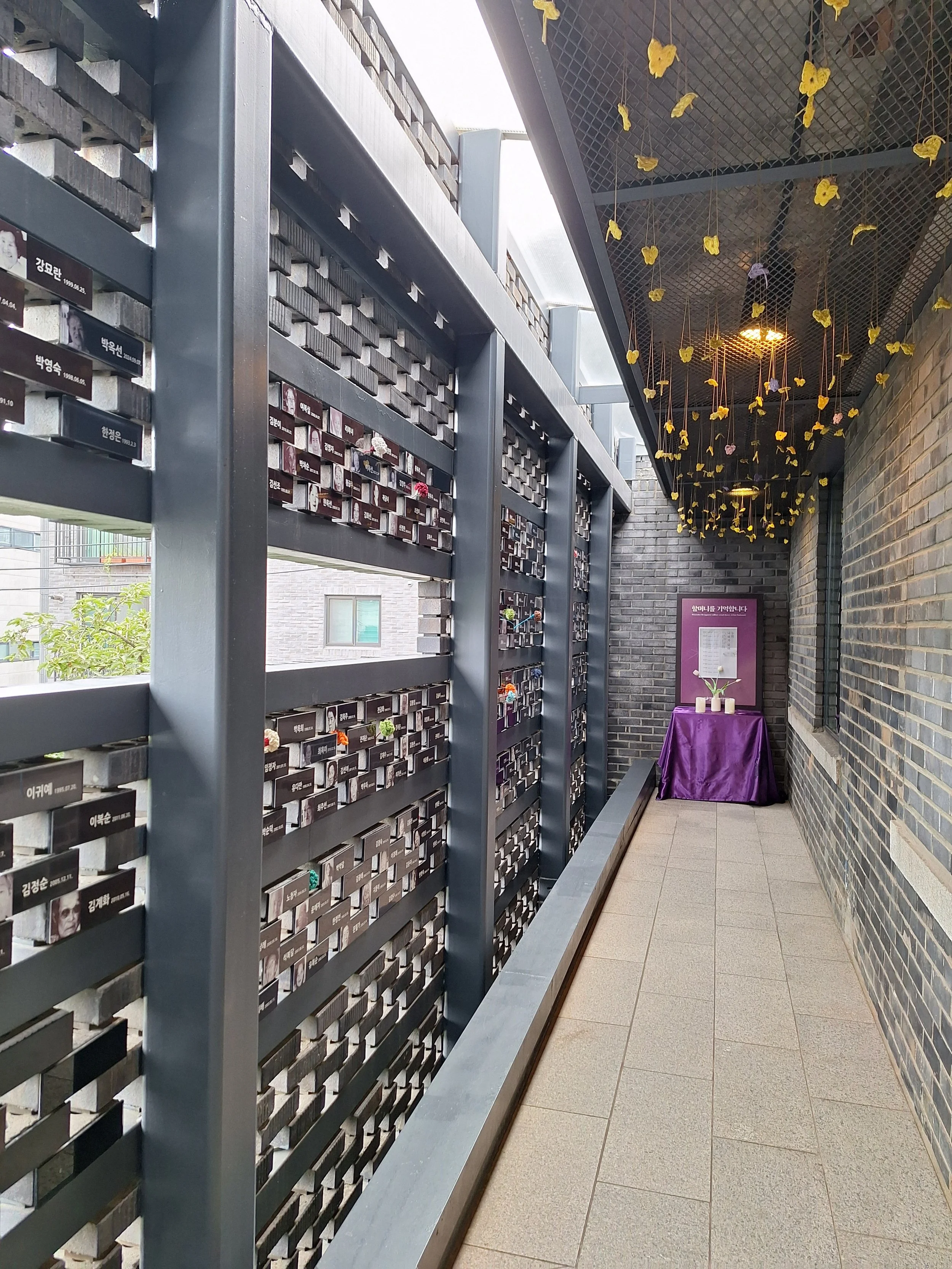
The Memorial Hall is the most saddening display. Names and dates of death on the bricks commemorate known victims. Victims whose names are unknown are also remembered, represented by black bricks. Hallam and Hockey (2001) argue that people manage relationships with the dead through materiality; memorials “deploy words in the service of a particular conception of memory and its relation to materiality” (171). Visitors do not encounter an abstract category of “comfort women”, but a tangible wall with names engraved that must be faced and walked along. Even for bricks without names, they give physical weight to the invisible deceased, bringing the “absent” present. According to the audio guide, despite its grief, the Memorial Hall is deliberately located at the brightest part of the museum, exposed to sunlight as a symbol of hope. As a site of ongoing relation, the hall makes the deceased halmonis visible and spatially orients the dead toward the living.
Hope also emerges from two special exhibitions, from the legacies of Kim Bok-Dong and the surprising solidarity between Korean halmonis and Vietnamese survivors of sexual violence committed by Korean soldiers during the Vietnam War. In the outdoor area below, the museum confronted a history rarely centred in South Korean public memory, featuring the testimonies of Vietnamese victims. Here, the familiar national narrative of Korea solely as a victim of colonial violence is unsettled. Koreans appear not only as those who were “wronged”, but also as those who “wronged” others.
The survivor-activist Kim Bok-dong said to Vietnamese survivors: “We are the same victims of Asian wars. The only difference is that they were harmed by the Korean military.” And another quote: “I am sorry, as a Korean citizen, that the Vietnamese suffered like us (halmonis) because of the Korean military. I will continue to support survivors of sexual violence around the world so that they may be consoled, even a little.”
The late Kim Bok-Dong’s lifetime dedication to peace, activism and women’s rights is inspiring, showing “victims” are not passive but resilient. For her, peace means a world where people “live comfortably without war”. She also extended her activism beyond South Korea’s national borders by establishing scholarships for ethnic Koreans in Japan, supporting Vietnamese survivors, and creating the Butterfly Fund to redirect Japanese government reparations to other survivors of wartime sexual violence worldwide.
The weekly Wednesday Demonstration in front of the Japanese Embassy in Seoul continues till today, demanding recognition and accountability. Activism seems like a long road; it is work, but it also works.
Before I left, I handed back the audio guide. The same reception woman asked gently, “Did you see everything well? Did you also visit the Vietnam section outside?” The exhibition’s heaviness lingered, but so did the warmth of the receptionist’s voice, Kim Bok-dong’s legacy and the hope cultivated by this space of memory and resilience.
As I left, I also left a butterfly note. These notes are a form of “memory writing”, a “hybrid” entanglement of “material objects” and “embodied practices” (Hallam & Jockey 2001: 177). The butterflies form a growing network of solidarity between halmonis, activists, other supporters, and those suffering abuses across the world. As each visitor leaves their note, they enter into a dialogical space that extends beyond the current time-space. The butterflies address both the living and the dead, and connect the past and future visitors.
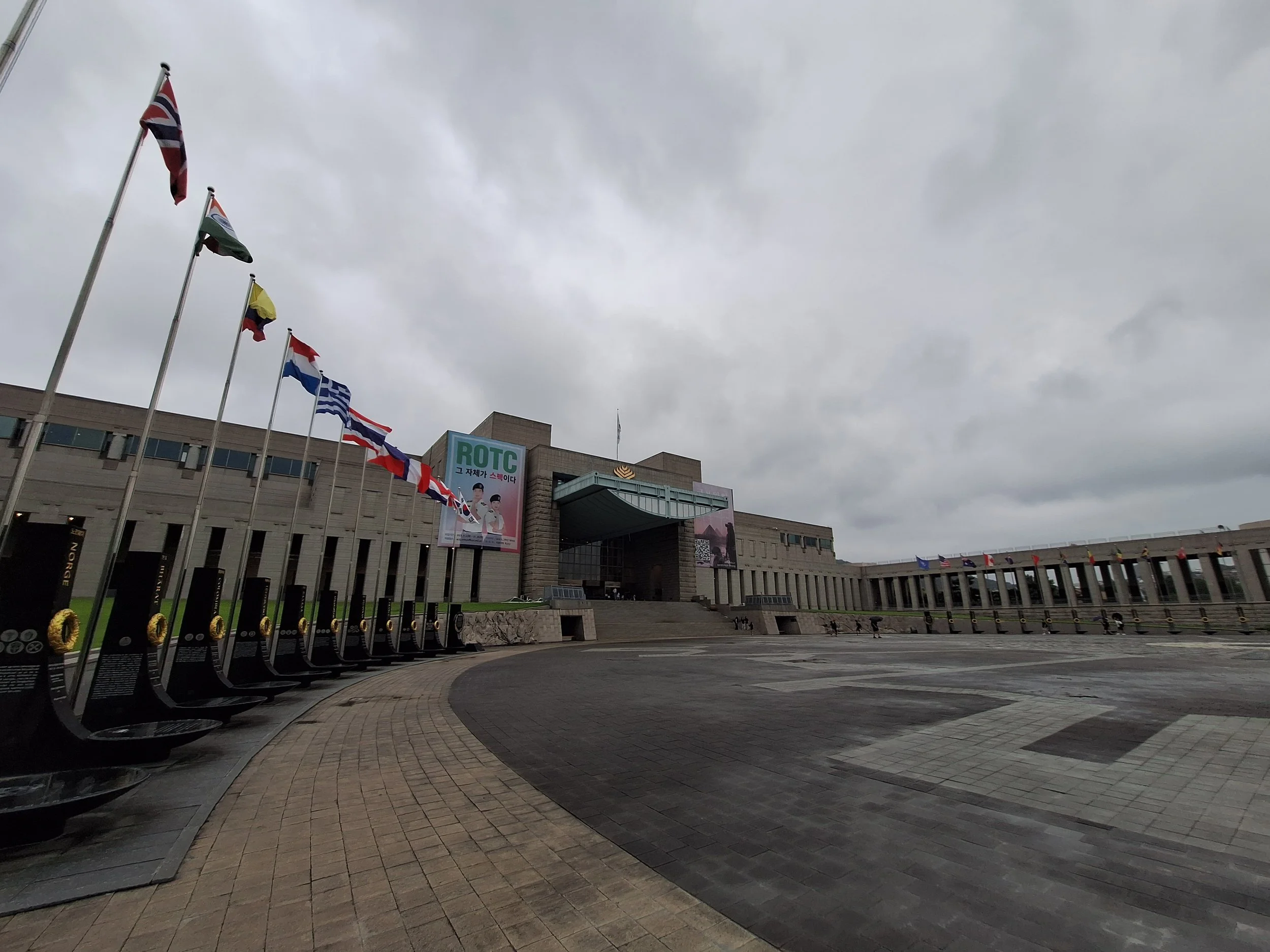
The War Memorial of Korea
A week later: the War Memorial of Korea
Again in the rain, I visited the War Memorial of Korea. I immediately felt the contrast between it and the War and Women’s Human Rights Museum. Where the feminist museum is only as big as a large house, this War Memorial has multiple indoor main halls and a large outdoor space with statues and flags. Its architecture is angular and grand.
Built to commemorate the Korean War and also in the hope of “peace”—but as in the “peaceful reunification of North and South Korea”—the War Memorial also serves as a pedagogical site for national military history. When I entered the museum, I encountered a group of young men in military uniform, who I believe were conscripts on a visit to learn about the military history and the Republic of Korea armed forces they were part of.
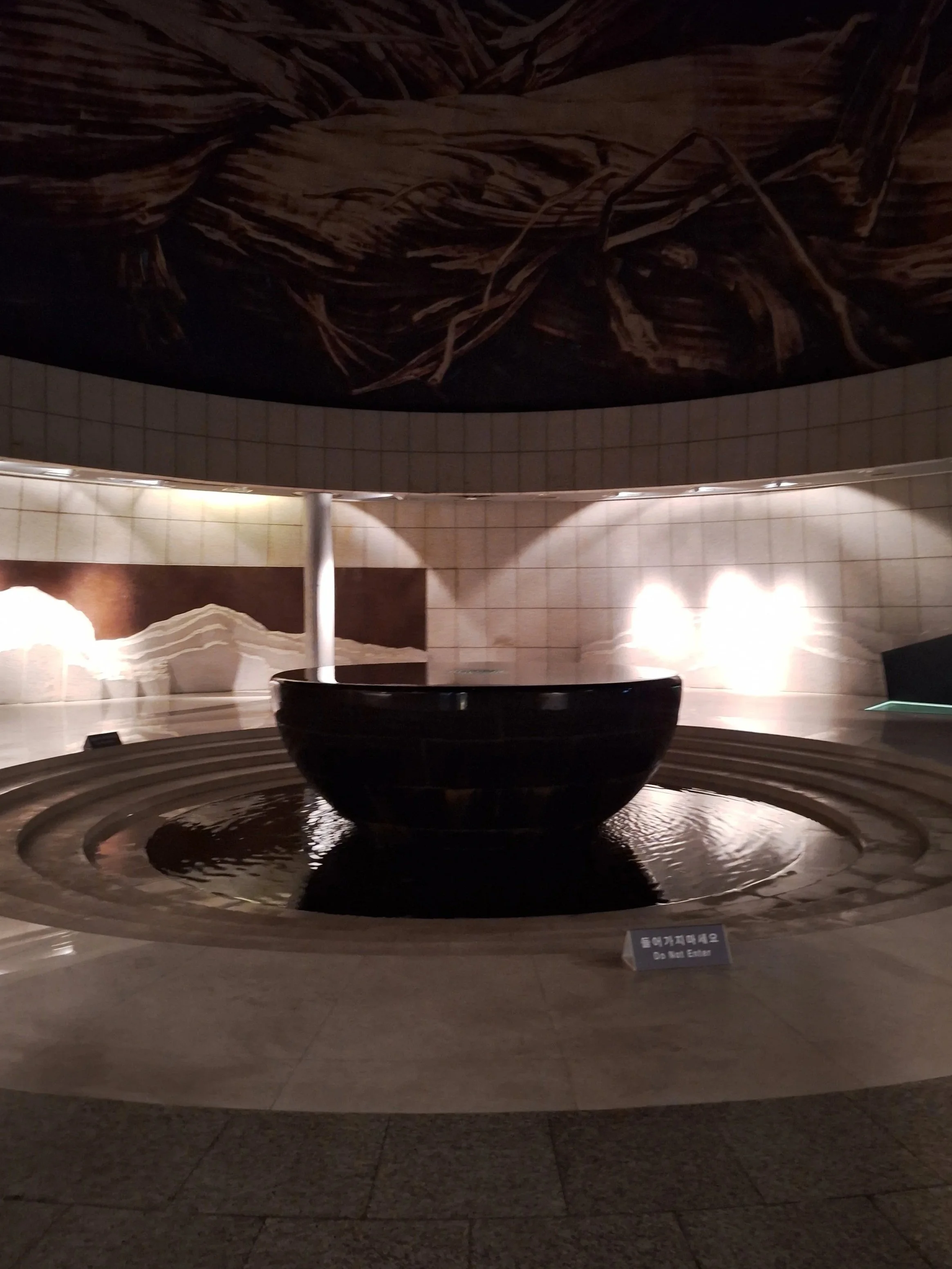
There is also a Memorial Hall. It honours soldiers and policemen killed in the Korean War and the Vietnam War. Like the Memorial Hall in the War and Women’s Human Rights, it was quiet. The installations and sculptures titled “the Spirit of the Nation”, “Traces of Patriotism”, and the “Creation” represent the Republic of Korea, the desire for one non-separated nation, and hope despite past destructions. The deaths are sacrifices made for national unity.
The exhibitions display weaponry and war histories from the Three States era (from the 1st century BCE) to the present. The Korean War is framed through international alliance and sacrifice, emphasised as the United Nations’ first large-scale peacekeeping coalition, supported by 63 countries. Here, “peace” is defined through national security and collective military effort.
I specifically remember a gallery titled “From a Recipient Country to a Donor Nation.” It presents South Korean history as linear progress: from need to self-sufficiency, from being “helped” to becoming a “helper”. In its narration, with support from 63 countries, the Republic of Korea has risen from a war-torn aid recipient to a G20 economy and contributor to UN peacekeeping missions in places like South Sudan and Lebanon. I thought: isn’t this the teleology of modernity that anthropology so often critiques?
South Korea casts its past as “less developed,” only to reposition itself as a “modern” nation now able to assist the “Third World.” As anthropologists such as Wolf (1982) and Escobar (1995) critiqued, Eurocentric developmental narratives reproduce a single historical trajectory of progress that naturalises global hierarchies. Reinscribing this logic, South Korea adopts the very framework that once positioned it as lacking to advance itself geopolitically. As Cho Han (2000:59) notes, in South Korea, “after the 1970s, the discourse of nationalism was directly connected with economy-first policies that sought the development of a powerful nation.” Within this discourse, becoming a “donor” signals entry into modernity and geopolitical power. “Help” appears neutral and benevolent, while obscuring unequal power relations; “peace” emerges as the outcome of linear progress and geopolitical stability.
The Vietnam War is featured in the exhibition “Expeditionary Forces Room”, but only as a chapter highlighting the Republic of Korea's contributions to medical care and reconstruction. As expected, the dark history of sexual violence committed by Korean soldiers against the Vietnamese is absent. This museum, after all, is a patriotic space dedicated to honouring those who devoted their lives to the nation in wars from the past to the present, not a place for self-criticism. National guilt is not contained, tolerated or relieved by the space, but simply an elephant in the room, or perhaps the elephant is not even here.
Two narrations, different “sacrifices”
National museums reflect a form of politics that might be called sacrificial nationalism. The nation is imagined as something that must be sustained through the offering of lives. At the War Memorial of Korea, soldiers’ deaths are framed as meaningful sacrifices made for national survival, unity, and progress. Loss is not presented as tragic alone, but as necessary and honourable. Peace, here, is not the absence of violence but is achieved through disciplined bodies, military alliances, and a heroic willingness to die for the nation. The state presents military interventions, UN peacekeeping missions, and development aid as national generosity while obscuring whose labour, lives, and sufferings make these “sacrifices” and national glory possible.
The War and Women’s Human Rights Museum exposes the exclusions built into this sacrificial nationalism. The halmonis’ suffering does not fit the heroic narrative of chosen sacrifice. Their bodies were not offered to protect the nation, but taken through imperial and militarised violence that rendered women’s lives expendable. This suffering is difficult to assimilate into nationalist memory because it disrupts the image of sacrifice as noble. By centring halmonis’ testimonies, sufferings and activism rather than heroic death, the museum does not convert gendered violence into a redemptive national story. Instead, it speaks of halmonis’ “sacrifices”—including victims who “sacrifice” their lives traumatically and survivors who “sacrifice” their time and effort in activism—as a political call to confront ongoing abuses of women’s human rights worldwide.
Offering a feminist critique, Cho Han (2000:57) argues that South Korea’s “compressed” economic growth produced “grand statepower and patriarchal families, but no citizens or autonomous individuals,” even as such “national persons” enabled the rapid growth. The halmonis sit uneasily within the nationalist discourse. Their activism can be absorbed into nationalism when it aligns with the discourse of anti-Japanese imperialism and helps cast South Korea, with its Butterfly Fund, as a global “helper” of other “Third World” women in need of “saving”. Yet, halmonis did more, especially with the inclusion of Vietnamese victims of Korean soldiers’ sexual violence, shattering the patriarchal nationalist discourse.
Two narrations, but both speak of “peace”
Both museums narrate the past of wars and imagine a future of peace. One centres on bodily abuses, trauma and sexual violence. The multisensory curation helps museum visitors step into the halmonis’ shoes (which is not to say the halmonis’ experience is translatable or anyone can simply “understand” or “feel” the same merely via an exhibition). Peace and hope emerge from feminist resistance and activism. The other centres on the nation, weaponry and military alliances, embedding peace within militarised security, state sovereignty and geopolitics.
Both speak of transnational solidarity; one through shared struggles against sexual violence, the other through multinational military cooperation. Both claim hope. Both speak the language of “peace”. Yet whose peace, and at what cost?
Can history be told without fixing permanent categories of victims and perpetrators? Solidarity is a step towards “peace”, but to avoid new exclusions, we have to be aware of who we are building solidarity with and not with. Perhaps peace is not a singular horizon but a contested moral project, shaping whose suffering counts and whose is rendered invisible.
It’s a long road to freedom and peace. And I have no answers. But I think to speak of peace, we must first ask: peace for whom, and narrated by whom? In museums and other educational spaces, this begins with listening differently, critically and attentively to silenced voices.
It’s raining, and it’ll rain again, but there is sunshine. The question is whether we can learn to see it through the shadows of rainclouds.
Bibliography
Cho Han, H.-J. 2000. ‘You are entrapped in an imaginary well’: the formation of subjectivity within compressed development - a feminist critique of modernity and Korean culture. Inter-Asia Cultural Studies 1, 49–69.
Escobar, A. 1995. Encountering development: the making and unmaking of the Third World. Princeton, N.J.: Princeton University Press.
Hallam, E. & J. Hockey 2001. Death, memory and material culture. Oxford: Berg.
Korea War-memorial Organization 2023. The War Memorial of Korea (available on-line: https://www.warmemo.or.kr:8443/Eng/index, accessed 8 February 2026).
The War and Women’s Human Rights Museum 2024. The War and Women’s Human Rights Museum (available on-line: https://womenandwarmuseum.net/233, accessed 8 February 2026).
Wolf, E. 1982. Europe and the people without history. Berkeley, Calif.: University of California Press.

Whose Youth Pastor Has a Side Gig at Netflix?
The Stanford Prison Experiment, the Milgram Experiment, and Netflix reality TV. All equally crazed ventures that test the limits of the human psyche. From Love Is Blind to The Ultimatum, it would appear that there is a bored psychologist on the Netflix team who cares little for an ethical code. But I posit that this is not a dubious psychologist. This is a rogue youth pastor who seems intent on titillating the audience into chastity.
The Hays Code once barred directors from showing married couples sleeping in the same bed for fear that the very insinuation of sex would be too racy. On Temptation Island, a woman watches her fiancé have a threesome with two other women.
What do the depictions of love and lust on our television say about the dating world?
By S. J. Gul
“I would like a diamond ring on my wedding finger
I would like a big, shiny diamond
That I could wave around and talk and talk about it”
Every couple of months, it feels like Netflix drops a new bizarre dating show created by people who have never had sex, have simultaneously somehow been through five of the messiest divorces known to mankind, and yet possess a view of love solely informed by Disney movies. I feel like I’m being held hostage by a youth pastor who skimmed Deleuze in a coffee shop and went wild with it.
These shows tend to follow the same format: Contestants genuinely think they’re about to be on a raunchy dating show, only to be blindsided by a Foucauldian nightmare cone from “Factory, China”, silently surveilling the contestants throughout the villa as they are forced into a celibacy retreat. Maybe I just wanted to describe Too Hot to Handle, but the vast majority of these shows involve (a) the tiniest swimwear I’ve ever seen, (b) copious amounts of alcohol, and (c) explicit moral instruction as to what constitutes a good relationship (read: culminating in marriage, 2.5 children, and a designer pug).
And we love it! With several international spin-offs, we’ve encountered moments that have been seared into our skulls. From a contestant not knowing what language her own tattoo is in, fondly reminiscing about how a frat party where a girl broke her neck from falling off a roof, to not knowing where Australia is (this is all the same contestant, and only in the first episode at that - Haley, the woman you are).
In the age of situationships, dating app fatigue, and young people turning to matchmakers out of sheer exhaustion, the fantasy becomes obvious. Get out the stocks and your rotten produce! Let us punish the hot people for having meaningless drunk encounters with each other! Why can’t they want committed relationships with people like you?
The guy with the mullet may never want you back, and you can't punish him for letting you abandon your dignity by triple-texting him after 3 vodka crans - but the hot people on your TV can be forced to sit down together, finger-paint, and talk in circles about self-actualisation.
Some may argue that this is situated in a uniquely Western dilemma (particularly some incel with a Greek statue in their profile picture arguing that this is the outcome of Weimar Republic-level decadence and it’s all the fault of women having access to birth control). That reading falls apart the second you look at how so many versions of Love Is Blind exist, and my Arab father has provided me with his personal commentary on Love Is Blind, Habibi.
Sidenote: There is something painfully funny about the show presenting its concept as novel in a Middle Eastern context when so many Arab grandmothers also did not see how their husbands looked until the day they were married - and they didn't need a Netflix production team to do it.
The abject failure of shows like Indian Matchmaking and Jewish Matchmaking to actually make matches only illustrates this more clearly. Only one couple from the multiple seasons of Indian Matchmaking actually got married, with little contribution from the glorious Auntie Sima, and they divorced within a year amid reports of domestic violence (ET Online, 2023).
These shows lean into inflammatory narratives, inviting viewers to turn to their friends and say, “Why are women like that?” or “Ugh, men.” You get the unlikeable over-successful career women who are framed as too picky. You get men demanding supermodel wives while their hairlines sprint away from them at the speed of Sha’Carri Richardson.
I don’t mean to be overly frivolous here because there’s an interesting underlying tension between clashing ideals of compatibility. Some people treat a match as someone who mirrors them, someone with an impressive career wanting a peer who understands ambition. Others treat a match as someone who fills in the spots they leave blank. There isn’t really an explicit acknowledgement of this rather gendered expectation (women tend to want peerdom, men tend to want someone more complementary) - well, no acknowledgement beyond Sima Auntie telling every man, woman, and dog to lower their expectations and Aleeza of Jewish Matchmaking likewise instructing the singles to “date ‘em till you hate ‘em!”
In an era where so many people feel disillusioned about relationships, these shows give viewers the hope that there is something out there that transcends the often shallow interactions people have on dating apps. Someone could be surrounded by hot Instagram models and still be faithful to you. That they could fall in love before first sight.
And it also results in the sweet schadenfreude for cynics in seeing these comedically shallow relationships crumble and collapse. It provides a voyeuristic perspective of relationships that allows us to minimise our own worries by comparing them to someone else's. Your girlfriend may still be hung up on her ex-humiliationship, but at least she’s not having a threesome on Netflix after announcing her loyalty to you. It’s so bad out there, doesn't your mediocre partner, who never gets you flowers, look so much better in comparison?
While it is an open secret that repeat offenders like Harry Jowsey, who seem to be a permanent fixture on set, might not be falling in love like a Disney princess, this does not mean their emotions are fake. These shows project romance as a series of replicable steps and keywords shaped by the show’s incentives rather than as a private relationship. These shows reward accelerated intimacy and an unrealistic amount of emotional literacy. Imagine if you had to explain every move you made around your crush to a production crew for the cutaway to your confessional. Yet the feelings themselves can still be real. Under conditions of isolation, alcohol, and being deprived of distractions (on most sets, cast members don’t have access to their phones, books, or any other reprieve from what’s going on), emotions are heightened, making it possible to experience genuine vulnerability within an exaggerated romantic form. It may be disproportionate and slightly ridiculous, but it doesn’t mean it’s not real. In fact, acting slightly ridiculously is a well-known sign of being authentically in love.
While we may have never seen someone get stood up at the altar like in Love is Blind, we’ve all seen our friend (or been the friend!) whose boyfriend clearly doesn’t like them as much as they want him to.
In Chanté Joseph’s article, “Is Having a Boyfriend Embarassing?”, it argues that there's been an increasing cultural shift wherein women conceal the identities of their boyfriends (Joseph, 2025). A tacit acknowledgement that “boyfriend-land” is where individuality goes to die as you merge your identity with another person.
However, she highlights that while women may be concealing the identity of their boyfriends, they still post some form of soft launch - faces hiding between flowers or a strategic phone placement in a mirror selfie.
The cultural fixation can be summarised like so - people want to centre existing in a relationship but not necessarily their partners - the clout of having a socially approved relationship with the partner themselves being replaceable. Being in a relationship has benefits, but your partner is human and therefore has the capacity to be a liability that could embarrass you. In the words of renowned social theorist (Carpenter, Sabrina), "heartbreak is one thing, my ego's another".
When (not if) he does something humiliating, you can claim you were never that serious anyway. These Netflix shows have gamified this paranoia; every episode of Temptation Island is structured around "wait until you see what they did when you weren't watching." There's nothing more mortifying than having to archive old posts, scrubbing evidence of an ex. Your parents could just stop seeing each other; you must perform a digital murder of your own relationship while 400 people watch. Even so, you can never kill it completely - someone will screenshot your soft launch, and it's floating in a group chat you'll never see. Someone will ask about your ex at a party, and you’ll mentally draft a PR statement.
At first, I thought this was a result of a particularly curated social bubble. I wouldn’t be surprised by my friends’ conscious efforts to decenter romantic love. I am, however, an anthropology student with dyed hair, combat boots, and a tendency to wear pomegranate jewellery. My social circle is not representative of the cultural zeitgeist.
I think on the right, this situation is flipped in a mirror image. It's trad wife, not trad situationship! Forget meet-cutes in bookstores, and that ambiguous phase between friendship and romance that is both nostalgic and infuriating - Find Someone, Get Married, and Have A Socially Approved Relationship - in that order.
In both cases, it's decentering your individual partner from being a soulmate to being a placeholder romantic object. Both treat the actual human as interchangeable - what matters is the relationship as proof of concept.
This fixation makes sense in a world where stable jobs, affordable housing, and long-term security feel increasingly fictional. When material fairness collapses, romance becomes one of the last arenas where people still expect meritocracy. The bank may never approve of your loan to buy a too-small flat, but you don’t need a good credit score for your parents to approve of your future spouse.
No one owes you a living, but surely you are owed love! Specifically, a love made legible and “proven” through a piece of paper.
But even then, there’s been increasing cynicism.
While Netflix shows conveniently stop at the altar - with a total of 14 couples saying "I do" across the U.S. seasons of Love is Blind, and eight of those couples remain together as of late 2025, and an announced engagement on Perfect Match (which conveniently disintegrated after the premiere of the show).
I’ve recently been watching Couples Therapy on Showtime and in every comment section, you have at least one person praising the Gods that be, that they are single and not in a relationship like that. While the relationships pictured are ridiculously fraught, there’s something more authentic to them than the regular Netflix fare. The show regularly features middle-aged couples struggling to cope with finances, infidelity and trauma. It’s not as sexy; It’s still spectacle - with their beige background and therapist with a face that has subtitles. But there’s a glimpse of hope there; couples grappling with the roots of their issues stemming from childhood. It’s painfully earnest and sincere and therefore cringeworthy.
There’s a queer polyamorous couple engaging in a “conscious decoupling” that asks if they can send pictures of their cat when they are meant to not contact each other for two weeks.
There’s a couple who struggle with intimacy in an interreligious relationship because of an in-law repeatedly evoking demonic imagery to describe their relationship.
Of course, we don't want those relationships. We want a nice engagement and then a fade-to-black where everyone presumes we're living forever in the last five minutes of a rom-com.
I’m not saying that reality TV shows can exist as the frontier for showing us what dating should look like. But in a world where dating seems more fraught than ever for Gen Z, it’s interesting how the same shows provide different narratives: whether that’s inculcating puritanical abstinence until marriage, echoing the same message as most immigrant parents after you turn 25, “Don’t get a boyfriend, get a husband!” or encouraging a total divestment from relationships, accepting a certain heterofatalist mediocrity, maybe marriage has always sucked.
Maybe the real show isn’t on Netflix at all. It’s in the way we perform love for each other, for strangers, for algorithms, and for ourselves. We swipe, soft-launch and situationship our way into romantic risk aversion. We want a version of love where we can guarantee that the person you love will not hurt you because you will see the red flags a mile away. But a love that can be fully optimised is not intimacy. It is risk management. And until you find a consulting firm willing to take that on – and I give it 5 years till an LSE grad proposes just that – this does not make for marriage material.
But whatever it is, this isn’t your sign to redownload Hinge.
References
ET Online. (2023, August 23). Indian Matchmaking star Pradhyuman Maloo faces domestic violence allegations. The Economic Times; Economic Times. https://economictimes.indiatimes.com/news/new-updates/indian-matchmaking-star-pradhyuman-maloo-faces-domestic-violence-allegations/articleshow/102994179.cms?from=mdr
Joseph, C. (2025, October 29). Is Having a Boyfriend Embarrassing Now? Vogue. https://www.vogue.com/article/is-having-a-boyfriend-embarrassing-now
Doing One’s Part: An Anthropological Interrogation of Effective Altruism and Why We Help
Why do we help? It’s a question that has followed me from soup kitchens and homeless shelters to house-building sites. Here, I reflect on the uneasy space between care that feels meaningful and care that feels insufficient. Alongside this ethnographic texture, the essay turns to anthropology to sit with (and interrogate) the logic of Effective Altruism, a movement that urges us to measure, compare, and optimise our moral efforts. Without dismissing its importance, I ask what gets lost when value is reduced to what can be counted, and what remains when help is understood instead as presence, obligation, and the ordinary work of “doing one’s part” in a world that may never be fully repaired.
By Nadia Pritta Wibisono
There was cinnamon in the stew.
There was cinnamon in the air, too; dust suspended after it had been freshly ground from whole sticks, not the stale powdered kind kept in the back of the spice rack. The kitchen ran with a busy hum: people chopping vegetables with varying levels of confidence, someone wiping down a counter that would immediately be dirtied again, and I was dicing my second crate of pears for this evening’s crumble, observing it all while making small talk with a fellow dicer. The kitchen leader had his arms crossed as he looked at the whiteboard detailing today’s menu, which best utilised the donated ingredients in the kitchen.
The cinnamon felt almost excessive. It caught me off guard. Later, the volunteer in charge of the stew told me it was part of her family’s recipe. A small detail, offered without ceremony, folded into a meal that would be served to people who had nowhere else to be that evening.
London has more than 150 organisations working on homelessness. That number alone should tell you something. Not just about the scale of the problem, but about its stubbornness. The issue of homelessness is a dense, tangled knot of housing shortages, mental health crises, migration policy, labour precarity, addiction, austerity, and bureaucratic exhaustion. In policy circles, it’s often called a “wicked problem”—a term that manages to sound both technical and defeated.
Moving to London meant confronting the issue and visibility of homelessness every day. I started volunteering with a few organisations: soup kitchens, temporary shelters, and meal services. Sometimes it feels good in the way that helping often does, but sometimes it feels bleak. When I go home, feeling both satisfied and exhausted, the questions come:
Am I doing this because it helps, or because it helps me feel better about myself? Am I putting a band-aid on a gaping wound that requires surgery? Would my time be better spent elsewhere? Should I be doing something more aligned with my skills, or with causes that are said to have greater impact (and what does that even mean)?
I’ve been circling these questions for most of my life. When I was fifteen, I started my school’s first volunteer house-building project. After fundraising enough money for two houses, a handful of high school students spent a day under the blistering tropical heat at a construction site. We learnt to bend wires, mix and pour cement to build the foundation, which took hours and left a permanent scar still visible on my left arm. I remember watching the professional construction workers who taught us, finishing in hours what we struggled to approximate in a day. At the time, the logic seemed obvious to me: why would a group of teenagers do work that could be done faster, better, and definitely safer by trained construction workers instead? Wouldn’t it be more efficient for us to focus on fundraising and let the professionals do the job?
Years later, I learnt that this approach had a name: Effective Altruism. It has a simple premise: given limited resources, how can we do the most good? Effective Altruism draws on a utilitarian moral philosophy that leans heavily on evidence, measurement, and comparison. The appeal is obvious. Why wouldn’t we want to help out as many people as possible and make our efforts worthwhile? Effective Altruism resists vague goodness. It demands ROI-optimised rigour (Return of Investment), encourages impartiality, and urges us to care about suffering wherever it occurs, not just where it’s most visible or emotionally salient. It advocates for what they call “long-termism”, pushing us to zoom out of our human lifetimes and consider the generations yet to come.
Some of the causes championed by Effective Altruists are undeniably important. People inspired by Effective Altruism have referenced GiveWell’s research, for example, and donated to its recommended charities, such as the Against Malaria Foundation, which has distributed over 200 million insecticide-treated bednets. They reported that collectively, their efforts have “saved 159,000 lives”. Other priority causes they’ve calculated as important include AI safety, animal welfare, and pandemic prevention; causes we can all agree are important.
What about homelessness then?
If reducing suffering is the goal, then surely homelessness should be a priority. Living on the streets shortens lives. It damages health, dignity, and social belonging. It’s visible, immediate, and deeply human. And yet, within Effective Altruist frameworks, homelessness is not explicitly called a priority. The reasoning is usually framed in terms of cost-effectiveness. Homelessness is a complex, hard-to-evaluate social issue, and the same money spent elsewhere could do far more good. It’s altruism arbitrage: your £5 would go further in Lagos or La Paz than in London. So is working on homelessness, by Effective Altruist standards, ineffective?
___
I turn to anthropology to interrogate some of the principles of Effective Altruism.
I was drawn to Effective Altruism’s rigour to soothe myself from the frustration of seeing all the feel-good activism that treated beneficiaries as photo props. “Numbers don’t lie,” we always hear. The aura of neutral certainty appealed to me, but Sally Engle Merry (2011) argues that indicators conceal who gets to define them, use them, and for what purposes: “The deployment of statistical measures tends to replace political debate with technical expertise.” The numbers have names, and the numbers have faces.
Effective Altruism’s long-termism often carries an implicit faith in our ability to model the future: that with enough data, foresight, and analytical clarity, we can identify the right levers and pull them in time. In today’s short-termist world, thinking about the seven generations to come feels radical. In The Good Ancestor, Roman Krznaric shares the same long-termist belief, but introduces the notion of “deep-time humility”. Perhaps, by placing human history against the vast scale of deep time, it reminds us how provisional our knowledge really is, and how easily urgency can harden into certainty. Caring for the long-term is not only a question of choosing the right interventions, but of tempering confidence with restraint and avoiding “solutionism” as a default posture.
We are talking about value: what counts, and who gets to count it. David Graeber (2002) asked. He wrote about the “false coin” where market principles (rational, self-interested calculation) and their supposed opposites (family values, altruism, devotion) are presented as distinct but are, in fact, two sides of the same flawed system. Maybe I find Effective Altruism fascinating because, far from opposite sides of a coin, it welds market principles and altruism into one: a laminated moral economy rather than a coherent alloy.
Effective Altruism tends to treat value as something that can be abstracted from context, compared across causes, and optimised. Anthropology is more suspicious of such abstraction. Value, according to Graeber, “is the way actions become meaningful to the actors by being placed in some larger social whole, real or imagined’’. True value is deeply embedded in the social process itself, in the ongoing creation of human society, meaning, and relationships, rather than in detached, objectified, or individualistic notions perpetuated by dominant ideologies.
___
So then, why do we help?
The people I’ve met while volunteering aren’t naïve. They are clear-eyed about the limits of what they’re doing. Unlike Crisis UK’s “together we will end homelessness” slogan, none of the volunteers genuinely believes that they are going to end homelessness. Many of them regularly question whether their efforts matter, yet they do it anyway. Why?
A recurring conversation among volunteers is the paralysing moral overload of figuring out what to do when coming across a homeless person in the street. Sometimes buying a meal deal for someone sitting out in the cold or picking up a volunteering shift could be enough to make them feel like they have done their part, without fully addressing the issue.
“Survivor’s guilt” is a common phrase I hear. They say that life feels like the luck of the draw, that they were born lucky to be in a family that could afford school and housing, or lived in a city with a network of support.
“If I suddenly lose my job, I could just move back in with my parents. Relatives or even friends could give me some sort of support, but they don’t have anyone. The people back home, far, far away, are relying on them,” one volunteer shared.
Being born lucky also means they are mere inches from the chance of homelessness. “It’s like there is an invisible barrier separating the two worlds: the housed and the homeless,” someone brought up as we were chopping vegetables. The guilt is insurmountable: helping, penetrating that barrier, even when it never feels like enough, feels better than remaining paralysed by it.
___
Volunteering is also an act of reweaving the frayed social fabric of the city. In my conversation with a retired man who has volunteered at the shelter for eight years in a row, what initially seemed like a tangent gradually revealed something deeper.
“Developed places like London have become more affluent. The poor come up, ‘make it’, and forget about their past. Like my 86-year-old cousin Dot [who lives far away from the city], who has sons that don’t come back and help.” His voice slowed as he recalled these moments.
“I guess I was the same, too. When I was young, my aunty kept calling. I just left it to ring. What does that say about me? I regret not helping my aunty. She passed now…” He paused and looked into the distance.
“Maybe that’s why I volunteer.” Volunteering, for him, appeared to be a form of repentance, a way of being there for others now, in the face of earlier absences after moving to the city.
___
During meal service, we ladle stews into their bowls, give extra servings, and ask if they would like cream with their crumble. When it was time for us to close, I heard a group of patrons who seemed to have just met for the first time gather and call the volunteer leader to joke about giving “compliments to the chef” like they were in a fine dining establishment.
I asked why she continued to volunteer. She stated simply, “My country’s migration policies and border control have impacted the people we see today, and the people we probably would never see. Doing this is my duty as a British citizen to make up for it. I’m just doing my part.”
She then loaded the van with empty gastros to return to the kitchen, not to rest, but to prepare for the next day.
___
These motivations look messy from an optimisation standpoint. They are inconsistent. They are emotional. They are deeply personal. And yet, they are not trivial. They reflect an understanding of ethics not as a problem to be solved once and for all, but as something lived, negotiated, and revisited over time.
Anthropologists like Veena Das and Michael Lambek (2010) sometimes refer to this as ordinary ethics: the ways people make moral judgements in the course of everyday life, without grand theories or guarantees. Ordinary ethics doesn’t promise maximum impact. It doesn’t pretend to be pure. It operates in conditions of uncertainty and constraint. It accepts that moral life often involves doing what one can, rather than what would be ideal.
This doesn’t mean abandoning effectiveness. It means recognising that not all forms of value are legible at scale. Care, especially relational care, does not always aggregate neatly. Its effects are diffuse. They show up in moments of recognition, in the maintenance of dignity, in the quiet refusal to let someone be reduced to a problem to be managed.
There is a tendency, in debates about helping, to frame things as either/or. Either you care about effectiveness, or you indulge in feel-good gestures. Either you think globally, or you’re trapped in parochial concern. But these binaries flatten moral life. They obscure the fact that different value systems can coexist, sometimes uneasily, without one invalidating the other.
Effective Altruism has pushed important conversations forward. It has forced many of us to confront the limits of intuition and the dangers of sentimentalism. But anthropology reminds us that value is not only about outcomes. It is also about relationships. About presence. About the quiet insistence that care still belongs here—sometimes no more elaborate than cinnamon in a pot of stew.
References
Crisis. (2019). Ending homelessness: Together we will end homelessness. Crisis. https://www.crisis.org.uk/ending-homelessness/
Das, V. (2012). Ordinary Ethics. A Companion to Moral Anthropology, 133–149. https://doi.org/10.1002/9781118290620.ch8
Effective Altruism. (2022). Introduction to Effective Altruism | Effective Altruism. Effective Altruism. https://www.effectivealtruism.org/articles/introduction-to-effective-altruism
Graeber, D. (2001). Toward An Anthropological Theory of Value. Palgrave Macmillan US. https://doi.org/10.1057/9780312299064
Homeless Link. (2023). 2023 London Atlas of Homelessness Services Launched. Homeless Link. https://homeless.org.uk/news/2023-london-atlas-of-homelessness-services-launched/
Krznaric, R. (2020). The Good Ancestor: How to Think Long Term in a Short-Term World. Wh Allen, Penguin Random House.
Lambek, M. (2010). Ordinary Ethics: Anthropology, Language, and Action. Fordham University Press; JSTOR. https://doi.org/10.2307/j.ctt13x07p9
Merry, S. E. (2011). Measuring the World: Indicators, Human Rights, and Global Governance. Current Anthropology, 52(S3), S83–S95. https://doi.org/10.1086/657241
The Palestinian “Disaster” Image
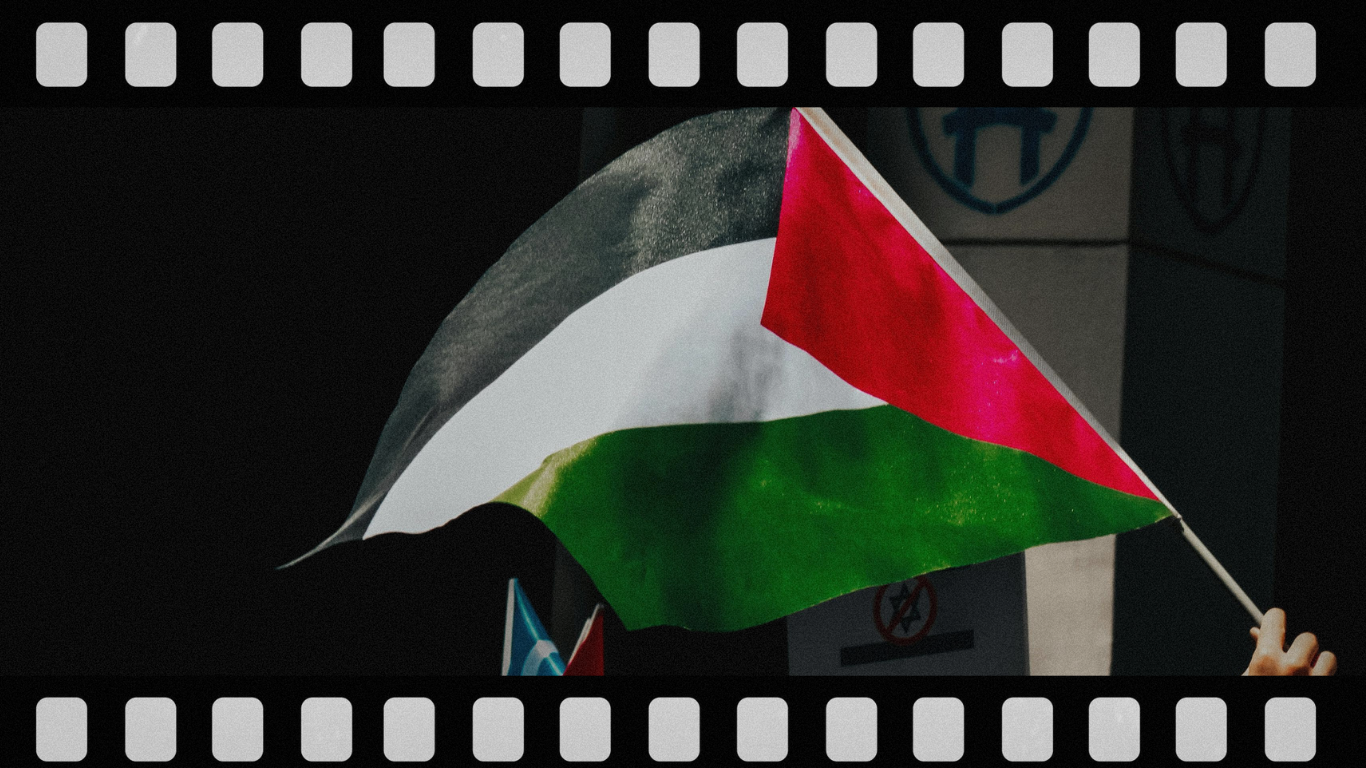
Palestinian photographers who document suffering under occupation face an ethical paradox that collapses the distance between photographer and subject. Through the case of photojournalist Ashraf Amra's refusal to photograph the 2015 Dawabsheh family funeral, the analysis argues that the ethics of imaging suffering under occupation is about navigating an impossible position where both visibility and invisibility serve structures of colonial violence. The work demonstrates how digital proliferation produces "accountability theater," reframing the ethics of disaster photography from questions of representation to questions of reception.
By Leen Jumah
When the photograph of four-year-old Ali Dawabsheh's charred bedroom went viral in 2015, Palestinian photojournalist Ashraf Amra faced an impossible choice: document the scene where an entire family burned alive in a fatal settler attack, or protect the dignity of the dead. He took the photograph. Three days later, his editor asked him to return and photograph the funeral. This time, he refused.
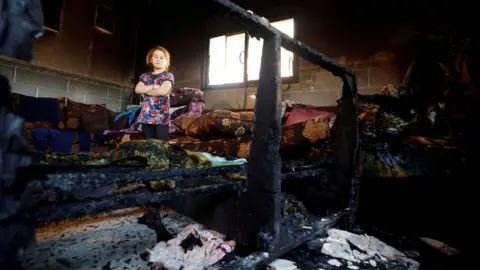
Amra Ashraf (2015)
Palestinian photographers have become the world's most prolific documentarians of their own suffering – and the most conflicted about it. In Gaza alone, over 200 journalists hold press cards. American critic Susan Sontag argued that photographs of disaster risk immunizing viewers through overexposure, transforming atrocity into an aesthetic object. But what happens when the photographers and the photographed are the same people? When the camera is not a colonial instrument wielded by outsiders, but a tool of Palestinian self-representation under occupation?
During the ever-digital age, it's difficult to understand where to draw the line, especially when all aspects of the genocide are being shared online, from Gaza daily routine videos to "what I eat in a day war edition." Is it Palestinian photographers' responsibility to photograph images of wailing mothers and share them? Is it really holding anyone accountable if there are tens of thousands of the same familiar cries of mothers and fathers at their children's graves? Does visibility equal accountability when the images are endless? Palestinian photographers reveal what Sontag could not fully articulate: the ethics of imaging suffering under occupation is not about choosing between dignity and documentation, but about navigating an impossible position where both visibility and invisibility serve structures of colonial violence.
Sontag's "Regarding the Pain of Others" (2003) warns that photographic documentation of atrocity produces a peculiar kind of spectatorship, one that simultaneously acknowledges suffering and maintains a comfortable distance from it. She describes how images of distant wars become consumable, how repeated exposure breeds a dangerous familiarity that mistakes recognition for understanding. The photograph becomes what she calls "a means of making 'real' matters that the privileged and the merely safe might prefer to ignore." Yet Sontag's analysis assumes a fundamental separation between the photographer and the subject, between those who document and those who suffer. Palestinian image-making collapses this distance entirely.
American Anthropologist Lila Abu-Lughod (2025) extends this critique by examining how cultural representation under conditions of domination creates the "pornography of pain", images that simultaneously expose suffering and reproduce the power dynamics that enable it. When privileged audiences consume images of Palestinian death, they often position Palestinians as perpetual victims, as people who only exist in relation to their suffering. Abu-Lughod argues that even well-intentioned documentation can reinforce colonial narratives when the viewer's gaze remains unchanged, when the image confirms rather than challenges preexisting assumptions about who deserves sympathy and who deserves sovereignty.
The Palestinian photographer exists within this paradox. To not photograph is to allow atrocity to occur without witness, to grant permission for the erasure that occupation depends upon. Israel's systematic targeting of Palestinian journalists reveals how threatening Palestinian self-documentation is to the occupation's narrative control. Yet to photograph is to participate in an economy of images where Palestinian humanity is only legible through death, where the price of visibility is the reduction of an entire people to their most traumatic moments.
Amra's refusal to photograph Ali Dawabsheh's funeral represents not abandonment but recognition of this impossible bind. Having documented the crime scene, having created evidence of the attack, he drew a line at transforming private grief into a public spectacle. His refusal acknowledges what the endless stream of images obscures: there is a difference between documentation as evidence and documentation as performance, between making atrocity visible and making it consumable.
The digital age has intensified this dilemma exponentially. Social media platforms have transformed Palestinian photographers into involuntary content creators, their documentation immediately absorbed into algorithmic feeds where images of children's bodies appear between Netflix Ads and bikini pics. The "what I eat in a day" videos from Gaza emerge from this impossible context as an attempt to assert normalcy, to claim humanity beyond suffering, yet inevitably framed by the siege conditions that make a simple meal an act of survival worth documenting.
This proliferation creates what I might like to call “accountability theater”. When a mother's wail becomes one among thousands, when each new massacre produces the same outcry followed by the same inaction, the image loses its capacity to shock precisely because it has succeeded in becoming visible. The problem is not, as Sontag feared, that viewers become numb to distant suffering. The problem is that visibility without consequences is its own form of violence, it forces Palestinians to perform their grief endlessly while offering no transformation of the conditions that produce it.
Abu-Lughod's framework helps explain why this visibility fails. The pornography of pain operates by offering viewers the pleasurable sensation of moral righteousness through sympathy without demanding any structural change. The viewer can feel moved, can even feel outraged, while maintaining the distance that allows occupation to continue.
The image becomes a substitute for action, proof that "something is being done" simply because "something is being seen."
Palestinian photographers understand this trap intimately. They know their images will be consumed by audiences who treat Palestinian death as inevitable, as the tragic but unchangeable backdrop of Middle Eastern politics. They know their documentation will be used selectively, that images of Palestinian suffering circulate freely while images of Palestinian resistance are labeled as terrorist propaganda. They know that no matter how many children they photograph, the phrase "Israel has a right to defend itself" will follow each massacre like punctuation. Yet they continue photographing. Not because they believe visibility alone will end occupation, but because invisibility guarantees its continuation. The choice is not between dignity and documentation, but between different forms of violation. To refuse to photograph is to allow the occupation's preferred narrative of empty lands and absent people. To photograph is to create an archive that refuses erasure even when it cannot yet force accountability.
This is the ethics of imaging under occupation: there are no good choices, only choices made under duress. Amra's photographs of the Dawabsheh home serve as evidence in a legal system that has yet to deliver justice, but they exist nonetheless. They wait, as Palestinian photographers wait, for a future where Palestinian testimony is valued and translates into transformation rather than recognition. The question is not whether Palestinian photographers should stop documenting their reality because they cannot afford to. The question is what responsibilities viewers bear when confronted with this documentation. Sontag and Abu-Lughod both understood that the problem lies not in the image itself but in the structures of power that determine how images are received, interpreted, and acted upon. Until those structures change, Palestinian photographers will continue navigating the impossible space between dignity and documentation, creating an archive of atrocity that demands not just to be seen, but to be answered.
References:
Abu-Lughod, L. (2025). “Revisiting the Awkward Relationship of Feminism and Anthropology” [Lecture]. The Juliet Mitchell Lecture, Cambridge University Corpus Christi College. 15 October.
Sontag, S. (2003). Regarding the Pain of Others. New York: Picador.

Can sensory ethnography redistribute authority?
This commentary essay asks whether sensory ethnography can truly redistribute authority, and if not, where its failure occurs. Drawing on debates around sensory methods, participatory pedagogy, and (un)marked authorship, I provide a reflexive account of my own mini-ethnographic experiment. Through this, I suggest that reclaiming the ‘I’ is not a confessional gesture but a methodological stance to resist the fantasy of neutral observation.
By Junghee Yang
One of the enduring attractions and challenges of ethnography lies in the demand to translate corporeal, embodied experience into language. This process entails two interrelated dilemmas: on the one hand, attempts to attend to non-verbal cues of smell, touch, sound, and affect are inevitably reduced into language, flattening precisely what makes them meaningful; on the other, this reliance on textualisation reveals broader questions of authority, neutrality, and the politics of who can write from where. These acute dilemmas emerged during my own mini-ethnography project on sensory experiences and emotional labour in shared kitchens of student residential halls. I found myself continuously hovering between erasure of my bodily presence in the name of analytical distance and the risk of over-marking it as experiential authority, until I settled to confront the need for vulnerability and partiality.
During fieldwork, the role of the observer prioritises visual metaphors, potentially overlooking other modes of knowing (touching, smelling, listening, moving, and feeling). I found this especially true in my own field site, where sensory cues like smell and sound often revealed more about social dynamics than visual observation alone. Scholars like Sarah Pink propose sensory ethnography as a remedy. In “Doing Sensory Ethnography” (2009), Pink critiques the visual/textual bias of ethnography and advocates for “participant sensing,” which emphasises marginalised senses. Rather than about diversifying data, it is about facilitating relational interactions between researcher and participant. By “walking with others” or just by “being there,” the ethnographer learns as an apprentice and gains access to otherwise unrecognised forms of knowledge (22).
Initially, I drew on Pink (2009)’s concept of sensory ethnography as a form of apprenticeship, expecting this approach would help me make sense of multisensory experience into a more generalised form of knowledge. However, the writing process revealed that sensory data was always filtered by my body, my positionality, and my habits of perception. As a Korean woman interacting mostly with Asian women from India and China, my sense of what counted as ‘foreign’, ‘familiar’, or ‘Western’, and even what counted as sensory data in the first place, was already shaped. Although I intentionally included European and male participants to diversify perspectives, I noticed myself unconsciously aligning with the former through gender and with the latter through cultural familiarity. I was continuously aligning and distancing between the insider and outsider positions depending on the relational context, closely reflecting what Narayan (1993) calls a “multiplex identity” (673).
What seems like a matter of identity and proximity in the field becomes a question of authority on the page. As Atkinson and Hammersley (1994) famously critiqued, anthropology’s longstanding overemphasis on textual forms, reinforced by the broader ‘rhetorical turn’ in the social sciences, has constrained the possibilities of ethnographic insight. Before entering the field, researchers consume canonical, standard texts that shape how they expect the field to appear; after fieldwork, they produce similarly structured narratives that contribute to what Geertz (1973) described as a “literary convention.” In it, ways of seeing and knowing are standardised as a genre of textual product. Their critique still rings true as an invitation to reflect on the aesthetics and ethics of ethnographic texts, rather than a call to abandon writing.
Interpreting this critique as a call to expand ethnographic tools to photography, film, or other visual media would miss the point. What Atkinson and Hammersley point to is a more complex dilemma in the anthropological practices of reading our inter-textual world, both literally and figuratively. In the literal or usual sense, ‘text’ refers to techniques of ethnographic writing that have historically privileged visual information and language-reliant knowledge production. In the figurative sense, ‘text’ stands for the cultural baggage and power relations that shape the production and consumption of ethnography. In this context, the risk is not simply an overreliance on writing or vision, but a narrowing of what observation is allowed to register. When seeing becomes the dominant mode of knowing, ethnographers risk, ironically, losing sight of other forms of presence. In practice, these losses (embodied non-verbal senses, ethical and political accountability) are inseparably intertwined. This raises a question that sensory ethnography aims to answer: If sensory ethnography enables new ways of seeing and listening, can it also redistribute authority?
My proximity to the field also created a set of difficulties during the participant observation and the writing process that followed. I struggled to leave a void in the data, filling in narrative gaps with my own voice, not in the analytical sense, but in the generative sense. At the same time, I hesitated to quote myself, worrying that these would make the project appear too personal, particularly given that my field site included my living space, and my research access came so easily compared to peers’ projects. This hesitation persisted even though I was aware that my sensory impressions constituted a central source of field knowledge.
I also struggled with using the first-person voice, fearing it would appear messy or insufficiently theoretical. To compensate, I conducted more interviews, anticipating that expanding the number of external voices might legitimise the text where my own presence felt excessive. Only later in the writing process did I recognise how this impulse mirrored a pursuit of ‘professionalism’ and a broader disciplinary challenge. Revising the project meant not resolving this tension, but letting it remain visible. It also exposes the myth of ‘complete participation’: in my case, insiders perform distance in the hope of meeting academic expectations. Further, it exposes an irony of sensory ethnography where writers could minimise their own body, filtering out their interpretation of smell and sound, although the sensory research requires embodied honesty. These realisations led to revisions in both content and form. I rewrote a significant portion of my mini ethnography from the third-person description with a first-person narrative of my own sensory experience. This felt like a bold move, to expose ‘I’ as both asset and liability.
Here, I realised Pink’s suggestion maintains a methodological invention rather than a political one. Without sensitive attention to positionality and power, sensory methods risk becoming another form of extraction or Othering. There remains the risk of reproducing an extractive gaze that simply collects sensory data without interrogating its own authority, even when the fieldwork appears immersive. I call this the ‘Sniffing Coloniser’: a figure who claims closeness through embodied experience yet reinforces hierarchies by narrating sensory difference. Atkinson (2014) similarly critiques this possibility of sensory ethnography becoming performative, suggesting that researchers may ‘do’ sensory work to appear progressive while unchallenging institutional norms (79). Then the more pressing question becomes: When sensory ethnography fails to redistribute authority, where does that failure occur?
Arjun Shankar’s (2019) concept of “participatory pedagogy” offers a useful response. Drawing on fieldwork and a participatory photography project with youths in rural India, Shankar experiments with transgressing sensory biases to learn how images can be heard. Shankar’s pedagogy of listening, or “participatory hearing”, is grounded in reciprocal teaching and learning in the field, which enables the participants’ “practices of refusal” (231) on dominant narratives about rural life. By taking these refusals seriously, the researcher is forced to begin from narratives of lack and powerlessness, rather than omniscience. Consequently, Shankar models a humbler anthropology that foregrounds co-creation, reciprocity, and refusal as methodological commitments. Rather than resolving questions of authority, this approach reframes how authority might be unsettled through practices of listening.
Shankar’s intervention makes newly visible another enduring dilemma in anthropology: the tension between claims to neutrality and the politics of marked and unmarked authorship. This is not a failure of participatory pedagogy per se. Rather, it reveals a constraint imposed when such experiments must ultimately take the form of a readable academic text. As Atkinson and Hammersley (1994) already observed, while science and rhetoric cannot be sharply distinguished in ethnographic writing, the dominant style still favours authorial omniscience. This compels researchers to position themselves as neutral, objective observers distinguishable from the Other. In this form, ethnographic writing is not merely a genre but a persuasive apparatus that translates qualitative experience into scientific knowledge and secures anthropology’s disciplinary authority—an apparatus shared, in different ways, across research traditions beyond anthropology. The move toward humbler, sensory ethnographies often faces requirements of renewed distancing at the moment these experiences are rendered as data, inscribing the familiar divide between the Author and the Other. As “Writing Culture” (Clifford and Marcus 1986) reminds us, this is not a stylistic issue but an ethical and political one.
Put differently, participatory pedagogy is not a remedy if thick description continues to involve others on unequal terms. Crucially, this tension extends beyond anthropology. Feminist geographer Max Liboiron (2021) critiques similar dynamics in the academic norm of unmarked whiteness:
It is common to introduce Indigenous authors with their nation/affiliation, while settler and white scholars almost always remain unmarked, like “Lloyd Stouffer.” This unmarking is one act among many that recentres settlers and whiteness as an unexceptional norm, while deviations have to be marked and named. Simone de Beauvoir (French) called this positionality both “positive and neutral, as is indicated by the common use of man to designate human beings in general.” (3).
Un/marking is about the power that decides who gets to speak as a universal voice and who must speak from a situated voice. Some researchers, such as Sophie Chao, insist on full transparency, opening their works with positional declarations: “I write this commentary from the positionality of a Sino-French female, middle-class scholar, trained in Anglo-European forms of research and operating within a discipline – anthropology […]” (Lundberg, Regis, et al. 5). Her model shows how reflexivity rather than composed objectivity exposes the politics of knowledge production, marking and rendering the researcher’s positionality thick rather than neutral.
The value of such experiments lies in their capacity to expose how sensory descriptions can be shaped by culturally situated or class-specific habits of perception. What becomes legible as ‘foreign’, ‘familiar’ or even as sensory data is already subjectively distributed across bodies, backgrounds, and social proximities, which is a point that became unavoidable through my own mini-ethnography. Again, in exploring the (inter)textual world of contemporary anthropology, methodological and political dimensions of text and observation cannot be seen as separate domains.
Sensory ethnography attempts richer ways of seeing and listening, but my experience suggests that its political stakes do not lie in how many senses we activate, or how immersive our fieldwork appears. They lie in a quieter, more uncomfortable moment, predominantly after the fieldwork: when sensory experiences become text, and when the writer decides what to do with the ‘I’. When sensory ethnography fails to redistribute authority, the failure happens here. When embodied knowledge is translated into a readable form that argues neutrality, fluency, or professionalism at the cost of the writer’s marked position. Reclaiming the ‘I’ in sensory ethnography is not about self-disclosure of authenticity, nor is it a confessional tool. It is about refusing the fantasy of neutral observation and staying with the risks of writing from somewhere.
Bibliography
Atkinson, Paul. For Ethnography. SAGE, 2014.
Atkinson, Paul, and Martyn Hammersley. “Ethnography and Participant Observation.” Handbook of Qualitative Research, Sage, 1994.
Clifford, James, and George E Marcus. Writing Culture: The Poetics and Politics of Ethnography. University Of California Press, 1986.
Liboiron, Max. Pollution Is Colonialism. Duke University Press, 2021.
Lundberg, Anita, et al. “Decolonizing the Tropics: Part One.” ETropic: Electronic Journal of Studies in the Tropics, vol. 22, no. 1, James Cook University, July 2023, pp. 1–28, https://doi.org/10.25120/etropic.22.1.2023.3998. Accessed 2 Oct. 2023.
Narayan, Kirin. “How Native Is a ‘Native’ Anthropologist?” American Anthropologist, vol. 95, no. 3, Sept. 1993, pp. 671–86, https://doi.org/10.1525/aa.1993.95.3.02a00070.
Pink, Sarah. “Doing Sensory Ethnography.” Sage Research Methods, vol. 1, no. 1, 2009, https://doi.org/10.4135/9781446249383.
Shankar, Arjun. “Listening to Images, Participatory Pedagogy, and Anthropological (Re‐)Inventions.” American Anthropologist, vol. 121, no. 1, Jan. 2019, pp. 229–42, https://doi.org/10.1111/aman.13205. Accessed 18 Apr. 2022.

Why don’t more anthropologists work in pairs in the field?
Why does anthropology continue to valorise the lone ethnographer? This piece explores the enduring romanticisation of solo fieldwork and criticises the epistemological individualism that positions the solitary researcher as the authoritative interpreter of cultural knowledge.
By Tin Sum Ying
In 1967, Renato and Michelle Rosaldo travelled to the Philippines to conduct fieldwork on the Ilongot people of northern Luzon, investigating the history of local headhunting practices – a form of ritualised killing involving the taking of a victim’s head as a trophy. In trying to comprehend why men beheaded their enemies, Renato found insight in the idea of releasing liget, which Ilongot described as the feeling of intense rage experienced in bereavement. As he reflected, he initially struggled to grasp the concept of liget on an embodied level before experiencing a devastating loss of his own, which enabled him to identify with headhunting as a way to assert agency in the face of senseless tragedy (Rosaldo, 1993). In contrast, Shelly interpreted headhunting as an activity to allow young men to assert themselves in Ilongot society and achieve a ‘completed’ adult status, framing it as a “form of generativity that is both social and concrete […] born in a youth’s desire to equal peers and reach their elders” (Rosaldo, 1980). These two interpretations invoked different theoretical traditions – one personal, subjective and self-analytical, the other focused on the social functions of status and prestige – yet which approach was more correct? Or is there value in holding both simultaneously?
Two anthropologists, two perspectives, one fieldsite; and yet this kind of dual fieldwork remains rare. Anthropological inquiry has long been built on the ideal of the solitary ethnographer, the privileged, isolated researcher who embeds themselves into a social context and emerges as an authoritative expert. Even as Malinowski established participant observation as the foundational model of anthropological enquiry, critiquing earlier ‘armchair anthropologists’ who theorised about distant cultures without direct engagement, he nonetheless took for granted their individualist approach to research. In the Malinowskian paradigm, a single ethnographer would enter the field with a bag of methodological and theoretical tricks to transform people’s narratives, experiences, performances and intimacies into a piece of research; this scientific approach to grasping the native’s point of view expects interlocutors to ‘open up’ and articulate their worldviews, beliefs and practices to the anthropologist, who assumes the role of the authority who validates, analyses and gives meaning to their confessions. As Rosaldo critiques, “The Sacred Bundle the Lone Ethnographer handed his successors includes a complicity with imperialism, a commitment to objectivism, and a belief in monumentalism […] and a strict division of labour between the ‘detached’ ethnographer and ‘his native’” (Rosaldo, 1993). In this paradigm, ‘anthropological knowledge’ is situated within a framework of control, where explanation and articulation form mechanisms of power.
Yet even as anthropology has moved away from an unquestioning adherence to naïve realism, recognising the arrogance implied in the ethnographer’s assumed authority to “explain the other”, the persistent reliance on individual research reflects a continued romanticisation of the ‘lone ethnographer’ figure. While the postmodern crisis of representation forced anthropologists to acknowledge that ethnographic research involves constructing partial, situated truths rather than uncovering an ‘objective reality’ (Clifford and Marcus, 1986), there remains a sense that the discipline’s critical turn is enmeshed in the same power dynamics it critiques. An idealisation of epistemological individualism means that the modern anthropologist risks being trapped in a form of ‘hyper-reflexivity’ that emphasises the externalisation of positionalities, identities and desires, reflecting on how they might affect research without offering truly counterbalancing perspectives. In the era of self-scrutiny and confession, the ethnographic encounter becomes a mere performance of self-awareness. It is perhaps ironic that while anthropology has long aimed to critique and challenge Western intellectual traditions, it nevertheless upholds the myth of the fieldworker as “maverick and individualist”(Sanjeck, 1990), glorifying novelty and individual brilliance while dismissing collaboration and pathologising overlapping research interests.
And ethical critiques aside, while ethnographic individualism and subjectivity should be valorised for fostering the rich, personalised insights crucial to anthropological knowledge-making, they also introduce pragmatic issues regarding accountability, rigour and transparency. It is near-impossible to externally verify all aspects of conducted research – even with supervisor oversight – particularly as ethical procedures require falsifying the names and details of key settings and interlocutors (as seen in the controversy around works like Alice Goffman’s On the Run). Again, the system depends on trust and the privileged position of the single anthropologist for generating truth.

What possibilities could arise if we abandoned the lone ethnographer model? To propose a thought experiment, I imagine embedding two semi-independent researchers in the same fieldsite, not to validate each other’s findings but to intentionally observe and cultivate different approaches. This is not quite the same as the practice of a second anthropologist revisiting a site of past research, such as Kathleen Gough’s re-analysis of The Nuer, though of course such analyses play a crucial role in situating and updating anthropology within ongoing discourse. As I conceive it, a ‘parallel’ approach would begin with some shared research interests and questions but subsequently allow researchers the freedom to pursue divergent trajectories, where the aim would not be to reinforce a single interpretation of ‘truth’ but to explore how different perspectives might evolve in contrast. This would make explicit anthropology’s constructed nature, highlighting that subjective and partial knowledge is a key feature – and strength – of the discipline. Given that ethnography deliberately refuses preconceived hypotheses, such an approach would foreground how meaning is shaped by the confluence of what interlocutors and individual academics find significant in the field.
A parallel approach would also serve as a ‘counterfactual case’, shifting reflexivity from a mere intellectual acknowledgement of biases to something tangible and relational. By embracing epistemological multiplicity and discursive thought, we could simultaneously engage explicitly with positionality while increasing trust and lowering the risk of falsification. And beyond the methodological implications, this model could potentially inspire innovative forms of ethnographic writing, where juxtaposed accounts could highlight contradictions and real-time debates between researchers. Rather than ‘collaboration’ in the conventional sense, a ‘dialogue of divergence’ would stress the conflicts and unresolved tensions inherent in interpretation, raising the question of, what if the ideas we produce are irreconcilable? (and isn’t that exciting)?
Of course, this approach does not dissolve the hierarchies between anthropologists and interlocutors but instead keeps the anthropologist-as-interpreter structure intact. Yet I hold that such internal contestation introduces a different kind of destabilisation, one that directly challenges the solitary anthropologist’s epistemological authority and forces us to confess that ‘ethnographic truth’ is multiple. Rather than curating an “opacity”, which, to me, continues to privilege the anthropologist as the arbiter of what is revealed and concealed, embracing partiality and productive unknowability could generate a kind of radical transparency.
If this proposal is theoretically vague, that is because I am not entirely convinced that it could work in practice. Anthropological partnerships, where they do occur, often emerge for deeply personal reasons (most commonly because the researchers are married, given the extended amounts of time spent in the field); purposefully maintaining a working partnership in the field might be more challenging. Introducing a second semi-independent fieldworker would also introduce additional complexities, not least the issue of ‘funding overlap’ in an ideological system that prioritises originality as the key measure of the value of knowledge. There is also the question of authorship: how would researchers account for their partner’s contributions in a framework of intellectual property that fails to accommodate the inherently social and fluid nature of knowledge production?
And that is not to say there are no methodological benefits to solitude. Instead of reinforcing power dynamics, working alone can be a way of cultivating vulnerability – as successful research is contingent on the generosity, hospitality and emotional investment of interlocutors, a solo ethnographer may enable deeper engagement precisely by appearing more approachable and ‘in need of care’. The introduction of a second ethnographer could disrupt this, potentially reinforcing a sense of distance or self-sufficiency. But this, too, could be worth investigating; studying how the presence of multiple researchers shapes the field itself could offer valuable insight into the relational nature of ethnographic immersion.
I can’t claim to have any definitive answers – I am simply proposing a thought experiment, one which I hope is exciting and enriching to think about. As opposed to simply assuming that ‘two perspectives are better than one’, this could be a stimulating way of experimenting with partial truths, immersion and vulnerability, and a method of externalising core theoretical debates. Perhaps the real question isn’t why don’t anthropologists work in pairs? but rather, why do we still valorise the individual ethnographic gaze in a discipline that claims to embrace multiplicity and polyvocality?
Note to actual anthropologists – if you’re reading this, please let me know where I’m wrong (in particular, I have no idea how collaboration between anthropologists and research assistants actually works)! I fully acknowledge that it’s a bit presumptuous for me to write this as a second-year anthropology student with no fieldwork experience, so I would be very grateful to hear any insights and critiques.
Bibliography:
Clifford, J. and Marcus, G.E. (1986). Writing culture: The poetics and politics of ethnography. Berkeley, Calif. ; London: University Of California Press.
Rosaldo, M.Z. (1980). Knowledge and passion : Ilongot notions of self and social life. Cambridge: Cambridge Univ. Press.
Rosaldo, R. (2014). Grief and a Headhunter’s Rage. The Day of Shelly’s Death, pp.117–138. doi:https://doi.org/10.1215/9780822376736-003.
Sanjek, R. (1990). Fieldnotes : the Makings of Anthropology. Ithaca, NY: Cornell University Press.

In Conversation with Neil Armstrong
This conversation with Dr Neil Armstrong, a researcher of SOAS's Centre for Anthropology and Mental Health Research in Action, explores the intersections between anthropology, mental health care, neuroscientific research and institutional psychiatry. The conversation considers alternative approaches to care, the role of 'silliness' and play, and what anthropology can offer to mental health.
Interviewed and edited by Gloria Bhiziki and Elise Lee following Dr Neil Armstrong’s Friday Seminar on 'What Does Anthropology Have to Offer Mental Health Research?”
Neil is a member of SOAS’s Centre for Anthropology and Mental Health Research in Action (2022).
Elise: We’ve been reading a book by Langlitz (2012) in one of our courses, Mind and Society. Pointing out problems of biomedical randomised experiments, the book suggests instead a biocultural model that considers individuals' cultural backgrounds. Instead of the neuroscientific biochemical model, should we have biopsychosocial experiments that account for individuals' social and cultural backgrounds?
Neil: I suppose you’re asking if it’s possible and preferable. It’s possible to do a randomised control trial (RCT) of an intervention that took the social and the culture seriously. Already, even mainstream RCTs control what they think of as demographic information, so it could be an extension of that. I don't see why not, but broadly there are also limitations of RCTs. It’s not so much whether interventions play out differently for different sorts of people but also whether you even should be using different sorts of outcome measures. Normally, we've got a standardised intervention that your standardised outcome measures, so the data can be somewhat comparable. If you want to take cultural differences seriously, you might want a different kind of intervention with a different group and a different way of understanding the outcomes of different groups. If that were the case, you might want to enhance the way you think about demographic populations, but the endpoint might be more radical than that.
Gloria: In addition to that question in the book, neurosciences seem to be somewhat obsessed with schizophrenia as the epitome of psychosis. Why do you think that is?
But that's kind of fading now, you say the book’s 2012. For a while, they were super excited because people diagnosed with schizophrenia were seen as being in a sense the most “mad” (I know that's not the perfect way of putting it), but I think it's been a shift now partially because that research didn't lead to anything particularly new.
Gloria: Yes, a lot of research in the book didn’t lead to anything.
There are atypical antipsychotics like olanzapine that are broadly the same as the antipsychotics that they replaced. They may be preferable in some respects but basically, no one came up with much so far. I think there's been a shift towards things like neurodiversity. This is a business they're trying to charge; you’re doing loads of research on a new product or problem because this is a business. There's been a move towards people who are, let’s just say, not as distressed. A lot of people with schizophrenia are not holding down full-time employment and sometimes go through very difficult situations; but if you have different sorts of populations–let's just say you are functional and are earning lots of money–you might have nonetheless become a potential new market for new kind of treatment, that might be “exciting”. I know a lot of psychiatrists are quite sceptical about some of the categories now popular in research like ADHD, neurodiversity, this sort of thing. People feel that sometimes there's an increasing bias in research towards less serious middle-class things.
Elise: In consideration of bureaucratic surveillance, do you think psychiatric hospitals still have a place in the treatment of mental illness, particularly due to the history of asylums, eugenics and ableism?
Yeah, I do actually. I think that sometimes people go “mad”. A lot of my friends and myself too used to be a service user in hospitals several times. Sometimes it's not a bad idea in my view. The word “coercion” is probably overused sometimes. A friend of mine, who kept being admitted to the local mental hospital, was all over the place. At that point, he couldn’t look after himself and was gripped by preoccupations. It's okay to, and he would say the same thing, it was helpful. That's not to say what happens in those hospitals is ideal but I’m not against the idea of compulsory treatment sometimes for some people.
Elise: Considering that you say compulsory treatment or mental health hospitals are useful for some people, then how could we address their problems?
I think partially what we ought to do is think about ward cultures. We're starting on some research at the Centre about this now. You can create wards that are more compassionate, open to distress, and humane, but less pathologising. I think that if staff didn’t have to spend a lot of time tick-boxing and producing notes, they might talk to patients a bit more, but I don’t think that’s the whole solution. You may have to change how their jobs are structured, the risk culture and who’s accountable for what, so they can have more time for informal ad-hoc connections. I also think to some extent what we at the moment expect professional services to deliver might be better thought of as something people could do themselves. I’m involved with service user organisations which is not so much like, “Here's a distressed person who needs to be cared for,” but more like, “Here's a group of people who are facing distress in various kinds of ways who might be able to understand and help each other,” which I think is often better. One of the worst things that can happen to someone if they're a long-term service user is that they are always a recipient of care, they have nothing to offer. Those people walk around having a sense that “I’m a problem that needs to be fixed” but in fact, I get to know people like this who can also support others and listen in a way that clinicians are not good at. If we could create institutional conditions, you might need professionals too, but it might just be that some of the things we want to do in a clinical ward might in future be done in patients-run organisations.
Gloria: You point out how people tend to feel they are the problem that needs to be immediately fixed by the system. But, there’s an opposite of that kind, where we use a biological explanation that removes responsibility for and externalises the harm from you. It’s like, “Oh, this is just how I’m built” and results in the desire to use medicine to treat it. I think we do need a balance.
Yeah, I’m totally with you there. Sometimes people’s absolution of saying, “My brain’s circuitry is faulty and there’s nothing I can do,” may undermine people’s agency. Sometimes people want to be told, “None of this is your fault, none of this is even about you, and this just happens to you.” One of the drivers for highly bureaucratised and highly biological care is not just structures, it’s also where people experiencing distress want to be innocent victims of injustice as if their neurocircuitry is being visited by aliens. Of course, you need to be compassionate, you need to see how people are often going through adversity, people experience trauma or difficulties often in early life, but still, you have agency. I think trying to develop that sense of agency is helpful. A psychiatrist can’t say something inappropriate like “You should get your act together” to a patient, but I have been a patient, among friends, we trust each other, and it might be helpful.
Gloria: You mentioned aliens and that reminds me of another book we did for this course. Lepselter (2016) looks at UFO abductees. They kind of control the situation by suggesting there’s an apocalypse coming and they remove responsibility for the situations they are in, not only from themselves, but also place it on the state. I guess we do need a balance where you also consider helping yourself. They do build communities, but in a negative way where the world is ending.
Interesting. A friend of mine works with a group of UFO believers and a lot of them have been abducted. He feels that it can become very harmful to people as they become very preoccupied. On the other hand, maybe we all want to be abducted a bit. There are days when I won't mind being abducted for days or weeks. You could see drinking and drugging as a kind of abduction, waking up not knowing what exactly happened last night. I like the poet John Burnside, he had a massive drink and drug thing going on and he would sometimes write incredibly beautifully about it all. He had been “abducted” by alcohol perhaps.
Elise: How does place-making differ between psychiatric wards, rehabilitation centres, mental health institutions, and labs where researchers conduct experiments for the neuropharmaceutical industry? Gloria: It’s the place where the researchers conduct experiments on rats and mice in comparison to the place where it is put into practice in psychiatric wards. How are these places made and why are they so different although they influence the same kind of industry?
When I speak to researchers whether in bench or clinical studies, they often don’t directly see chosen patients and are unaware of what it’s like to be a front-line clinician. A lot of front-line clinicians don’t read the research because they just think these researchers don’t know. It’s annoying because sometimes high-end research people were once psychiatrists who saw more patients but they've advanced by publishing a lot of research rather than by helping more with the front line because of how career structures work. In mental health, treatment success isn't highly measurable. No one talks like, “This psychiatrist, his patients all get away, he’s amazing”. Likewise, in a way nobody says their work becomes widely respected, people may say it has been adopted by hospital managers and made into policy, but that’s slightly different. So, the links are quite loose between sitting in an NHS clinic and some guy doing some work on rats.
Elise: Following up on place-making, what kind of bureaucratic processes are required to make these spaces? Are there bureaucracies behind buying the furniture, installing different windows and painting the walls in psychiatric wards?
There are, but they're not standardised. At least for NHS trusts, they're quite separate, they do things like that variously. I find a lot of patient art in psych hospitals patronising; they are selected patients' paintings, and of course, they’re not pictures of psychiatrists mistreating people. Maybe a room like this (an LSE classroom) is created by bureaucracy. Maybe a committee made all the decisions to decorate it, but it’s probably maintained by different disconnected teams, like cleaners and the IT people. Nobody is ultimately responsible, the ultimate responsible person may be quite separated from those people who touch it.
Elise: Do you think how the place is made will influence the experiences of service users?
Yes. I think you can design for surveillance, for example, some of the older hospitals have very long corridors. They are not necessarily great for creating circumstances that make it easy for patients to informally interact in spontaneous ways, but you can alternatively design for this too. In the psych wards, there are often thoughts about security. I have to say the idea that someone watching you doesn’t necessarily make you as a patient feel annoyed because some wards can have an atmosphere where other patients can be scary; sometimes patients don’t think of each other as comrades.
Gloria: In consideration of people publishing articles and acknowledging one person contributing to it, I guess that’s like how science works, demystifies itself and doesn’t want to change the entire system. It also goes back to nobody responsible for anything.
No (agreeing). If you want to think about what might be the change in healthcare, you might want to have the moment, like “hang on a moment, psychosis might be one form of healing that might not need to be treated, or maybe bipolar disorder is habitus”. You might want to work with their tastes, values and commitments rather than treating them as victims of having a faulty brain. It might be a matter of, first, speaking to senior clinicians who might start to change policy, but it needs either interventions or institutional change and that's quite a long process. It requires us to yet follow through on all things, not just having a nice idea that we can discuss in a seminar with people. It's like NHS bosses don't know what people say in LSE seminars or any other seminars.
Elise: Laura Bear, who is teaching us the course is also involved in the Centre at SOAS. You mentioned how university seminars obviously won’t have any direct effect on anything, what may the Centre do then?
We hope the things we do will bridge the gap between the interesting ideas and actual lived experiences of mental healthcare. Some of that is collaborating with other researchers to introduce ethnographic methods into what they're already doing. Let's say you have a group of people within the NHS who are trying out a new kind of treatment. To show the full benefits of the innovative treatment style, you might need to have that kind of subtlety and flexibility of ethnography. If they build into our analysis, then we might change the things that we judge as being a success or a failure. We're also trying to produce some kind of training for peer support workers. The NHS now employs a lot of people with lived experience of distress and they are backed differently in different trusts but they are a part of care. The problem is that lived experience is one thing, but it's in a sense not a form of expertise, so the tricky thing is sometimes I can see situations where a lived-experience person says, “I have this experience”, but the clinicians feel, “I have loads of patients why do I care about this one?” What I think anthropology can offer is that this one person is a way of theorising so that the systematic and the rigorous start to view it as valid data rather than just a personal anecdote. We’re developing the training now and we hope to deliver them next year. In that case, we think simply having some anthropological training could lead to changes in the balance of power and discussion.
Elise: The anthropological training is to the peer supporters, right?
Yes, perhaps we will teach them re-theorising experiences. They had training, but we think a lot of the training was for them to anticipate a medical response to distress. We're not saying it’s wrong, but we’re saying there might be other frames too. In particular, their lived experience may not have translated very well into a medical model. It might be much easier to articulate your own experience if you have access to theoretical resources.
Gloria: There was a piece of work of yours on “public silliness”. Do you think we have to increase the aspect of play not only in universities but also in general life? (See our last article: In Conversation with the Teaching Creativity Team)
Yes. One of the things I've found sad is how extremely humourless a lot of mental health care is. I think humour is such a part of surviving the less fun bits of life, and I regret it's not just part of more daily life. We’re doing the silliness workshops. So much mental health is about things like self-monitoring and self-management–planning, taking time off, being kind to yourself, working out what you can and can't do. I'm not saying there’s anything wrong with that but that can lead to a very buffered individualistic kind of sense. I think people need connections, and I don’t think you self-manage your way into connections. I think actually you often need to stop thinking. There are various ways to stop thinking but in our social workshops, we’re doing it in a very safe way. People mock a bit, they're facilitated, thinking in quite a skilful way, just by being spontaneous, playful, non-competitive, not worrying too much about what it’ll look like in pictures tomorrow, relax a little bit, and get over themselves a little bit.
Gloria: There’s the narrative that the 90s is the “decade of the brain”, said President George Bush, do you think any decade is or could be the “decade of mental health”?
I hope not. It feels like it's just more and more predominant in universities and broadly in life. It’s not that all mental health care is bad or counterproductive. I don't want to tear everything down, but I think often we do better by thinking about it in non-medical terms like “loneliness” and the best way to generate community is not to think it's a mental health disorder. Say, I've got some students who seem to be impervious to loneliness but they’re not the healthy ones to me whereas the people who say “I feel lonely” to me know in their mind that there isn't enough community in their world and they feel the adverse effects of it– that's not pathology; the pathologist is outside of them, it's not in them. I think treating it as a mental health thing just seems to me to be the wrong way to go about it and I feel like quite a lot of forms of distress are like this. I think we're too quick to pathologise and medicalise.
Elise: When you mention “pathologising”, do you mean something like imposing labels and categories on people of different kinds of mental disorders like “bipolar”? It’s like if you’re labelled, you feel the need to fit into that label, and there’s a looping effect. Do you think these labels and categories are still useful? Earlier, we talked about how compulsory treatments in psychiatric wards might still be useful for certain people despite their problems.
Yes, but to some extent it's not for me to say whether the terms are useful because I'm not a psychiatrist, a psychologist or a nurse. I sense that the problem is more that the institution can only read those categories and I would like institutions to read other categories too. At the moment, most hospitals just organise around the medical bureaucratic categories, which seems problematic; they can be narrow and reductive, but maybe the category is useful anyway. I think some people seem to experience distress which perhaps goes beyond what you might expect even knowing things about their backgrounds, networks, social situations and context. Maybe there’s something that might have to do with the brain or the gut– I don't see why one would close the door there. I don't think the existing categories are likely to be durable, they’re constantly evolving. In a way, not only anthropologists, but most clinicians I know are already thinking that. For the most part, there isn’t a wrong thing called “schizophrenia”, there isn’t a wrong thing called “bipolar”. Maybe the diagnosed categories attached to the treatments continue to be helpful in mental health care, I don’t see why not.
Elise: It seems that there is a paradox that when you want to care about people who are distressed or lonely, there’s always a risk of pathologising everything and turning it into a crisis, like the “mental health crisis”, then it may be problematic.
Yes. I think not everything we’re doing is working. There’s never been so much mental health care. When I was an undergraduate, there was hardly any mental health care for students but I don’t think we were super depressed or anxious, to some extent, I think maybe we were happier, partially because we were less serious. I think we’ve been more exposed to more psychology which may be individuating, problematising and pathologising. It seems to me that psychological assumptions and ways of thinking are permeating into schooling in a way that I think can be potentially harmful. In the meantime, a lot of the interventions are not effective.
Gloria: I feel like the hyper-awareness of everybody being connected and constantly perceived also pathologised everything.
You guys are living in this world where everything is documented. There’s no forgiveness. I think of it almost in theological terms like you are living in a religion where there is no forgiveness whereas for us we could have committed all sorts of indiscretions and there is no record. It’s not just a way of enabling some kind of moral misbehaviour, it's also not having to think so much about how things look to other people. We were just able to be spontaneous, like in our silliness workshops. There are no accounts, it’s temporary, and we’re playing. Now, everything is documented and there’s a problem there.
Bibliography
Langlitz, N. 2012. Neuropsychedelia: the revival of hallucinogen research since the decade of the brain. University Of California Press.
Lepselter, S. 2016. Resonance of unseen things. University Of Michigan Press.
SOAS 2022. Dr Neil Armstrong. SOAS (available on-line: https://www.soas.ac.uk/about/neil-armstrong, accessed 26 January 2025).

‘I think we’re all together here, on the ward’ - A Personal Reflection on Sarah Pinto’s Daughters of Parvati: Women and Madness in Contemporary India
Maite Ramos explores the interconnected nature of care, mental illness, and the female experience through her lived experience of psychiatric care in the United States and Sarah Pinto’s account of female psychiatric wards in North India. The article connects experiences through time and space to piece together the role of anthropology in examining systems of care, which reveal themselves to be alienating yet have the potential for solidarity, power, and love amongst those on the ward.
By Maite Ramos
In mid-October of last year, I read a monograph by Sarah Pinto Daughters of Parvati: Women and Madness in Contemporary India, which grapples with themes of agency, gender, medicine, and madness in the female psychiatric wards of North India. The author focuses on two wards in particular. Firstly, Moksha, which is a rural institution that often treated women from lower socioeconomic backgrounds and frequently suffered from lack of funding and oversight. The other is the female wing of the Nehru Government Hospital, which serviced an enormous number of urban women around New Delhi. While different in many ways, both units frequently relied on diagnoses of female hysteria or related disorders like spirit possession to explain the complex and disturbing symptoms women presented with. Pinto teases out threads of kinship and love and their relationship to North Indian psychiatric patients struggling to find their way through the ups and downs of their lives. As a middle class American, I was taken aback at how deeply my own teenage experiences of psychiatric care in the U.S. parallelled Pinto’s stories.
When I was 14 years old, I was institutionalized for the first time. I was suffering deeply, and the language typically used to describe my experience - of sadness, isolation, fear, and self-consciousness, - did not accurately describe the somatic pain that radiated through my body and life. I struggled then with feelings of the madness that is being a teenage girl; of being in a body that I did not understand, of being expected to behave in a way I felt I could not achieve. I was also reconciling with the truth of systemic childhood abuse, which plunged me head-first into a crisis of the meaning of care. This challenged normative ideas about kinship, and questioned the separability of the care I had received from the abuse I survived. I was falling deeply into the harmful coping mechanisms common amongst teenage girls, such as Anorexia and self-harm. I felt a pernicious panic that I was losing control, but also a savage relief in becoming unmanageable and disfigured. I listened to music full of rage and pain at such a high volume my ears hurt, I restricted my body until it became almost fully under my control, I exploded my pain out into my circle of similarly suffering friends, and I started to know my new sexual body as something uncanny and distressing.
As I began to visibly deteriorate, the choice was made to put me in a psychiatric ward. I was admitted in mid-November after muddily describing what I was going through to my dad, in what I thought to some degree was a deathbed confession. First, I was taken to the emergency room. I waited with my dad in the sterile waiting room. I felt relief, anger, and fear. After a day in a hospital bed, hooked up to an uncomfortably cool IV, witnessing my body probed and recorded by others, we were told that I would be transferred to a state-run inpatient girl's ward. My phonewas taken, I said goodbye to my dad, and was loaded into the back of the cop car in paper scrubs adorned with handcuffs and shackles. The dehumanization of this moment set the tone for the rest of my experience with the American psychiatric institution
The first night at the girl’s ward was desolate. The next 11 days are blurry in my mind, filled with endless gaps of nothingness and acute moments of agony. I was kept in scrubs for three days while my clothes went through rigorous sanitizing and inspection. I only met with a psychiatrist once, in a cold room with two chairs and nothing else. The other patients and I had meals three times a day, medication handouts twice a day, and “group meeting” for an hour a day. Other than that, we were pooled together in the common room with activities one might find in a Kindergarten. What I remember most was the other woebegone teenage girls; us sitting in tight circles coloring in children's coloring book pages with magic markers; us swapping stories and mementos; us trading socks for extra blankets or smuggling our phone numbers to each other or using the knotted bundles as the only token of love and hope we were still allowed. I remember walking in silent lines to the cafeteria, I remember the fantasies we had of romance and rescue. I remember the heartbreak of a daily phone call hour, when most of us cried and asked to go home. I remember one girl, about my age, named Kelsey, who called her estranged mother to speak to her toddler who had been put under her mother’s care by CPS (Child Protective Services). Kelsey had already been to this ward three times before.
This experience defined the next decade of my life, both privately and publicly. I was institutionalized three more times after that, the last was for 11 months during my sophomore year of high school. However, I don’t think the consequential admissions left as vivid of a stamp on my life as the first psychiatric ward. It shaped how I viewed myself as a subject, the kind of agency I had, the kinds of places I was allowed, and what would happen to me if I was deemed truly mad. I learnt how much power there is in the love and connection that happens in solidarity with other women who are deemed broken. I thought, perhaps naively, that this was some bond I shared with only the people who sat in those circles with me.

While many of our contextual realities may have differed from the patients of Moksha or Nehru on the surface, in that dark, carpeted community space we too were struggling with control, abandonment, care, love, and kinship. We were desperately seeking a place where we fit at the fraying edge of relationships and institutions, where we fit within our own bodies that we had been told are sick. We, too, negotiated truth and agency with the medical system, our families, and each other. We knew that the reason we were there was largely because there was no other place to put us; many of us were already involved with other institutions like CPS or the carceral system. In this way my psych ward mirrored Moksha, which upheld the normative gender and kinship structures for those women who were failing to fit within their bounds. However, we had the added nuance of being legally unable to make decisions for ourselves due to our age. Our agency was mitigated by the fact that we were children who were not to be trusted with the assumption of truth or legal rights to determine the kind of care we wanted or needed. The American conception of hyper-independence also bleeds through my experience of care, whereas the residents in Moksha and Nehru were often steeped in a deep sense of community and kinship which perforated the boundary of medicalization – for better or for worse.
The most consequential difference between us and Moksha was that our situation was explicitly temporary. Most of us were only there for the minimum hold period for psychiatric cases, during which you were deemed a threat to yourself or others (for minors, this was 10 days). Some filtered in and out of the ward, adding sporadic time to their cumulative weeks in psych wards. This element of never-ending transition added something frenetic to all of our negotiations, that seemingly many residents of Moksha gave up after a time and languished into acceptance or lethargy. We often fretted about the stress at home and returning to it, while simultaneously aching for the freedom of being in the real world again.
An odd but significant detail is that we could not see outside - all the windows were frosted. This elevated isolation and imposition of control was unfamiliar and hostile. It exacerbated the symptoms which had brought us here in the first place. However, many of us with non-psychotic symptoms became ‘manipulative’, a word that I have a deep repulsion and hurt feelings towards. To my ear, it is a biased word, laden with assumptions about morality, and often steeped in sexual connotations when used towards women. Perhaps this stems from Freudian understandings of hysteria and the later disarticulation of Freudian women’s motives and illnesses. What I wish to say in my defense to accusations of manipulation is as follows. : In my experience, when all that you can use to communicate is your symptoms, because your agency is negated by your illness, as Pinto describes in both Moksha and Nehru, you will try to find a way - consciously or subconsciously - to achieve your goals by "using” your symptoms.
Needless to say, it unsettles me to read this notion of manipulation in accounts of mental illness. One one hand because the word itself is riddled with shame and stigma, but on the other because it feels uncomfortably like pathologizing a natural human trait we all regularly participate in throughout our lives. It certainly has its merits as a defined symptom in particular diagnoses, such as Narcissism or Sociopathy, but in the context of Moksha and my own psychiatric experience I find it places the sufferer within an impossible task of both behaving ‘normally,’ while also submitting themselves wholly to the agency and naming of other people. Other people determine your level of sanity - often ensnaring you in the confines of diagnostic criteria - but when you are not playing by the rules of insanity the way you ought to, you are given the double stigma of manipulating your own illness in order to achieve something most likely impossible in a clinical psychiatric setting: freedom and agency. The language of mental illness is a never ending losing hand as a patient; everything you are depends on how you can appear to others - and as a student of critical feminist theory I am obligated to note that this is mostly professional men - regardless of whether or not you are actively in control of your appearance of sanity or insanity.
Despite this, I cannot fully dismiss the necessity of control as care. Care as an imposition of normative behavior and values; care as removal from the ‘real world’ that was bleeding us dry. Many of us could not even define the kind of care we wanted or knew what kind of care was healthy. However, we could describe abandonment and what it felt like to be dumped. We struggled, like the women of Moksha, with the blurring of care and abandonment and how it felt to be controlled and also left to the judgment of people who did not feel any attachment to us. It was both dehumanizing and a relief to become a chart instead of a person, which I would argue occupies a large space in abandonment. To some degree, abandonment in my context was a release of the things that both constrain and punish you, and make you a person. Even now, I doubt I could create a comprehensive system of care for myself encompassing everything that is good and healing for me in my worst moments when breaking from sane behavior. I challenge anyone to do the same. So, I struggle to invest full-heartedly in any ‘empirical’ or ‘objective’ way to create care for all based on a universal diagnosis. Care is messy and ugly. The duty of those providing it is to remain sensitive to the complexity and personal attachment of care.
My experiences as a mentally ill person have been full of contradictions. On one hand I feel profoundly connected to other people who went through similar experiences. Thosewho listen to the same music, and those who have the same scars. n the other hand, I feel deeply lonely. That is the nature of being ill in many ways: you may be sharing the same illness, the same hospital room, but you are not sharing the same body. No person knows what it is like to inhabit another person's body, mind, and soul (much to the dissatisfaction of many an ethnographer), but you can sit together and hold hands. I cannot tell you what it means to me that the women Sarah Pinto writes about are like me, or perhaps just that we were like versions of each other, because I don’t know. It feels oddly wrong to view them in the way Pinto views them, largely because I am both her and I am those women. Likewise, it feels uncomfortable to interject my own experiences in the nuances of Pinto’s ethnography and project myself on strangers, and it feels equally strange to take the subjective side of the clinicians and caregivers when my experiences are so ontologically akin to those of the women of Moksha.
Ultimately, what I am left with upon finishing Pinto’s monograph is educational value colored with my own dissolution and questions about what it means to be ill as both a subject and an agent of academia. What does it mean to be a part of a whole that is so pockmarked by pain and abuse across time and space? What does it mean to connect both abstractly and emotionally without any tangible connection? What does it mean to feel that you might truly hear and see someone on a level that supersedes the differences of culture, knowing you will never be contextually the same? What do my feelings mean in the historical perspective of colonialism, anthropology, and psychiatry? These are the questions that float in the margins of my book and now in the addendums to my own memories. What Pinto finds in me as a reader is an unwitting, silent participant in her ethnography; someone who was both there and never there at all.

In Conversation with the Teaching Creativity Team
Teaching Creativity is a research project co-designed by Maria Efthymiadou, Yixuan (Zoey) Liu, Sasha Rozanov, Bella Kurankye, and Dr Anjana Bala. This project prioritizes emergent frameworks, self-expression, and developing a creative voice rather than a set research goal and predetermined agenda. Bella has created a short film about Black joy, Zoey a photography-video project that is now turning into a series of zines, Sasha an EP, and Maria a collage on femicide in Greece.
Interviewed and edited by Gloria Bhiziki and Elise Lee
Introduction (Written by Dr Anjana Bala)
Teaching Creativity is a research project co-designed by Maria Efthymiadou, Yixuan (Zoey) Liu, Sasha Rozanov, Bella Kurankye, and Anjana Bala. Born out of a fellowship from the Eden Center and undergraduates looking for summer research experiences, this project prioritizes emergent frameworks, self-expression, and developing a creative voice rather than a set research goal and predetermined agenda. The researchers have individually and collaboratively worked on two phases of the project: first, they each developed personal creative projects over the summer with little parameters and structure. Despite that, each of them created novel and unique artistic works: Bella has created a short film about Black joy, Zoey a photography-video project that is now turning into a series of zines, Sasha an EP, and Maria a collage on femicide in Greece. They were trained in processes of critique, feedback, and support inspired by the Critical Response Process and DAS Theatre Feedback, processes for giving and receiving artistic feedback. They treated their creative projects like fieldwork (the art object and process as the “field”) and have written auto-ethnographic pieces on this process. Secondly, during the fall, each of them developed their research projects exploring creativity in higher education. Bella is exploring whether assessments can include grading the "process" rather than the end "product," Maria is exploring whether corridors can be sites for ephemeral creativity, Sasha is investigating whether university can be a playful space, and Zoey is designing a collaborative note-taking journal.
Depending on funding, there will likely be a phase 3 in Winter Term 2025, born out of Maria's research and findings, which includes curating their work in a corridor space at LSE. Their work will be curated around the theme of "Unfinished," a recognition that we are always works-in-progress and that whatever we present to the world is only a tiny slice of who we are, like a small door that opens onto forever moving and altering processes.
Can you tell us about the first part of the project?
Bella: My creative project was a short film about capturing the everyday moments of joy within the black community, specifically black women. It challenges the mainstream narrative that confines black identity to struggle and trauma. The short film was collected over 3 or 4 months during the summer. It highlights black joy in an important way that’s never been seen before.
Maria: I created a collage centred around violence against women at the hands of a male partner in Greece using upcycled and recycled materials. Viewers of the piece usually gravitate towards a specific image of a man holding artichokes like a bouquet. The artichokes show the dichotomy within gender roles and how even something romantic could be done with the prospect of gendered expressions such as “What am I going to get out of this and when is she going to get in the kitchen?” I also plan on adding textured aspects inspired by the Wall of Dolls in Italy. It's an art piece on domestic violence with dolls and the names of victims to signify how they’ve been objectified and placed into a societal mould of appearance and promiscuity. To sum everything up, I wrote an Ancient Greek quote in red lipstick on the collage because it’s the colour of blood and love. The quote ‘Έρως ανίκατε μάχαν’ is from Antigone by Sophocles and translates to “Love, unbeatable in battle” but I follow it with a question mark, because is love really unbeatable?
Sasha: For my project, I’ve been writing songs. This isn’t something I’m new to, but I’ve never committed to a collection of songs. I thought more about what I was communicating because I was aware of an audience and the anthropological thought underpinning the project. For me, the nature of songwriting is introspective observations that you unravel and figuring out how to communicate what feels intangible and try to map a sentiment onto the listener. I explored different modes of configuration and playing, writing, and re-writing and I considered the role of mental environments in communicating that which feels intangible.
Zoey: My creative project is a photography collection, and the theme is the Japanese word ‘瞬き (Mabataki)’ which means “in the blink of an eye”. I wanted to express this through photography where something disappears in a second and you only realise the importance of this meaningful moment later. I began with a video, but after reviewing it, I found there was something unsatisfying, so I began to design my own zines to explore whether there is something experimental and inspirational beyond only visual aspects. Today, I just went to the London Graphic Centre to test different papers.
Were there any difficulties you encountered in the project?
Maria: We started from nothing and were told to do something creative. And as cool as that is, it was also overwhelming to have so many options and wait for inspiration. Other than the difficulty of deciding what to do at first, my topic is sensitive and personal to everyone. I feel like most women, if not all, can relate to this, whether it’s fear in the presence of a man, or worrying about how you’re getting home that night. I considered whether I was portraying it in the right light, if I was excluding some experiences or if I could trigger someone. At the end of the day, I felt that working in the abstract was freeing and translated what I wanted to say; it's direct but not necessarily graphic.
Sasha: Communicating through abstract forms is difficult – it's like filtering through an endless ball pit and trying to find the centre based on an inkling of something you want to express. You have no logical direction and must navigate the rational with the intuitive. I would play the piano or write in a reactionary way then go back to reason and tweak things from a standpoint of craft. In my reflections, I found it hard to be present and create well with time constraints and when sharing a space with my brother. Social media would also distract me with the ways other people create and the myriads of processes in the professional world that I couldn't access. It’s so psychological when part of the self is invested in it.
Bella: I agree, it was like trying to find something in a ball pit. I had no idea what I was filming because I had no plan or script and ended up overwhelmed, especially when putting the film together. It's particularly interesting when you create something without a direction because once I put the footage together it all made sense. That was the most magical thing to me.
Sasha: Completely agree with having no direction. Often, you discover what the song is meant to be halfway through the process. I feel like that’s the human aspect of it as well.
Zoey: Photography could be considered a traditional methodology in anthropology. In last year’s course, we discussed indigenous media and the debate about “giving the camera back”. Whilst taking photos, I couldn’t find an answer to whether I have a right to represent others, which became the main reason I decided to make zines instead, so I could express my confusion and position towards these ethical questions. This debate persists in anthropology, and I wanted to use zines to express this.
Anjana: Part of this project’s intention was that anyone can be creative, and it isn’t something taught but rather, as Sasha is exploring in her own work, prompted. I believe students can gain confidence in their own creative voices by entering this place of discomfort and acknowledging creativity must come from themselves. Beginnings always evoke a sense of crisis. I think that it can be empowering once you get over that difficulty. I also think that’s what university is about—learning how to navigate independent choices. Of course, with the right support when necessary and acknowledging that this navigating comes easier to some than others for a variety of reasons.
Bella: Thank you for giving us the space to meet in a safe space to give each other feedback, advice or support. I remember when my camera broke down and Zoey asked if I wanted to use her camera.
Sasha: You used the word “safe”. Anjana creates a feeling of safety to get stuck, feel uncomfortable, and explore whatever without judgement. As Anjana was saying, creativity is deeply individual and centred around choices. Choices unguided by external restrictions are scary but you also access untapped agency.
Maria: Our unfinished theme gives you so much peace because you get to take your time and get a result you are proud of. I forgot to bring a doll that I was going to stick on a collage back home in Cyprus, but I had the chance to finish it physically as I intended because of the flexible deadline.
Sasha: This differentiation and integration between the deadlines and the unstructured aspects was helpful because we had literature reviews to do, but afterwards, I had all this creative energy, and it felt so good to put away the academic for a second. This marriage between the structured academic side and the creative side was crucial.
Anjana: I want to reiterate that this work is 100% from them. They are not the research assistants, but the researchers. I think it’s important to talk about creative projects as unfinished. I was telling Sasha about how my peers and I only had one day to rehearse for a huge performance at the Royal Albert Hall, so we knew that whatever we offered would be unfinished; we were always going to offer our imperfect selves. So, what does it mean to be okay with that fact? So, we’re just exploring what it means to inculcate unfinished work into artistic processes.
Can you tell us about the second part of the project?
Anjana: They have each designed creative research projects, based on a literature review they conducted over the summer, and are looking at how creativity functions in higher education.
Bella: My research project considers whether educators should shift from grades to alternative assessments. I really hate how we are only assessed on an essay and wish there were creative alternatives. I’m looking at student and academic staff perspectives and how they can be incorporated into traditional grading systems. I'm interviewing four students to document their revision process and how they submit essays, and I’ll ask four academic staff at the LSE to look at it and consider whether this is an appropriate way of assessing students.
Sasha: I was looking at creativity understood as an internal experience of novelty and how you can trigger this novelty. I don’t think the end-product is determined by the amount of creativity but rather the amount of craft. I looked at various ethnographies of playing, especially in rituals. This could mean taking a concept or practice and reconfiguring it by finding different angles and colours to see and remodel tradition. I'm considering the current role of play in the LSE and how often and why it’s used by teachers. Also, how creativity perhaps depends on experiences of presence and play. In the creative project, I found myself engaging with play and reconfiguration the most when distractions were absent. I’m exploring this in the context of higher education.
Zoey: I'm designing a collaborative journal, focussing on the inseparability between critical and creative thinking. In the first part, every student each week can present their ideas from a course in the journal in any creative form: photography, sketches or catalogues. The second part is a questionnaire that critiques the previous person’s work in the journal which could be from a student, a classmate, or an academic staff member. After the process, I will reveal to them whose work they have critiqued and discover if this breaks down the power hierarchy; or it deepens your understanding of the course materials.
Maria: I wondered what spaces trigger creativity in higher education within individuals or collectives, so I decided to investigate the role of corridors in triggering creativity, especially those that have visuals in them and social interactions that happen within them. I read some literature in which staff mentioned how informal spaces like kitchenettes helped provide inspiration and creativity in their teaching. Therefore, I wanted to see how corridors which we consider liminal and unimportant are expanded in use. I will be looking into this through participant observation and then interviewing five students, five teaching staff and five non-teaching staff. I’ll ask them the role corridors play in their day-to-day interactions and consider what we can add to them to trigger creativity, as well as about their views on creativity in their respective roles.
Anjana: The whole thing is iterative; one person prompts another to consider something else. Hopefully, their work will be able to go up to the third-floor corridor or wherever they are comfortable sharing their art. What's nice is that I may suggest something, and they can refuse and challenge me, and set boundaries. This helps them develop their voice.
Anjana, how do art and academia intersect?
Anjana: Anthropology and art intersect on numerous levels: many anthropologists have an artistic practice, and most artists I know consider themselves researchers, it is just a different kind of "research" than we imagine in academia proper. For me, an artistic practice has been crucial for me to develop a sense of cognitive flexibility, curatorial thinking, and above all, self-confidence.
Anjana, are there any challenges to being an artist and an anthropologist at the same time?
Anjana: I don't see any challenges per say. Artists and academics both balance a lot of different projects at once, it is just that a portion of my projects are more embodied. I see my dance work as a kind of "edited collection" or "conference", which are both ways of bringing together many different minds, ideas, and practices.

The iPod Nano: A Cultural Reset
The release of the iPod nano in 2005 marked a shift in the way music is consumed. We now take for second nature the integration of music platforms in our cellphones: music being carried with us at all times. Speculating over a potential comeback of this gadget, this article explores the way (over)consumption has affected human relations with music and perhaps trivialized moments once deemed special.
By Marianne Graff
Christmas morning of 2011. As I run down the stairs to see what gifts Santa brought me this year, I find a tiny box. To my amazement, I unwrap it: the iPod Nano. This little pink square marked the start of my music listening journey: this technology revolutionised the way I, and the rest of the world, streamed music. From strictly listening to music on the car radio with my parents, I could now listen to songs I had chosen, at the reach of my fingertips: pretty big deal for an 8 year old. So, I started carefully purchasing songs and curating proto-playlists, with each song choice being special. As the iPod was introduced to the market, streaming music took a completely different direction.
The iPod Nano emerged as a compact, sleek, and highly portable music player in 2005, building upon the success of its predecessors, the iPod Classic. Its introduction marked a significant shift in how people consumed music. As Steve Jobs introduced this new gadget by pulling it out of his front Levi’s pocket (https://www.youtube.com/watch?v=7GRv-kv5XEg), the Nano’s small size and large storage capacity made it easier than ever for users to carry their entire music libraries in their pockets. They now had the freedom to compose their libraries however they wanted: I strongly believe that the iPod Nano was the start of an obsession for playlists, and their meticulous curation. As the iPod Nano gained popularity, it inevitably contributed to the decline of physical music formats such as CDs, and other streaming channels like the radio. With the ability to store thousands of songs on a single device, consumers no longer relied on CDs to access their favourite tracks. Additionally, the Nano facilitated the rise of digital music downloads through iTunes, further diminishing the need for physical media. Its portability and ease of use encouraged users to listen to music in new settings, from commuting to exercising, leading to a decline in traditional radio listening among younger demographics. Is the iPod Nano at the origin of our generation’s incapacity to do a single activity or chore in silence? This product revolutionised the music listening experience, allowing for greater mobility and convenience: everything now in one place.
The production of the iPod Nano series started in 2005 all the way through the 2010s, with its last release being in 2017. Its smooth design, intuitive interface, and expansive storage capacity resonated with consumers, propelling it to the forefront of the industry. In its first 17 days on the market, the Nano sold one million units : an overwhelmingly positive response. With a capacity to hold 1,000 songs, its convenience quickly convinced the public, as this showed significant advances compared to a classic mp3’s 100-song capacity. The production of the iPod Nano also led to the start of illegal download music sites, where, I think it’s safe to say, many of us downloaded our music from back in the day. But when Apple launched iTunes, it was able to take back control, and capitalise on their innovation as much as possible. However, from 2012 onwards, the iPhone started outselling the iPod, and by a landslide , eventually making Apple the giant we know today. The rise of smartphones, which offered all characteristics of the iPod, and more, became an unbeatable competitor, making the iPod Nano slowly lose relevance through the years. Apple went on to discreetly discontinue its iPod series in 2017, marking the end of an era.
While the product has been discontinued, we have seen a rise of the year 2000s (Y2K) comeback both in fashion and in music: a resurgence of interest in retro technologies, driven in part by a yearning for simpler times. Is it just childhood nostalgia as we slowly reach adulthood? As everyone knows: trends work in cycles. Eventually, everything comes back into fashion. I think this applies to music too - or at least in the way it is consumed. We have seen the resurgence of vinyls in full force the last few years, as well as CDs and cassettes. So, I wonder, how long until the iPod Nano becomes the next trendy fashion accessory? The renewal of vinyls and such has suggested a potential market for other vintage music formats. However, any comeback must be adapted to modern times: how will the iPod Nanos of indie film bros in Dalston take form in our current age?
To conclude , it is undeniable that the iPod Nano has had an irreversible influence in the way music is produced and consumed: the product dictated the way iPhones, and thus most smartphones today, function: alongside streaming platforms! Music on our phones is now second nature, thanks to the iPod. The digitalisation of the mp3 thus represents the start of music into digital space: everything is now in the Cloud. Paradoxically the iPod Nano allowed us to have music at our fingertips, And while every aspect of our lives becomes commodified and digitalised, conceptualised as separate from our real material life, are we losing music’s touch? Maybe the reason consumers went back to Vinyls was because we lacked the tactile experience and emotional connection we associate with physical format CDs and vinyls, amidst our technological world. Maybe, the iPod won’t be making a comeback, and people will keep resisting and moving away from digitised music.
Regardless of whether or not it will make a comeback, it is important for us music enjoyers to reflect on what we now consider second nature: easy access to music. Did the iPod Nano start our sensory overstimulation? As music access was more difficult in the past, whether through the necessity of buying vinyls, attending live concerts, or being lucky enough to have access to a radio, listening to songs was considered as more of a special occasion. Maybe as consumers, we are losing the true value of music without realising its full worth, through the commodification of music streaming. Maybe, the comeback of the iPod Nano would help people value the music they handpick, rather than having access to infinite tracks on titanic streaming platforms that have become Spotify or Apple Music. While neoliberalist markets have allowed consumers to have any imaginable product at the tip of their fingers, to what extent should music, and more broadly art, experience the same? Should we all go looking through our childhood memorabilia to uncover our pink iPod Nanos?

Peace at the Expense of Freedom: Western Anti-Imperialism on Ukraine.
Challenging the lack of solidarity between Ukraine and Palestine activists in the UK, this article demonstrates how Western anti-imperialism has become simplistic. The piece challenges those who prioritise peace over freedom, and calls for a return to an anti-imperialist politics which centres those most affected by conflict
By Chad Nickson
Some time ago, I joined a pro-Palestine demonstration and marched down past Downing Street to Parliament Square. As we marched, blue and yellow flags came into view; a small congregation stood in front of Downing Street on the weekly solidarity demonstration for Ukraine. I remember thinking to myself how beautiful it was to see causes against oppression uniting on the streets of my city, but as we drew closer my optimism dropped. The Palestine demonstration sliced directly through the Ukrainian one and short of complete blindness to each other, the only interaction or acknowledgement I picked up on (and I prayed my ears were wrong) was both groups chanting louder, as if trying to drown out the other. Competing for their spot in the cacophony of London’s Wednesday evening; the atmosphere between the two groups seemed hostile.
In Parliament Square, I approached a ‘Stop the War Coalition’ stand and expressed my concern about their pamphlet ‘Lies, Propaganda, and the West’s War Ukraine’ written by founder Chris Nineham. The title of this pamphlet alone betrays its political stance, and I challenged the rep at the stall on elements in it which fed directly into Russian propaganda. Nineham’s pamphlet presents repeatedly disproved pro-Russian arguments that the invasion of Ukraine is somehow justified by NATO expansion. Nineham quotes Russian scholar Anatol Lieven that the US knew that “moves toward NATO membership for Ukraine would be regarded by Russians as a catastrophe of epochal proportions” without apparently consider that Ukraine desires NATO membership because of centuries of Russian aggression. Nineham also falsely describes the 2014-2022 war in the Donbas, and the annexation of Crimea, as purely a civil war between separatists and the government when it was largely a Russian occupation. After I laid out my arguments, I was patronisingly told to ‘agree to disagree’ with a handshake. When I refused, I was told to ‘f*** off’.
I was furious and heartbroken. Here I was, standing at a demonstration for freedom with people I would call friends or comrades, and yet having to defend the basic ‘left-wing’ lines of solidarity with the oppressed, that ‘none are free until all are free’ and that, quite simply, invading another country is bad. I left. On my way home, I returned to lend my solidarity to the Ukrainian demonstration. If no other pro-Palestine campaigners would, at least I would. I stood there, Keffiyeh around my neck and Ukrainian pin on my lapel and listened to the speaker defend US and Western imperialism because “nobody is perfect” ... Needless to say, I left that demonstration in a state of fury as well.
2 year anniversary demonstration of the full scale Ukrainian invasion, Feb. 2024
The simplistic narrative of ‘Stop the War’ is not a fringe ideology. In June 2023, Glasgow UCU passed a ‘Stop the War’ motion which characterised the war as a “battleground for Russian and US imperialism” and individuals speaking in support of the motion explicitly accused NATO of “warmongering”. It is a staggering feat of mental gymnastics to accuse the US of the same crime as Russia in this war, but it is one taken again and again. Take a look at the replies to any Instagram post on Ukraine by ‘Al Jazeera’ and you will see the vitriol there is for the Ukrainian struggle: a post about Zelenskyy’s ‘Victory Plan’ proposal on the 11th October 2024 prompted comments that “the only reason for this war is Russia don’t want nato weapons”, and accusations regarding Zelenskyy “finessing” NATO for money. Instagram comments may not be the most reliable source of news, but it is an indication of an ideological pattern, one which justifies Russian Imperialism. A pattern of Russian flags being flown during the coups in former French colonies such as Niger, Mali, Burkina Faso, and Chad. A pattern which includes President Lula of Brazil accusing NATO of starting the war, and of the great anti-imperialist Noam Chomsky describing Russia’s invasion of Ukraine as ‘more humane’ than the US-led invasion of Iraq in 2003 despite the over 100,000 potential Russian war crimes documented so far. The US-led invasion of Iraq was a horrific crime, that is undeniable. Comparing illegal invasion with illegal invasion is a pointless and destructive task, this too is undeniable (Chomsky’s arguments were passionately dismantled an “Open Letter to Noam Chomsky (and Other Like-Minded Intellectuals) on the Russia-Ukraine War”, written by Bohdan Kukharskyy, Anastassia Fedyk, Yuriy Gorodnichenko, and Ilona Sologoub). This pattern is described by Ukrainian lecturer Yuliya Yurchenko from the University of Greenwich as “the anti-imperialism of amoral idiots”. It seems that those who oppose Western (the US, Britain, and Western Europe) Imperialism are susceptible to the simplistic narrative that ‘the enemy of my enemy is my friend’ which leads them to justify the Russian invasion.
Yurchenko’s diagnosis bears semblance to the “Anti-Imperialism of Fools” that academic Fred Halliday identified amongst left-wing groups who supported the 1979 Iranian revolution, despite the obviously repressive politics of its leader, Ayatollah Khomeini. The uncritical identification with Khomeini as an ‘anti-Western’ figure, as historian David Graeson notes in, “distorted the views of those who would ordinarily have opposed his regime on class grounds”. A similar misreading can be found in modern views of Russia, where Putin’s ‘anti-Western’ appearance distorts the views of those who would (and should) oppose his regime on the grounds of its extreme repression. Graeson writes that the failure of left-wing groups in 1979 to accurately assess the situation led to disillusionment with left wing ideologies and groups fracturing. The same fractures are apparent today, where pro-Palestine and pro-Ukraine rallies chant against each other, rather than uniting in solidarity.
March for Palestine
Anti-imperialists who are primarily focused on the imperial and neo-imperial projects of the ‘West’ (the US, Britain, and Western Europe) are typified in this country by hard left groups like ‘Stop the War’. The movement was founded in 2001 shortly after 9/11 in opposition to the so-called ‘War on Terror’ and in its early years fought against the horrors unleashed by US-led forces against Iraq, Afghanistan, Libya, Syria. Before ‘Stop the War’, and since then, there have been others who have fought the wrong associated with Western imperial heritages, by campaigning for colonial reparations, challenging institutional racism, or opposing military intervention. These campaigns, which have cut their teeth opposing Western power and intervention, seem to find themselves in a moral quagmire around the politics of Ukraine. On the one hand, solidarity is one of the most defining features of anti-Imperial politics (demonstrated admirably by the huge support for Palestine) and standing in solidarity with Ukraine is an anti-imperialist position, this is clear. It is, in historian Timothy Snyder’s words “a situation of unusual moral simplicity” in which a sovereign nation was attacked in clear violation of international law by a dictatorship and is now defending itself and asking for help. On the other hand, Ukraine (by necessity, it should be added) is in bed with the imperial ‘West’. In an ‘enemy of my enemy is my friend’ logic, to stand in solidarity with Ukraine means to betray the belief that Western military intervention is always bad. The situation is made more challenging by the USA’s ‘ironclad’ support for Israel as it commits genocide in Gaza. It is the same military aid bill that provides defence to Ukraine which gives Israel the means to bomb Palestinian children. This is, obviously, unconscionable. Tying Ukraine and Israel together in this way leads many who are less knowledgeable of the 300 years of Russian oppression of Ukrainians to reject Ukraine alongside Israel.
There are two paradoxes at play here. The first is of US support for Ukraine and Israel. Morally and practically the difference is staggering. In the case of Ukraine, weapons a supplied for full scale land warfare against a much more powerful invading enemy. In Israel, weapons are supplied to a colonising power with one of the best militaries in the world, against a tiny strip of land which has no official army and is one of the most densely populated places on earth. The US rhetoric which aligns the two as similar struggles is frankly absurd, but the paradox is easily explained through cold strategy - it is geopolitically useful for America to support them both. In this sense, leftist commentators have it right that the US is not morally engaged in the war. But this is where the second paradox emerges: ‘solidarity for the oppressed’ and ‘condemnation of the West’ seem incompatible on the occasion that the West supports the oppressed. Dishearteningly, it seems that many prioritise the latter at the expense of solidarity. Those that don’t, find themselves in the uncomfortable position of seeming to defend the US military. This paradox is fuelled by simplistic political narratives. In a world of larger-than-life heroes and scheming villains, in which every story must have a protagonist and an antagonist, politics takes on a ‘sloganized’, cynical tone in which political strife must be condensed into nothing more than a sentence. ‘Stop the War’; ‘Make America Great Again’; ‘Get Brexit Done’; ‘Education, Education, Education’. These slogans, which define so much of our politics distil complex political ideology and struggle into unrealistically simple single-issue campaigns which become blind to context. The problem with ‘Stop the War’ is not simply that it is wrong about Ukraine but that it is a simplistic single-issue campaign. The group's line is entirely predictable because it is true that the quickest way to stop the war is for Ukraine to stop defending itself. Unfortunately, that would mean defeat. Once the ‘war is stopped’ and Ukraine is defeated, what remains? Oppression and occupation, proven to be brutal by survivors of the occupied regions, and a victorious dictator with an explicit desire to destabilise and invade other neighbours, such as Georgia, of which Russia already occupies a fifth. In short, to ‘Stop the War’ is to freeze the war – to mutate the violence from defence to occupation. It is a privileged position to prioritise peace over freedom.
The lack of support for Ukraine from often hard-left spokespeople in this country is a betrayal, and one with serious repercussions. These spokespeople are not only alienating moderates but also those who prioritise anti-imperialism above all. What may be overlooked is another anti-imperialist stance, one which rejects all imperialism, be it Western, or Russia’s imperialism in Ukraine. The agency of Ukrainians, Georgians, and all others who share a tense border with Russia and do not have the comfort of distance is also sidelined. As Ukrainian journalist Oleksandra Povoroznyk pointed out, “a lot of people in the West are denying Ukraine any sort of agency by claiming we’re constantly being manipulated by NATO or saying it’s a US proxy war and the West is forcing us to fight. None of these people are actually paying attention to what we’re [Ukrainians] actually saying”.
So, what is to be done?
First, we must reflect. The ‘West’: Britain, Western Europe, and the US, is removed from war. We have the privilege of peace and freedom; we have not had them taken from us against our will. We have the space to debate and discuss, to write. The wars our country has fought have taken place far away. Modern Britain has been an invader, but it does not know anymore what it means to be invaded. In this environment, simplistic narratives fit onto a placard with much less of a headache.
Unfortunately, the reality of war is much more complicated, so we must listen to those who are not removed. As Oleksandra Povoroznyk has said, to understand what the Ukrainian people want requires one to listen to Ukrainians. That is the first step to acknowledging agency. Through listening we will hear that many Ukrainians, for a very long time, have desired stronger defence against Russia and a closer relationship to Europe. We will see that they had an entire revolution to this effect in 2014 (which was not a “US backed coup” as some narratives suggest). We will see that the simplistic narrative of Ukraine as a puppet of the ‘warmongering’ West assumes no Ukrainian agency.

We may then begin to challenge the simplistic narratives of our politics. The arguments I am challenging here boil down to the simplistic worldview that ‘the enemy of my enemy is my friend: that the imperial ‘West’ is the enemy, and so its enemy Russia may be a friend, or at the very least not as ‘bad’. This is a slippery slope into ruthless geo-political chess and a black and white binary of ‘friend and foe’, ‘goodie and baddie’, as though we live in a Marvel movie. The reality is messier. Russia, the US, and many other political powers are motivated by self-interest: trade, access to natural resources, money, defence. It is cold strategy which leads the US to support Ukraine and Israel, just as it is cold strategy that allows Russia to condemn Israel while invading Ukraine. Stopping at the ‘cold strategy’ in our analysis of conflict is playing the game of the great powers and betraying the reality of those suffering. By doing away with simplistic narratives and platforming the voices of those most affected, it is possible to both condemn the West and its role in destruction whilst also acknowledging that its military support for Ukraine is currently the only option in their self- defence against imperialism.
I began this article with the voices on the ground of London. Voices which should unite against imperialism and invasion, but which instead divide because of simplistic views of global power. To conclude, I turn, as I urge us all to do, to the voices on the ground in Ukraine. Shortly after Russia’s full-scale invasion, two letters were written to Noam Chomsky. Artem Chapeye, a previous translator of Noam Chomsky’s works penned a letter to “some Left-Wing Intellectuals”. Specifically, he addressed Chomsky, and his claims that Ukraine was “dragged into the war” by the US and NATO. In the letter, he begged: “listen to the local voices here on the ground, not some sages sitting at the centre of global power. Please start your analysis with the suffering of millions of people, rather than geopolitical chess moves. Start with the columns of refugees …”. Chapeye, a self-proclaimed pacifist, became a soldier after the full-scale invasion, declaring that the option - the privilege - of pacifism was lost to him on the day that Putin’s missiles began to fall.

Queer Nature: Anthropological Reflections from my Summer at Kew Gardens
Reflections on a summer spent at Kew Gardens 'Queer Nature' exhibition, revealing how we can use art, science, music, poetry, and nature to make anthropological knowledge accessible.
By Mahliqa Ali
‘Isn’t this wokeness gone mad, first plants are racist, and now you’re saying plants are gay?’
During the summer of last year, I worked at Kew Gardens, and when I heard that we were hosting an event called ‘Queer Nature,’ this was exactly the kind of comment I expected to hear. Based in Richmond in Surrey, the typical Kew Gardens visitor is reflective of the typical inhabitant of this scenic West London borough; most members and regular visitors are white, middle-class, middle-aged locals, and the area is known for its high number of Tories; unsurprisingly, Richmond Park & North Kingston Conservatives have one of the largest memberships of any Conservative Association in the UK.
The day-long 9am-5pm training session held for the Visitor Hosts reflected my fears – we all anticipated a backlash from the average Kew clientele, who might voice similar critiques to right-wing media personalities such as Piers Morgan, who ranted about ‘Kew going woke,’ and angrily questioning ‘Why can’t we just have straight plants?’. From these preliminary responses, Kew management developed a training programme in collaboration with an EDI session facilitator for us to prepare responses to homophobic comments we may receive from Kew-goers who were offended by placards stating that fungal reproduction is often asexual, and that many palm trees have both ‘male’ and ‘female’ reproductive organs.
The training sheet involved scripted answers to the questions, ‘Isn’t this jumping on a woke bandwagon, what do plants have to do with people being labelled queer?’, ‘Why is Kew running a festival just for the LGBTQ+ community?’, and my personal favourite, ‘Isn’t this wokeness gone mad, first plants are racist and now you’re saying plants are gay?’
The standard of the training impressed me – they covered common LGBTQ terms, defined labels, covered the history of gay rights and the sensitive history of the word ‘queer’ itself, prepared us to give answers which would shut down blatant bigotry and minimise complaints, and took the time to teach us about the individual contributing artists and their work.
The exhibition involved several installations within the Temperate Greenhouse, in the form of spoken word poetry, tapestries, plant installations, videos, and information boards, all along the theme of demonstrating that nature evidently does not fit into male/female binaries of reproductive parts and processes, and despite scientific aims to categorise plants and their characteristics into bounded classifications, the diversity of nature is not best portrayed by these rigid systems, just as humans are not. The After-Hours events involved music, cabaret, comedy, and drag performances.
The combination of the heavy preparation we were doing in anticipation of negative feedback from the event, and what we were hearing about general attitudes from the loudest voices in right-wing media (and the comments on Richmond community Facebook forums), myself and the other Visitor Hosts felt a lot of apprehension for the exhibition. I was almost certain that it wasn’t going to be well received, that we’d have to deal with homophobia every day, and that it would be a disappointment to queer people who would find it overhyped after they travelled to see it because of the adverts all over London.
But when I walked into the Temperate Greenhouse for my first shift at the exhibition, I was very pleasantly surprised to find Judith Butler’s face on a huge poster looking back at me. The entire exhibition had been so thoughtfully curated; it was a genuinely beautiful collection of art, science, and gender theory.
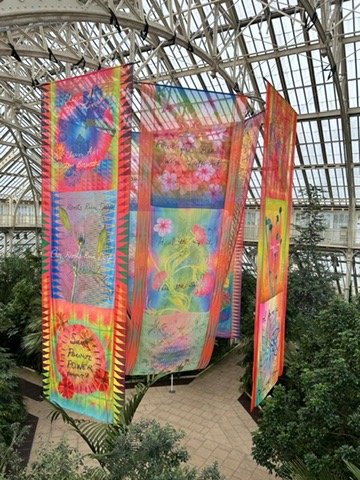
House of Spirits - Jeffrey Gibson
There was a spoken word poetry performance called ‘Reverberations’ by two artists about diversity, beauty, and queerness in nature, a planted area of pansies in honour of ‘The Pansy Project,’ in which artist Paul Harfleet plants pansies at sites where homophobic and transphobic violence has occurred across London and the world, a plant display called ‘Breaking the Binary,’ curated by Patrick Featherstone Gardens, comprised of plants which reproduce in ways that challenge conventional norms of male/female binary reproduction, a tapestry titled ‘House of Spirits’ by Jeffrey Gibson, created with botanical illustrations from Kew’s archives as an homage to the underground ball subculture of queer African-American and Latino communities in New York City, and a beautiful wall of tags where visitors were invited to write how they felt in response to the exhibition.
In particular, what really caught my interest was the way that science, which people have so much faith in as the true confirmer of facts, was used to prove that what people dismiss as unnatural and unscientific is actually a scientifically demonstrable part of nature. As anthropologists, we all know about the politics of knowledge production, and how dominant narratives reflect hegemonic understandings. I like to think of anthropology as a ‘potentially revolutionary praxis, because it forces us to question our theoretical presuppositions about the world, produce knowledge that is new, was confined to the margins, or was silenced.’ (Alpa Shah 2017) I have become frustrated countless times in the process of trying to explain this to my STEM friends. I felt enlightened by the way the exhibition had harnessed the respect that science receives as ‘the ultimate legitimate authority’ to expand people’s thinking.
The combination of art, science, and nature made complex academic ideas so digestible, concise, and clear while maintaining their richness and not being overly reductive. Throughout my anthropology degree, I have encountered so many fascinating ideas that I wish were more present in mainstream discourse. As I painstakingly make my way through pages and pages of dense critical theory about gender and sexuality for my course on gender and kinship, I often fear that these ideas, which are so important and so potentially world-altering, only ever circulate in academic circles. I often find myself wishing that anthropological theorists wrote more like David Graeber; unpretentious, understandable, and accessible.
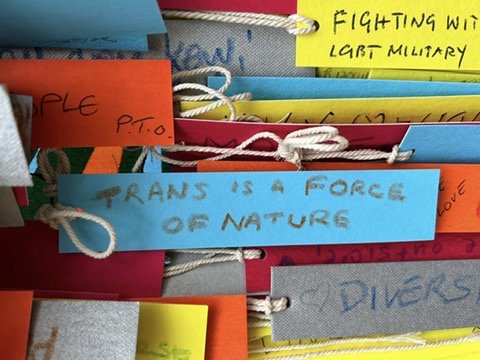
I love the work of theorists like Judith Butler and Gayle Rubin, and don’t want to understate or undermine the immense value of their writing for the anthropology of kinship, sex, and gender. But spending my summer watching a range of audiences from queer university students well-versed in countering conventions, to more conservative older visitors, all engaging with queer theory in diverse and open-minded ways, gave me a renewed sense of hope about the power that anthropology contains to challenge the preconceived assumptions that people carry with them in their perception of the world. The average non-anthropology-student is most likely not going to read an extensive, complex analytical deconstruction of heteropatriarchal societal structures, but they can most definitely engage with these ideas if they are made comprehensible and approachable.
I wanted to include a special mention of a contributor to the exhibition: Drag performer and anthropologist, Cheddar Gorgeous (aka Dr Michael Atkins), who focuses on disrupting gender conventions, contemporary urban gay spaces, and using graphic novellas as a form of ethnographic storytelling – Their work has been inspiring to me by demonstrating how an anthropologist can ensure their counter-conventional work isn’t limited to the academic sphere.
During that summer, I lost count of the amount of times I heard people say ‘I’ve never thought of it like that before.’ By definition, any ideas which challenge dominant understandings are going to be initially limited in their reach, and their merit derives from not being mainstream; but gatekeeping anthropological knowledge with complicated jargon doesn’t do anyone any favours. It has become clear to me that embracing interdisciplinary methods of presenting the knowledge that anthropology produces is an effective way to expand the reach of our discipline’s vital insights.
References:
Ethnography? Participant observation, a potentially revolutionary praxis – Alpa Shah (2017)
Piers Morgan rages over Kew Gardens ‘Queer Nature’ Event – Pink News (2023)
https://www.thepinknews.com/2023/09/07/kew-gardens-queer-nature-piers-morgan/

The Cinematic Universe of Women’s rage
This short essay explores female rage in the media, looking at how anthropology of emotion and feminist anthropology can comment on the characterisation of angry womxn, and their fragile empowerment.
By Ayomide Asani
Female Rage is all the Rage these days, (get it? ‘rage’ as in rage). But more seriously Womxn's anger has captured mainstream attention in the form of articles, video essays, and social media phenomena. Cinema today is littered with portrayals of Female Rage. ‘Movie Tok’ has also captured our fascination with womxn’s anger on screen. What I am concerned with, is how Female Rage and an Anthropology of Emotion intersect today. More importantly, how can Anthropology contribute to feminist discussions of womxn’s experiences?
This short essay will define female rage through an urban dictionary definition that states ‘female rage is a rejection of gendered ideas regarding who gets to express anger and in what ways’. Patriarchy touches every element of life and emotions are not exempt from this. Stereotypically womxn are labeled as emotional, spreading the idea that emotional expression can be differentiated by gender. For generations, womxn and femme people have been undergoing systematic modes of oppression that entrap womxn from bodily autonomy, perpetual sexual violence, and economic oppression. Under these systems of misogyny depictions within Film, Music, and Media use rage to collectivise and revolutionise womxn struggles. Centuries of womxn have felt the generational trauma at the hands of misogyny.
In anthropology, we view emotion as a way of knowing and a form of knowledge, which is often painted negatively in comparison to rationality as a post-enlightenment and patriarchal knowledge. This negativity trivialises womxn's emotions and also systematically bars men from expressing any form of emotion for fear of emasculation. Media has been a way of both perpetuating this and a means of expression for womxn. Sad Girl Tumblr epitomised womxn and young teenage girls' sadness. Lana del Ray, Effie, and Bella Swan ruled Tumblr posts and young womxn began to romanticise their sadness through smoky smudged eyeliner and ripped tights. This time was symbolic of young womxn struggling with mental health who wanted to feel seen and find community through female adolescence and the sometimes turbulent transition from girlhood to womanhood. This sadness is a direct result of the pressures that come with being identified as a womxn within society. For many womxn, these platforms weren’t a place to idolise mental health issues but to understand the reasons for these issues and their connection to their gender identity. In retrospect however, Sad Girl Tumblr has been criticised for its fetishization of sadness while creating a toxic outlet that didn’t facilitate the healing of young girls struggling with insecurities and mental health issues but instead pushed them further into the depths of sadness. This doesn’t mean that artists only speak on sadness as a way of demoralising womxn but rather sheds light on the importance of vocalising sadness.
Emotional knowledge was used as a way to consolidate solidarity between womxn allowing womxn to be empowered by their emotions rather than being suppressed. Thus, media has shaped ways of portraying and understanding sadness, but can simultaneously be construed as a platform for female empowerment.
It could be theorised that Female Rage is a reactionary response to the passive sadness that dominated the internet in the past years, evoking womxn and girls alike to reclaim their pain through an ‘agency of anger’(Shanspeare 2023). Sadness became too idle and muted, elegant tears became limiting. The angry womxn was becoming a way of expressing collective feminine rage to the psychological distress of being a womxn. Female Rage has become synonymous with female autonomy - being able to express emotions powerfully and chaotically, rather than fearing the gendered stereotypes towards womxn's emotions. Womxn alike are hungry for raw depictions of anger. To have their anger seen and made visible rather than hidden behind docile controlled emotions.
The Sad to Angry Pipeline is well documented within music in Aretha Franklin's 1967 Album ‘I Never Loved a Man the Way I Love You’ Franklin uses her soulful voice to depict heartbreak through the blues while progressing to an angry jazz sound in her timeless hit ‘Respect’ her strong vocal riffs illustrates the shift from melancholy to fury effortlessly. Speaking to the exasperation that womxn feel in response to constant disrespect. Similarly, SZA, a Pop RnB artist, invokes these themes through her vulnerable lyricism in her song ‘SOS’ she raps unapologetically ‘I talk bullshit a lot no more fuck shit I’m done’ (SZA 2022b) The blunt attitude directly juxtaposes lyrics like ‘Only like myself when I’m with you, Nobody gets me’ (SZA 2022c), an emotionally charged track that imploys the slow violin to encapsulate the themes of loss that SZA is expressing. In Fiona Apple's music, she also displays this progression of sadness to anger within her music within the song ‘Paper Bag’ Apple's tonal voice shifts from soft to tense as the song progresses communicating feelings of madness through the quickening tempo. As such, womxn resonate with outbursts of rage at an emotional breaking point. These bursts of fury are usually defined by screaming, yelling, and messy emotional breakdowns, basically what is typically defined as pure anger. However, anger is not only expressed in one way. Linguistic differences mean that many societies don’t have a word directly for anger but instead have words that express some aspects of, or varieties of, anger. For example, anger among Inuit people is expressed differently than in the West where anger is controlled from a young age and aggressive expressions of emotion are minimal. ‘Inuit, social order did not derive merely from following rules of expression, it depended on feeling culturally appropriate emotions. As they saw it, emotions motivated behavior’(Briggs 2000).
Female Rage has become a subgenre within cinema as nuanced storytelling surrounding womxn begins to expand. Rage has become both cathartic and satisfactory for many womxn to see portrayed on screen. Looking at the case of horror regarding female rage, we see how emotions and cinema are both socio-culturally constructed. In American Horror Story (2013) Angela Basset plays the titular role of Marie Laveau, the Voodoo Queen, becoming an ensemble cast member. Marie Laveau’s anger is expressed in a controlled and powerful way, in response to the injustice that black people endure due to racism. Vengeance through violence is a running thread and the audience is enthralled by Marie’s flair for empowering black womxn as Marie uses her powers to exact revenge on those who have wronged her. This anger is displayed through Marie's methods of revenge poisoning and murder allowing the horror genre to be fruitful in revealing black womxn’s rage.

(The Reluctant Bride by August Toulmoche, 1866)
In Waiting to Exhale (1995) Basset plays the character of Bernie married to the cheating John here Bernie is shattered by her husband's betrayal allowing the audience to understand her pain, regret, and ultimately outrage about the adultery. Olvia Pope (Scandal) and Annalise Keating (How to Get Away with Murder) also demonstrate the rage of black womxn in response to both betrayal and racism. Portrayals of black womxn experiencing rage on-screen are considerably controlled with mainstream depictions centering around racism, cheating husbands, and intense misogynoir. Due to the ‘Angry Black Woman’ stereotype, media portrayals need to be incredibly careful to not generalise all black womxn as angry and aggressive. Black womxn’s anger is constantly suppressed and monitored meaning that Black womxn's rage is inextricably linked to systematic modes of oppression. Black womxn’s rage is politicised with racial surveillance, with black womxn constantly having to survey their emotions for fear of being labeled as ‘angry’. I and many other black womxn have the shared experience of self-monitoring emotions and behaviors to avoid being perceived negatively and for the comfort of others. This penetrates the media which discourages extreme portrayals of black womxn's rage which disrupts mainstream sensibilities. Contrastingly, in Pearl (2022), we see a visceral depiction of female rage. Indicating rage brewing amid toxic mother-daughter relationships, isolation, and rejection from wider society. Voice is a tool of agency in Pearl, where she constantly screams and yells. The expression of anger becomes a dream fantasy idolised by commentators on TikTok Edits. People connect to Pearl's rage.
Womxn of colour explore anger on a different terrain than that of white womxn as their anger is even more taboo in public spaces. Racial stereotyping of Angry Black womxn has meant black womxn are under constant scrutiny for how they present their emotions if they are even allowed to present said emotions. Thus, making the display of anger another privilege given to white people. The emotions of black people are often seen as threatening or demeaning. Furthermore, womxn of colour are at the intersection of racial and gendered trauma. In many ways, their ownership of trauma is robbed from them. They are put in an ‘either-or situation’ making it impossible for them to feel both their traumas and the wider systemic trauma that has been placed upon them. Thinking of Katherine’s bathroom monologue in Hidden Figures (2016), where she has to travel off-building to use the bathroom due to segregation and isn’t allowed to wear comfortable clothing as she must also perform femininity in the workplace. Her anger and frustration stem from racist treatment under segregation.
Many depictions of black female rage hyperfocus on black womxn's rage rooting in jealousy of white womxn. For example, in ‘In Waiting to Exhale’ Bernadine burns her husband's car due to his cheating here the rage is controlled and calculated as a build-up of frustration over time. Because black womxn are scrutinised for their rage it must be justified under intense scrutiny within Western media. For, white womxn in Western media, anger is messy and uncontrollable. Yet, Nigerian film industry womxn’s rage in all instances is common in films both in loud and quiet on-screen performances.
The media itself provides an empowering outlet for womxn to express both anger and sadness. Such expressions can be active forms of resistance against patriarchal systems that invalidate expressions of emotion. The song ‘Kill Bill’ by SZA blends the feminisation of sadness and anger into a Pop RnB hit with over a billion streams on Spotify. Why has the song garnered so much popularity since its release? Artist popularity, strong lyrical and production capabilities, or perhaps the relatability of experiencing anger and sadness during a breakup. Art has always had a way of giving negative emotions agency in a modern world where late-stage capitalism and modern-day patriarchy have simultaneously commodified the expression of emotions and imposed strict gendered norms on them.

A Catalan Christmas in Times of Genocide
Thoughts on the Catalan anarchist tradition and the ethnic cleansing in Gaza as I roam the streets of Barcelona
By Soufyaan Timol - cover photo taken by author
One of the first images that strikes me as I lug my sister’s suitcase through the roads of Central Barcelona, mere hours after our plane landed, are the words chalked on a wall near a children’s playground: ‘Gaza no estás sola’. Only few meters away, marked in red across a traffic sign, is the emblematic A of anarchism, surrounded by a circle. A feeling of the transcendent breathes through the streets of Barcelona, of the unspoken, the unspeakable. I notice it again and again; a tradition that should be dead, buried; plastered all around the squares, featured in the display windows of bookshops, graffitied on walls and shop shutters, and all over the buildings it has appropriated. This tradition, anarchism, though repressed and suppressed, shunned from the mainstream, survives 87 years since its flag was raised against the rise of fascism in Spain.
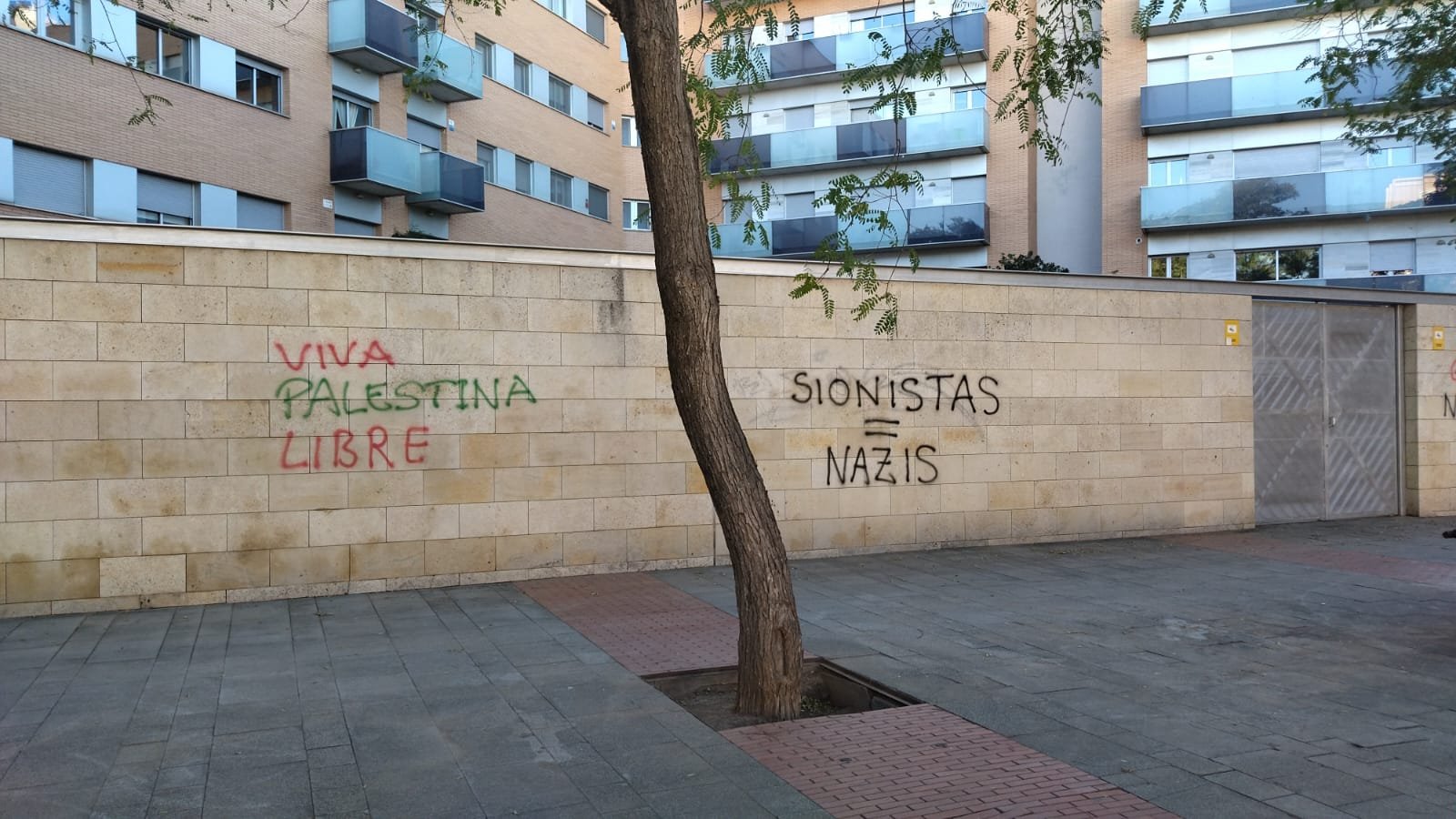
‘Viva Palestina libre’ (Long live Free Palestine) and ‘Sionistas = Nazis’ (Sionists = Nazis) on the walls of Barcelona. Photo taken by author.
In the spring of 1939, after 3 years of a civil war that left half a million people dead, the Spanish republic fell to Franco’s fascist forces. 36 years of a sadistic military dictatorship followed. Franco banned democratic elections, crushed unions, voided progressive laws, sent refugees to die in Hitler’s death camps, and established his own concentration camps where hundreds of thousands would be imprisoned. The dictatorship only ended in 1975 with his death, and a new democratic republic was established. Franco’s generals made sure that along his body, they buried the memory of his massacres, sweeping them under the rug of history (1). A minor blip in the country’s evolution, a time you don’t speak about, distorted, erased.
As well as the 36 years of dictatorship, the new state excised from Spain’s history the anti-fascist resistance. In Barcelona, no monument stands, no museum salutes, no day celebrates, perhaps one of the most momentous events in the West’s political history: the Spanish revolution.
When, in Catalonia, after the collapse of the republic and the initial attempt at a fascist coup, workers, organized in massive syndicates, armed themselves and brought down the fascist attacker, and, with the republic frozen, incapacitated, erected their own stateless society. Then Catalonia was run, not by the Spanish state, not by any political party, but by its working people, through a variety of anarchist and socialist syndicates. They collectivized production, introduced free healthcare, legalized abortion, and led a relentless war against social hierarchy. For three years, Catalans undertook the most radical of social experiments. George Orwell, who, like the tens of thousands of international volunteers, travelled to Spain to fight the fascists, wrote, in one of his most beautiful works, Homage to Catalonia (1938):
“It was the first time that I had ever been in a town where the working class was in the saddle. Practically every building of any size had been seized by the workers and was draped with red flags and with the red and black flag of the Anarchists… Every shop and cafe had an inscription saying that it had been collectivized; even the bootblacks had been collectivized and their boxes painted red and black. Waiters and shopwalkers looked at you in the face and treated you as an equal… There was much in this that I did not understand, in some ways I did not even like it, but I recognized it immediately as a state of affairs worth fighting for.”
Over three years of civil war, Franco’s forces, aided by fascist Germany and Italy, tolerated (and sometimes supported) by the Allies, vanquished the revolution, conquered city by city, until even Barcelona crumbled. What remains today are the mass graves, holding over 100, 000 bodies of Franco’s victims. The subsequent effort to erase from Spain’s memory — not just the anti-fascist resistance, but also the revolutionary moment, whereby for a few years the absolute reality of capitalism stood defeated, dumb, unable to rely but on its most reactionary bloc — was total, hegemonic. But the anarchist tradition lives on.
Walking around central Barcelona, I feel the libertarian spirit, alive and uncompromising. Street art abounds, with a character more left-wing than punk, more anarchist than anti-system. Posters calling for radical political action decorate every other wall along the streets of the historical old town. Massive squats skirt the edges of Central, where anarchist groups organize free dinners, clothes drives, reading groups, movie screenings, vigils, protests, occupations. Red-black manifestos dot the notice boards of Barcelona’s castle-like university. At the very heart of the city survives a bookshop run by the same syndicate, the CNT, that led the liberation of Catalonia in 1936.

Picture of the Libreria La Rosa de Foc run by the CNT syndacate in Barcelona. Photo taken by author.
In times where Israel’s ethno-fascist regime visits incessant destruction upon Gaza, at a rate of 300 deaths a day, it is impossible to stroll around Barcelona and, unless one confines herself to the tourist-chosen spots, to miss the support for Palestine. I feel safer, less secluded, knowing I am not alone in standing against genocide, unlike in Rome and Florence, which I also visited over the holidays, or in Mauritius, where friends tell me the subject is alien to most, or in London, where, despite the massive protests, the indifference, the silence, of academics, of universities and student unions, of the so-called ‘progressive’ left, deafens.
Through one of the numerous plastered posters — of which I manage to swipe a stunning one for my room, at the cost of a few angry looks from passers-by — I learn of a march for Gaza on my first day in Barcelona. The gathering, of a few hundred people, begins in front of a center for Catalan independence. The faces are young. Dozens of candles are passed around, and we light each other’s.
The chants throughout the march echo the feeling of those one would find in London. ‘Des del riu fins al mar, Palestina lliure’, ‘Israel asesina, Europa patrocina’. One resonates a bit more with me: ‘Gaza no estás sola’. Gaza you are not alone. Even when the world’s major powers support and finance your martyrdom, when the global intelligentsia baptizes you a home for terrorists, when most remain indifferent to your oppression, Gaza you are not alone.
At the end of the march, some speakers share a few words about Palestine, mostly in Catalan, which eludes me, though two or three deliver their speeches in Spanish, which I can somewhat understand. They state the death toll, standing then at 20,000, of which 8,000 are children. A woman, her back draped with the Palestinian flag, mentions how even the pope condemned Israel for its war crimes after Israeli snipers shot dead two Christian women in a church. His words, too late, too soft, fall short of addressing the gravity of the situation. Even the term ‘ceasefire’ leaves one’s moral sense wanting, when what people are calling for is simply an end to genocide.

Picture of the march the author has taken part into. Photo taken by author.
A young woman, probably a university student, describes with poignant thoroughness the man-made hell that the IDF has fashioned of Gaza: the bombing in the north, then the bombing in the south, the wholesale destruction of hospitals, refugee centers, schools, churches and mosques, the assassination of journalists, the parading of men naked in the streets, the cold-blooded murder of its own hostages, the eradication of entire families and the starvation of survivors, the denial of water and electricity, the harvesting of organs (2).
She accuses Israel of being of being a fascist (3) settler colonial project, the West’s monster, crafted in its own image, shaped by the legacy of the white man in the Americas, in Namibia and Ethiopia, in India and Australia, who, in his time, would enact ‘punitive expeditions’ against the uncooperative colonial subjects. When, calling upon the military might of his state, the colonizer would respond to an act of rebellion, real or invented; maybe the subject had burnt a settler alive, or tortured and raped women, or beheaded infant children. Simply uttering the name of the crime would make it true (4), a crime so horrific, so barbarian, so savage, committed against civilization, that the boundaries of law could not accommodate the response. Biblical extermination was called for; a violence so complete it would extinguish any hope of liberation. When Netanyahu asks the people of Israel to “remember what Amalek has done to you,” and to fight accordingly, he means that, as the bible verse he quotes says, the war of extermination waged upon Gaza is to spare no man, woman or infant (5).
There is anger, terrible fury, in her voice as she concludes, but so is there hope. Barcelona’s memory of resistance resonates loud in her anti-fascist rhetoric. She closes, not by calling for a ceasefire, but for an end to colonization and imperialism, for a world free of borders, free of ethnic hatred, free of fascism.
——
Over the next few days, while the city lights up with preparations for Christmas, I walk around with a bittersweet taste in my mouth. One cannot escape the reality of the genocide in Palestine. Millions displaced, entire neighborhoods levelled, their very social reality destroyed. But here, I cannot escape the pro-Palestinian movement against this genocide either, uncompromising, libertarian in spirit and in action. I already feel nostalgic; I know that I am barely scratching the surface of what this anarchist tradition holds over these few days. Knowing that it exists, though, that it lives on, is comfort enough. If European fascism, in a metastasized, ethno-religious form, survives into the 21st century, so does the resistance to it, and so do the radical possibilities that this resistance offers.
Notes
(1) The ‘Pack of Oblivion’, passed in 1977, imposed that Spain would not recall this history of fascism, and especially not prosecute the war criminals.
(2) A recent article by the human rights organization Euro-Med Human Rights Monitor calls for an investigation in what looks very likely to be organ theft on the bodies of Palestinians (read here). The article was republished by an arm of the United Nations Office for the Coordination of Humanitarian Affairs - OCHA (read here).
(3) Chris Hedges, who has studied Israel’s policies for over 30 years, covering the rise of the Israeli far-right, writes, in a beautiful piece: “there has always been a strain of Jewish fascism within the Zionist project. Now it has control of the Israeli State.” (read here).
(4) The degree to which the mainstream media has parroted Israel’s unsubstantiated claims is extreme, especially when all previous ones have been disproved. For a thorough deconstruction of Israel’s lies, see Lindsay Collen’s article for LALIT: Debunking Israel’s Lies and Propaganda (read here).
(5) The Bible verse Netanyahu references, 1 Samuel 15:3, states, “Now go and smite Amalek, utterly destroy all that they have, and spare them not; but slay both man and woman, infant and suckling, ox and sheep, camel and ass.”
References
Collen, Lindsey (2023) ‘Genocide Blog 17 - Debunking Israel’s Lies and Propaganda’. Available at: https://www.lalitmauritius.org/en/newsarticle/3269/genocide-blog-17debunking-israeli-lies-and-propaganda/
Euro Med Human Right Monitor (2023) ‘Int’l committee must investigate Israel’s holding of dead bodies in Gaza’. Available at: https://euromedmonitor.org/en/article/5982/Int%E2%80%99l-committee-must-investigate-Israel%E2%80%99s-holding-of-dead-bodies-in-Gaza%E2%80%8B
Hedges, Chris (2023) ‘Israel’s Final Solution for the Palestinians’. Available at: https://chrishedges.substack.com/p/israels-final-solution-for-the-palestinians
Relief Web (2023) ‘Int’l committee must investigate Israel’s holding of dead bodies in Gaza’. Available at: https://reliefweb.int/report/occupied-palestinian-territory/intl-committee-must-investigate-israels-holding-dead-bodies-gaza-enar
Orwell, George (1938) Homage to Catalonia
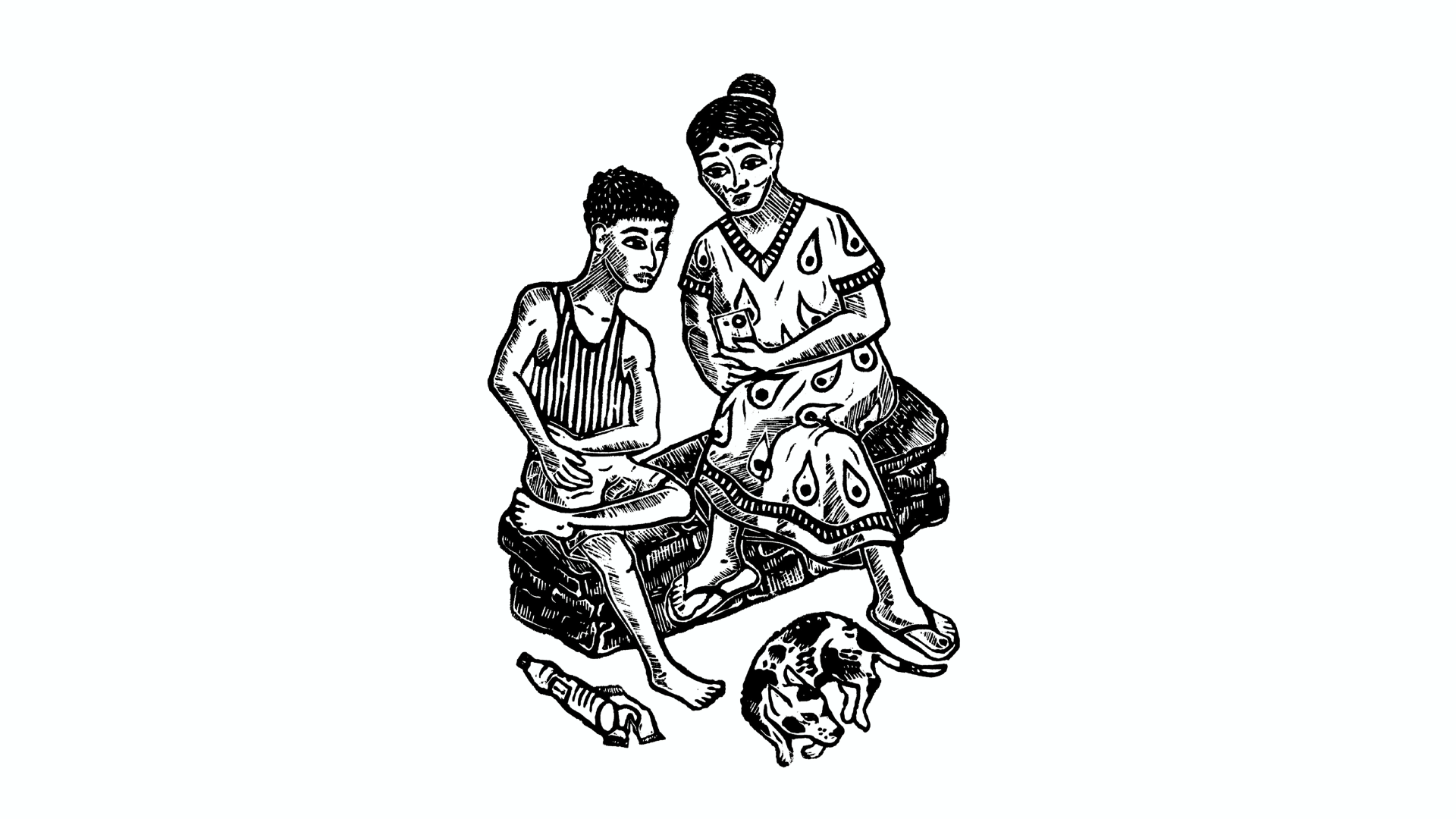
In Conversation With Purnima Mankekar and Akhil Gupta
Who is on the other end of the line when you receive company calls? How do they live their lives… and what do they think of you? We interview authors of a decade-long ethnography on the affective elements of racial and transnational capitalism.
Following their Friday Seminar, we had the pleasure of interviewing Professors Akhil Gupta and Purnima Mankekar from the University of California, Los Angeles on their new book titled ‘Future Tense: Affective Capitalism and Potentiality in a Transnational Service Industry’. The book explores the lives and work-lives of intimate strangers that make up Business Process Outsourcing (BPO) agents in South India. Since 2000, the BPO industry has grown to employ 700,000 young people in India. These workers spend their nights interacting by phone and online with customers in the United States, the United Kingdom, Australia, and elsewhere.
The calls are not only signifiers of transnational flows of capital, but are also windows between intimate worlds: they are among the tangents of racial affective capitalism. Professors Gupta and Mankekar’s research spanned almost a decade in Bengaluru, where transnational capitalism shapes and is shaped by a historically diverse workforce. The tech parks of the BPOs construct futurities and aspirations that provide critical insights into the imaginaries interwoven with transnational capitalism. This invisible labour is carried out at night, whilst colonial relations are both re-inscribed and altogether forgotten. What image of The West is painted from the end of that telephone line?
Seated comfortably in Professor Banerjee’s office, we sink into the sizable armchairs. Professors Gupta and Mankekar immediately invoke an atmosphere of serenity with their absorbing comments and witty exchanges. This is an opportunity for us to delve into the nitty-gritties of their research and anthropological method, so we begin with their embodied experience of fieldwork.
In your seminar you touched on the corporeal cycles of life in the BPO Centre, and in ‘The Missed Period’ chapter you discuss the direct effect of this on the body. How did it feel going nocturnal with your interlocutors?
Prof Gupta: When we began this project our daughter was six years old, so there was a balance to be struck between the personal and professional. We couldn’t both go off in the middle of the night, so we largely took turns. The companies also couldn't afford for us to be talking to their agents on the shop floor: interviews infringed on labour time. Instead we held interviews off-site, on BPO agents’ days off. Management were actually happy to have us there - for them we might have provided solutions to increase efficiency and reduce worker turnover, and we were happy to share this information as we thought it might improve working conditions, though of course we never shared any personal or identifying information. Before ours, there were a dozen books written on call centres, but almost none of them were done from inside a company. We had to sign NDAs…but quite frankly the kinds of human protocols that we have in anthropology are much stricter than any NDA.
Did you openly approach the companies as researchers, and were they receptive to this?
Prof Mankekar: Most companies were pretty open to it! Interestingly, even some of the managers were themselves curious about our work - they too were asking similar questions about the lives of their workers.
Prof Gupta: They were very interested in how working in call centres changed agents’ lives.
In our courses we have studied neoliberal development extensively, and how in South Asia especially, an entrepreneurial mindset is present in all modern companies. Did you encounter that?
Prof Mankekar: It was manifest in some of the training. Agents were trained to think about their own development as a project, very much in the way that neoliberalism presumes: you know, the whole care of the self model. This might be why there was so much attention paid to demeanour, and what people wore. But it is also true that these neoliberal visions of the self did not seamlessly take over because there continued to be a real commitment to family and the larger community. They were by no means the ideal neoliberal subjects!
Prof Gupta: It did make them entrepreneurial, but it's also an example of when context shapes capitalism; it's not simply the other way round.
BPO centres can be understood as new frontiers of capitalist accumulation, which we have come across in the work of David Harvey, and in a school of relatively modern Marxist anthropology. Where do you position yourselves along the scale of Marxist anthropology?
Prof Mankekar: I think we’re positioned in different places… why don’t you talk about where you sit [to Prof. Gupta], and then I’ll talk about where I sit.
Prof Gupta: What’s distinctive about this project is it brings together discussions of racial capitalism and affective capitalism. For us this was essential following Harvey and others’ particular lack of attention to the logics of race in theories of capitalism.
Prof Mankekar: I was informed by Marxist theorisations of culture - Raymond Williams, Gramsci, Althusser, Stuart Hall - and simultaneously by Women of Colour Feminism in the United States. As somebody who moved to the US from India where our conception of race was very different, it was a real eye opener. Especially in relation to how I, as a woman of colour, was perceived in the classroom, and later when I joined the profession. It was very personal and transformative. This allowed me to truly grasp racial capitalism from a feminist perspective. Working in a centre for Asian-American studies has really allowed me to push back against any Eurocentric, America-centric, or even an Atlanticist notion of race. It allowed me to examine: what does race look like in the Pacific? What does race look like in the context of settler colonialism? It's those two streams that have shaped me as a Marxist.
In the seminar, you talk about the idea of class/caste dynamics in an outsourcing system that seemingly transcends national borders. How do you situate the concept of ‘India Rising’ and nationalism in this situation?
Prof Mankekar: They are very closely linked. This idea of futurity and the future as articulated by call centre agents was very closely linked to India as a rising power. What was powerful for us to see was the suturing of individual aspiration with national aspiration.
Prof Gupta: What was also interesting was how this nationalism existed in an explicitly transnational setting which produced intimate connections between different nations through the agent and the customer. For both the customer and the agent, more strident visions of nationalism don’t necessarily conflict with working for or helping those in another country. They don’t see it as contradictory that you could become a majoritarian Hindu on the one hand, and on the other you’re doing this service work for people who may be re-transcribing colonial relations. It’s a job! They don’t see it as opposing ideologies. I don’t think we found any friction there at all. Only that perhaps agents might be more inclined to be critical of the West.

‘Shantiniketan Express’, Rahul Basu 2023.
Was there a desire on the part of managers and CEO’s to have a homogenised workforce, in trying to think about this concept of ‘One Nation’, beyond religious boundaries?
Prof Mankekar: That’s a really good question! I don’t think that was on the radar of the managers at all. They were living at a cultural moment in which there was linguistic, class and religious conflict. So I think it would have been really naive for management to even think about a unified working body. That was just not on the horizon, and nor was there on the part of the managers a Hindu nationalist agenda. It was not manifest in the training, though it may have been manifest in their particular attitudes toward individuals. It was definitely not on the agenda to construct a kind of universal, ‘Pan Indian Body’. That was happening in other domains, but not necessarily in the BPOs.
Prof Gupta: In Bangalore, people exist in a multilingual and multicultural context. For example, Kannada is the regional language, but it’s only spoken by a third or so of Bangalorians. People are there from all over the country.
Prof Mankekar: It has a history of a polyglot civic life; it’s not a new thing. The city is an actant: it is not outside, it permeates working life.
We were thinking about changing and mutating capitalism: that it doesn’t wipe out existing differences, but instead tends to transform them and be transformed by them. Do you think that the economic boom in India, especially in the tech industry, has been aided by the diversity of India? Is conjugated oppression in some way useful for this kind of capitalism?
Prof Mankekar: That is such a good question… in fact I wish I had pondered this before we wrote the book… I’d have to really think about that. I’ll say that the reason that we ended up in Bangalore is the chief minister had a vision of the area becoming a hub for IT, it was very much part of that regional policy. The history of scientific education and aeronautical engineering made Bangalore hospitable to the IT industry.

‘Untitled’, Rahul Basu 2023.
Prof Gupta: These industries each had their own call centre, and would start BPO’s in buildings adjacent to their IT centres. The places where there are no BPO’s are Chennai and Kerala. Possibly because they had communist governments who were not receptive to trans-national capitalism…..now of course, they are. With China leading the way, everyone is receptive to multi-national capital. When call centres first opened, there was definitely awareness about which kind of accents are desirable, or at least which accents were malleable to be changed. They would call this ‘MTI’ or Mother Tongue Influence.
We want to talk about another kind of mutation or possibility of mutation. We loved that your research was conducted in the span of 10 years, as a lot can change in a decade! So how did developments in technology and involvement of artificiality impact a space where you focus on contrasting tactile and tangible elements through embodiment?
Prof Mankekar: So there came a point in our research when many of these companies were shifting to more automated processes. And that’s when we decided we wanted to stop the research, because we felt there was going to be a change in the way in which this work was occurring, and we didn’t want to spread ourselves too thin. So huge change has occurred, and that’s going to be our next project which is going to be on AI, not AI in BPOs, not AI and labour, but on AI and the algorithmic cultures that are being constructed.
Prof Gupta: Even by the time we stopped our research, there was a lot of machine learning and predictive analytic already happening. Chat boxes etc hadn’t been developed but other stuff was already happening. The CEO of one company told us that when somebody calls his company he can predict the three most likely questions people are going to ask just from the phone number.
It feels like this topic is really related to David Graeber’s ’bullshit jobs’, and how technology supposedly would ease our labour but instead ends up creating new efforts, frustrations and exhaustions. What are your thoughts on this new evolving technology and the possibilities and hopes it creates, and on the changing nature of labour itself for the BPO agents?
Prof Gupta: So one of the ways in which labour had changed for BPO agents already by 2016-17, was that they were being heavily assisted by machine learning and predictive analytics. On their screens they were already getting advice about what they should say next to the caller or what, based on the caller’s profile, they should have said to the caller. 5 years ago this wasn’t the case.
The other thing about these technologies is that they have merged web surfing, chat and calling. So when you are surfing the internet and you are looking at Sainsbury’s site or some shop and you spend more than a few minutes looking at it, depending on whether you had been a high-value customer in the past, the machines track how long you are taking, what you spent in the past and then they drop a balloon saying ‘can I help you?’ on the chat and they move you from one platform to another because they don’t want people to get frustrated by inefficient searching. So they try to help you find it sooner rather than let you get upset by wasting your time. That’s how technology changes the way customers interact with the company.
Prof Mankekar: In fact when I was sitting next to one of the agents, he had two screens. One with the complete profile of the person he was speaking to so he knew what they were like, that they lived alone or had a huge hospital bill so he knew what he was dealing with.
Moving on a bit, we really liked your use of the word futurity in your lecture. It seems that anthropology thinking about conceptualisations of the future is quite a new thing to do, but why do you think it is such an important framework? And also what are your thoughts on the term ‘solastalgia’? It’s a term coined by philosopher Glenn Albrecht, but it’s been used by anthropologists to talk about ontological trauma caused by the lack of agency some people feel when their lived environments are changing very rapidly. It’s used by environmental anthropologists, but we think it can be applied to a lot more as it takes seriously the disruption of having unstable futures and considers that as traumatic.
Prof Manekekar: That’s so interesting, like the opposite of what we argue.
We did summer ethnography projects this year with grants from LSE. Ishani did hers in rural West Bengal [India], Lucy did hers in London, and Nazli in Istanbul. For Ishani, solastalgia was very helpful to understand that for some people, in the context of Adivasi youth, a connection to the past and a more historicised sense of the self was helpful for them to also project themselves into the future. So for the BPO agents, did the fact that many of them migrated and had a disrupted sense of place affect the way they envisioned the future?
Prof Mankekar: I wish we talked to you before we wrote the book! Of course it did, in many ways. That’s why we use the metaphor of mapping. In many ways there was a sense that this kind of dislocation was something that required some kind of ethical map for them to navigate this new unfamiliar space; very daunting spaces that the workers now had to inhabit. So what were the different kinds of ethical mapping that were available to them?
The one we talk about the most is that of relationality, meaning the relations between them, between themselves and their families. This isn’t a romanticised notion of family, but whatever it was, oppressive or not, it provided them with a grid or a map to navigate this extremely new unfamiliar terrain. I guess the difference between how we envisioned this idea and the way you talk about it is that I wouldn’t use the word trauma because I don’t think it was traumatic, but it was for sure dislocating and disorienting. Even if they didn’t migrate physically from another state or another part of India, just the migration from their almost slum-like homes to these high-tech glassy tech parks, that in itself was a dislocating journey. That’s a very dislocating journey that a lot of them make regularly when they come to work. So, what kind of ethical map was available to them to navigate this? Relationality was the main thing, super important.
Our last question is related to Nazli’s fieldwork. Nazli focused on HIV related stigma and testing in everyday spaces, and conceptualised the body something that doesn’t finish with the skin, whose boundaries are blurred, and how health is impacted by fear. So what are the possibilities that thinking about the body in relation to space, or being one with space, provide for anthropological thinking?
Prof Gupta: So Harris Solomon’s book on ‘metabolic living’ explores exactly this question, of how the relationship between the body and the city is a permeable relation, how the city comes into the body and the body inhabits the city in a particular way. He uses the metaphor of metabolic living (metabolism) to think about that. So our way of thinking about it is that the body, the agent and relations are fundamentally spatially and socially expansive. The self is shaped by relations the agent is in, the kind of working conditions they are in, how they care for kin and so forth. We emphasise in the book that this is not about individuals. We don’t stress individualism (and this is how neoliberalism differs), people are entrepreneurial but they are not individuals in the same way.
Prof Mankekar: That’s why the notion of affect is so useful. Because the skin doesn’t enclose the body. For example my body and this chair are constantly interacting with one another: my muscles are being shaped by this chair, it’s not separate from this chair.
So we want to end with a fun question. In the event of an apocalypse, or if you found yourself in an eternal tech park, which three anthropologists - or cobras - would you keep by your side while you try to survive and why?
Prof Mankekar: Hahaha. I’m not sure that’s such a difficult question
Perhaps each other?
Prof Mankekar: Definitely. I also think Sylvia Yanagisako, she has been a mentor to us and very formative in my thinking of family and kinship, so definitively Sylvia. Actually maybe Eric Wolf, from what Akhil has been telling me lately he sounds like an amazing, ethical good human being which I think would be very important to me
Prof Gupta: I would say Amitav Gosh - an anthropologist but novelist mostly. Maybe Catherine Stewart, actually maybe Anne Alison more than Catherine Stewart who doesn’t work on affect per se but whose work has been really wonderful.
Thank you so much for talking to us! It’s been an honour.
Mankekar and Gupta’s book will be published by Duke University Press, Forthcoming 2025.
This interview was joyfully conducted by Ishani Milward-Bose, Lucy Bernard and Nazlı Adıgüzel, transcribed by Iacopo Nassingh and Lucy Bernard.
All images original works by Rahul Basu. More works found here.
Thank you to Professor Mukulika Banerjee for your encouragement.

Lessons from Rojava
The Rojava Revolution occurring in North and Eastern Syria (AANES) since 2012 has been marginalised by left-wing discourse in the Global North. However, its capacity to put women’s liberation at the forefront of the revolution and to establish a system of participatory democracy are experiences everybody could learn a lot from. By looking at the revolution’s uniqueness this piece aims at revitalising our dormant revolutionary imagination.
Image credits: Rojava Information Center (2022) celebration of International Woman’s day in Qamishlo [instagram]
By Iacopo Nassigh
Global-North commies’ extinction
One thing us global-north left-wingers always tend to forget is that while in the last 50 years we have been sitting around and growing beards thinking that a revolution is impossible, it doesn’t mean that it has been the same in the rest of the world. Popular uprisings have been changing things up all around the world, showing that left-wing revolutions are not just a 20th century phenomenon. If one just looks at the last 15 years, several uprisings have dramatically challenged the status quo of world elites, from the Arab Spring all around the Middle East in the 2010s to the estadillo social in Chile (2019-2022).
Then, why, despite all of this, does revolutionary politics seem so far from the programs of the European Left, which is instead every day more prone to come down to compromises with the neoliberal establishment in the fear, often more supposed than real, to lose popular legitimacy? The question is extremely difficult, but my approximate answer would be that it comes down to a matter of what we have in mind when we think about democracy. I have the nerve to say that an anthropological viewpoint may suggest a way out of this situation. Indeed, as Graeber (2001) reminds us, what anthropology should be about is revealing that reality can be different from ours by looking at places in which it is. Anthropology should then give ‘power to the imagination’, as Graeber (ibid.) says, quoting a slogan from May 1968, roughly 50 years ago, roughly when in the Global North we stopped thinking left wing revolutions were possible.
Regarding our conceptions of democracy in the Global North, there is an elephant in the room. And the reason might be simpler than expected. As David Wengrow (2022) puts it, it may well be just a matter of racism. An embedded racism that, for example, blinds us when we celebrate Athenian democracy as the epitome of a functioning participatory democracy while it was probably no more than an imperialist state based on chattel slavery (ibid.). This same blindness prevents us from seeing how radical democracy is and has been successful in other places. Now, I will try and show that not only radical democracy is taking place, and probably originated as well1, outside of the Global North, but that by looking at its manifestations there, indefinite lessons can be understood about the State, the origin of inequality and ways to create a truly free society. In this sense, the Revolution in Rojava, officialy known as AANES (Autonomous Administration of North and East Syria), which has been developing amidst the Syrian Civil War since 2012 offers a fertile ground for thought.
Rojava Information Center (2022) celebration of the 10th anniversary of the Rojavan Revolution [instagram]
A first lesson: ‘give to women what belongs to them’
The first lesson we should learn from the Rojava revolution is that class doesn’t have to be the only discriminated identity that makes a revolution start. It can be gender as well. Even more, the Rojava revolution holds that the origin of inequality should be found in the latter and not in the former. This line of thought needs to be traced back to the thought of Abdullah Öcalan, the theoretical mind behind the revolution and co-founder of the PKK2 (Kurdistan workers’ party), who was put in jail by the Turkish regime in 1999 and has been incarcerated ever since. In his thought, the main reason for the unequal and unfair state of the current capitalist society, embodied in Syria by the Assad regime, is to be located in the oppression of women as, in his own historical metanarrative, ‘the decline of society (…) began with the fall of women’ (Knapp et al., 2016: 40).
However, this is no new argument at all. To say it better, it looks very similar to Engels’ (1884) famous argument3. Indeed, in what is probably Engels’ most well-known book he argues that in origins human society was regulated by a matriarchal and matrilineal principle that put women at the centre of society’s life and then all went wrong with the shift from nomadic to sedentary lifestyle which gave rise, in order, to private property, patriarchy and ultimately the State. One might say, and many actually do, that this argument is a bit simplistic and evolutionary; an example of 19th century anthropology that should be bypassed in order to pay attention to the uniqueness of every specific social arrangement.
Nonetheless, students of Engels who have refined the argument are still around us. One of them is Chris Knight, co-founder of the RAG (Radical Anthropology Group), still operating in London at the moment. For him, primitive communism’s origins lie in the evolutionary step that brought humans to distinguish themselves from primates as a species. In particular, the first act of the revolution that led to an egalitarian society is for him the uprising of female primates against dominant and immobile males in order to ‘force the leisured sex to help in childcare for the first time’ (1991: 25) (emphasis in original text), allying with outcast male primates. The core of this alliance was a sex-for-meat agreement by which the game hunted by males was exchanged with females for sex, thus taking away potential sexual partners from the alpha male primates.
Nonetheless, Knight does not only follow Engels, but add something to it. What Knight adds is the centrality of the menstrual cycle in this shift away from the domination of the alpha male in social arrangements. Indeed, the menstrual cycle was, according to Knight, the biological clock around which the times of the couples’ disjoining and conjoining would alternate, since men would leave in order to hunt when their partners were menstruating, and the end of the hunt would coincide with the end of the females’ cycles. Considering the biological proven fact of menstrual cycle synchronisation among females living in proximity, the final effect of all this arrangement was the splitting and reuniting of the males and females all at the same time, leading thus to a society with two centres of power, male and female, balancing one another through the overarching time-scheduling principle of the female menstrual cycle. As the theory goes, this revolution brought into existence egalitarian hunter-gatherer societies which turned into patriarchal and sedentary societies, scared of the power of women and thus terrified by their menstrual blood.
What is peculiar about these arguments resonating with Öcalan’s ones is that they are often discarded by classic Marxist theory for which “the history of all hitherto existing societies is the history of class struggle” (Marx et al., 2008). Instead, what the Rojava revolution has done is taking this seriously, stating in facts that there was a struggle before class struggle to solve: the one between genders. A ‘science of women’, Jineolojî 4 was thus created by the revolutionary forces in Rojava to address this core inequality. The main idea of Jineolojî is that ‘knowledge and science are disconnected from society (and from women especially) - they are a monopoly controlled by dominant groups, used as a foundation for their power’ (Knapp et al., 2016: 71). What it aims to do is thus giving ‘women and society access to science and knowledge and to strengthen the connections of science and knowledge to society’ (ibid.), to re-embed them to where they originally belonged as an anthropologist would put it.
What Jineolojî has meant on the ground, even for the most sceptical observers of the revolution5, is a dramatic repositioning of women in society through their direct political participation. In Rojava the principle of dual leadership, by which there should be two leaders (one of whom must be a woman) in any political assembly, applies at every level of political organisation. Moreover, every assembly must have at least 40% (in multiple instances they are actually more) women in it. But this is not all of it. At an extremely localised level, often the neighbourhood one, there is a ‘Women’s House (Mala Jinan), ‘an all-female house where women’s autonomy is discussed’ (Nordhag, 2021: 16), women’s peace committees that investigate cases of gender-based domestic violence, women’s education and research centres where ‘women bring their family and social dilemmas (…) and find solutions by talking with other women’ (Knapp et al., 2016: 70) while at the same time being taught about ‘computer use, language, sewing, first aid, and children’s health, and culture and art’ (ibid.). On top of all this, there is the YPJ (Yekîneyên Parastina Jin), the all-female women’s protection units, an armed body led by women in which they protect their lands and families, and now world famous for their fight against the IS.

Rojava Information Center (2022) meeting of a commune in the city of Qamishlo [website: https://rojavainformationcenter.com/2022/07/10-years-of-the-rojava-revolution-much-achieved-still-much-to-come/]
Thus, the Rojava revolution is showing the world a radical and successful feminism in which the key to women’s liberation is giving back to women the knowledge that has been taken away from them, creating female-only organs that can do this following the guideline concept of woman-to-woman solidarity as the basis of women’s (and thus everyone’s) liberation. However, as the shared metanarrative goes, women’s freedom and power are put in danger by the State, the ultimate masculinist construct. Thus, in order to protect women’s freedom the revolution had to replace the State with something else.
A second lesson: ‘The origins of the commune, cooperative and democratic confederalism’: Engels today
It is in its refusal of the State as we know it that the Rojavan revolution gives us a second lesson. Indeed, what Öcalan’s political theory, called democratic confederalism, the political ideology governing Rojava political life, wants to do is addressing the inherent oppressive nature of the Nation-State. The core idea behind democratic confederalism is one of total integration between political society and civil society in a bottom-up fashion. To put it in Öcalan’s words ‘confederalism proposes political self-administration in which all groups of the society and all cultural identities express themselves in local meetings, general conventions, and councils. Such a democracy opens political space for all social strata and allows diverse political groups to express themselves. In this way it advances the political integration of society as a whole. Politics becomes part of everyday life’ (Öcalan quoted in Knapp et al., 2016: 43). From the level of the commune to the one of the country thus the assembly has become in Rojava the main form of collective decision-making, trying to dismantle collective life as we know it in the Nation-State. But what is ultimately wrong about the State?
For simplicity, let’s just take the definition of State by Encyclopaedia Britannica “a territorially bounded sovereign polity—i.e., a state—that is ruled in the name of a community of citizens who identify themselves as a nation”. Thus, the nation-state is a ‘territorial bounded’ unity. What does this imply? It implies the drawing of neat borders that mark off a specific area, making it ‘bounded’. However, who are these neat borders for? Nobody needs a neat delineation of a geographical space if the relationship they have with that territory is not one of possession, or to say it better, of capitalist exploitation. The people who want boundaries are colonisers, rulers or landlords, not subsistence peasants. Borders have historically emerged as a way to assert domination over land within the typically western and moreover, historically typically masculine, binary between nature and culture. State’s borders are just taken-for-granted manifestations of this logic. In this vein, Nation-States have been successfully represented in propaganda in the form of a wedding (a non-consensual one I’d say), between ‘Father State and Motherland’ (Delaney, 1995: 187), the male ‘cultural’ dominator and the female ‘natural’ territorial victim of this domination.
The Rojava revolution dramatically challenges this ‘territorial boundedness’. What instead leads the way is Bookchin’s theory of social ecology (2006), the idea that links ‘the fate of ecological society to that of a revolutionary political project of local direct democracy’ (Hammy and Miley, 2022), stemming from Bookchin’s conviction that ‘our present-day ecological dislocations have their basic sources in social dislocations’ (Bookchin quoted in ibid.). Thus, human-nature co-dependence has informed the practice of the revolution. Cooperatives established in Rojava have ever since the beginning of the revolution tried to paradigmatically change the ‘territorial bounded’ nature of North-eastern Syrian landscape, transforming wheat and olives monocultures in fields hosting a wide range of vegetables (Rojava information Center, 2020) By crushing the boundaries of monocultures and those of strict individual possession and boundedness, the very basic principle of ‘boundedness’ that underpins capitalist exploitation and the Nation-State is at danger.

Rojava Information Center (2020) workers of the Umceren cooperative (Heseke countryside) are drying up bricks to construct a school for the local community [website: https://rojavainformationcenter.com/2020/11/explainer-cooperatives-in-north-and-east-syria-developing-a-new-economy/]
Going back to our definition, a nation-state is also a ‘sovereign polity (…) ruled in the name of a community of citizens’, but here as well the question of boundaries is a central one. Who is included in the ‘sovereign polity’? From Agamben (1998) we know that the ultimate characteristic of sovereignty is to distinguish between ‘bare life’ and ‘political life’, and isn’t this distinction historically and ideologically in the western polity, a distinction between men and women, ethnic majority and minorities? Indeed, historically women didn’t get only citizenship rights later, but their exclusion was part of the process by which men acquired citizenship as representatives of the entire family (Vogel in Yuval-Davis, 1998: 24). At the same time, are not the members of the nation’s ethnic majority often distinguished ethnically from the rest of the population, as bearers of some sort of ‘ethnic genius’ (Appadurai, 2006: 3)?
Rojava challenges these, one might say, ‘original exclusions’ at the base of the State project. I have talked about the centrality of women in the revolution, empowered in being protagonists of the holistic revolutionary project. However, in the many camps that occupy the Rojavan territory, ethnic boundaries (often neatly stressed across the region) are blurred. Arabs, Turkmens and Kurds have learnt to live side by side, revealing how the camp, instead of what predicted by Agamben (1998), can be a space for political participatory and inclusive activity (Bishara2017), where people have to collaborate to create a liveable future also through economic cooperatives, such as the one south of Tel Abyad (Broomfield 2023).
Thus, what Rojava is attempting to do is dismantling of the State and its inherent oppression stemming from its intrinsic boundedness and exclusion. This is not just revolutionary, this is even beyond Marx’s whole economic determinism. Indeed, the Rojavan revolution does not just say that gender comes before class but that the political comes before the economic. Turning their back to the dictatorship of the proletariat, Rojavans take seriously Clastres’ (1974) genius intuition that the original source of oppression does not come from economic division but from the existence of the State without which even class society would not be possible. As the argument goes, it is the centralisation of both power and wealth brought by the State that prevents people from just producing for subsistence and thus being in egalitarian relationships to one another. Thus, abolishing the State as overarching structure means abolishing, or considerably reducing, the risk of patriarchal authoritarianism within the revolutionary government. There is no Lenin or Mao in the Rojava revolution that can take over and transform a popular revolution in an oppressive, party-led, chauvinist regime. Instead, at the moment there are two co-presidents leading the revolution, Îlham Ehmed, female and Kurd, and Mansur Selum, male and Arab.
However, this statelessness nature of the revolution should not be confused with a return to some sort of Engels’ ‘primitive communism’. Instead, what the Rojava revolution does is creating a stateless contemporaneity, embedded in the long history of entanglements of the Kurdsish people, and the Middle-East at large with the global capitalist, colonialist, world. Indeed, the Rojava revolution is a late capitalist one, a revolution at the margins of the capitalist Empire, in an area oppressed and torn by conflicts caused by political interests of European superpowers, most notably from WWI mandates’ system and the Syrian and Turkish dictatorships now. From the destruction of war, a revolutionary life has emerged trying to pursue ‘collaborative survival’ (Tsing, 2015: 2) at the margins of the State and capitalist modernity.
Camps people are forced to live in, not academics theorise about: Agamben in the real world
Thus far what I have depicted may look like a socialist utopia but the reality is of course much more complex. As I have already mentioned, a lot of people in Rojava live in camps due to the displacement caused by the numerous military invasions, by the Turkish forces and the IS in particular. On the economic side, the general material conditions are often extreme. Indeed, as it has been the case of Cuba for more than 60 years, Rojava has been subjected to a heavy blockade by Turkey which renders many essential goods scarce and often, non-existent. Thus, often smugglers that follow an entrepreneurial logic are tolerated to keep the population using some essential goods, inaccessible in any other way (Broomfield, 2023). As many observers suggest, fossil fuel revenues are still the ones which provide the basic income of most of the population, as cooperatives are not as widespread as the revolutionaries would like them to be (Broomfield, 2023; Hammy and Miley, 2022).
On the political side, the shortcomings are multiple. People document how the discussion in the communes are often not as participatory and radical as auspicated as people sometimes go there to collect their rations rather than engaging in political action (Broomfield, 2023). Or even more worryingly, people sometimes are scared to express their opinion or feel that they do not count if they are not close to YPD members, the branch of the PKK with a leading role in the revolution (Hammy and Miley 2022). On the other hand, the revolution, being under a constant military siege on multiple sides, deeply depends on top-down military units, hindering the autonomy of the communes.
On another more theoretical level the Rojava revolution has worried left-wingers for one specific reason that I already mentioned: it is not mainly about class. As Graeber puts it ‘economic capital had been partly expropriated, social capital had been somewhat rearranged, but cultural capital – and particularly class habitus – had barely been affected’, concluding that ‘unless these structures are directly addressed, they will always tend to reassert themselves’ (2016: xix). However, one could say, what is cross-class solidarity there for if we do not accept that ingrained cultural capital is not strictly co-related with social antagonism to someone with a different class habitus? Could social and political class-solidarity be stronger than cultural differences between classes? Isn’t the idea of class homogenisation on a cultural level one that has had a controversial history in past, self-proclaimed ‘communist’, revolutions? The matter is complex, and I do not have an answer to these questions, but dismissing the revolution as doomed to fail because of this seems too simplistic to me.
At the end of the day, as everything human-made, the Rojavan revolution is highly imperfect. However, what seems saving it from its own self-destruction is one amazing detail: the awareness of this imperfection. Indeed, Öcalan himself sees self-critique as an essential part of the revolutionary process and this is widespread among the revolutionaries’ discussions at every level, to the point in which the revolution has been called a ‘self-critical’ one (Aslan, 2021: 333). As long as the revolution stays this way, it has the potential to improve. As dogmas and States go hand in hand, Rojava will remain the best example of an Anti-State holistic revolution, which makes of the intersectionality of its battles its point of strength. It may be the best model we currently have to give ‘power to the imagination’, to start the ‘war of imagination’ as Graeber also used to say, changing our imagination about possible futures and changing what we think about when we think of democracy. Maybe the first step in this way could be, when we hear the word democracy, to think before anything else about the words said by a revolutionary woman to David Graeber when leaving Rojava. While he was apologising about not having brought more goods with him, she said “Don’t worry about that too much (…) I have something that no one can give me. I have my freedom. In a day or two you have to go back to a place where you don’t have that. I only wish there was some way I could give what I have to you’ (Graeber, 2016: xxii).
Notes
1. Uncountable authors have shown how it is very likely that the birth of democracy took place outside of what we consider the Global North. Interesting for this article is Öcalan’s Prison Writings. The roots of Civilisation (2007).
2. The PKK has been active since the 80s in the Turkish-Kurdish conflict. In 2003 The PYD (Democratic Union Party has been founded) as a Syrian branch of the PKK. To this day, the PYD is the party leading the revolution in Rojava.
3. The argument can be found in ‘The origins of the family, private property, and the State’ (1884)
4. The Kurdish word jin means ‘woman’, olojî derives from the Greek for ‘knowledge’ the word Jin is also related to the Kurdish concept jiyan, which means ‘life’.
5. As in everything, also the Rojava revolution has its detractors. However, even Schmidinger (2018) documents how people’s opinions over women’s liberation in Rojava is highly positive.
Bibliography
- Agamben, Giorgio (1998) Homo Sacer : Sovereign Power and Bare Life. Stanford University Press.
- Appadurai, Arjun (2006) Fear of Small Numbers: an Essay on the Geography of Anger. Durham: Duke University Press.
- Aslan, A. (2021), Economía anticapitalista en Rojava. Las contradicciones de la revolución en la lucha kurda. Guadalajara, México: Cátedra Interinstitucional Universidad de Guadalajara-CIESAS-Jorge Alonso.
- Bishara, Amahl (2017) “Sovereignty and popular sovereignty for palestinians and beyond.” Cultural Anthropology, 32 (3), pp. 349–358,
- Bookchin, Murray (2007), Social Ecology and Communalism. AK Press.
- Broomfield, Matt (2023) ‘Is Rojava a Socialist Utopia?’, Unheard, https://unherd.com/2023/03/is-rojava-a-socialist-utopia/
- Clastres, Pierre (1987), Society against the State : Essays in Political Anthropology. Zone Books.
- Delaney, Carol Lowery (1995) ‘Father State, Motherland, and the birth of modern Turkey’ in Yanagisako, Sylvia Junko, Carol Lowery, Delaney (eds.), Naturalizing Power: Essays in Feminist Cultural Analysis. London: Routledge.
- Engels, Frederich (1884) The origin of the family, private property and the State
- Graeber, David (2001) Toward an Anthropological Theory of Value: The False Coin of Our Own Dreams. Palgrave Macmillan US.
- Hammy C and Miley TJ (2022) ‘Lessons From Rojava for the Paradigm of Social Ecology’, Front. Polit. Sci. 3:815338
- Knapp, Michael, et al. (2016), Revolution in Rojava : Democratic Autonomy and Women's Liberation in Syrian Kurdistan. PlutoPress.
- Knight, Christopher (1991) Blood Relations : Menstruation and the Origins of Culture. Yale University Press, 1991.
- Marx, Karl, et al. (2008) The Communist Manifesto. Pluto Press.
- Nordhag, Anders (2021) ‘Exploring peace in the midst of war: Rojava as a zone of peace?’ in Journal of Peacebuilding & Development. 16(1), 9-23, 2021.
- Rojava Information Center (2020) ‘Explainer: Cooperatives in North and East Syria – developing a new economy’ https://rojavainformationcenter.com/2020/11/explainer-cooperatives-in-north-and-east-syria-developing-a-new-economy/
- Tsing, Anna Lowenhaupt (2015) The Mushroom at the End of the World: on the Possibility of Life in Capitalist Ruins. Princeton University Press.
- Yuval-Davis, Nira (1998) ‘Gender and Nation’ in Wilford, Rick, et al (eds.), Women, Ethnicity and Nationalism: the Politics of Transition. London: Routledge, pp. 21-31.
-Wengrow, David, ‘The early history of humanity: we have never been stupid (until now?)’, 2 November 2022, LSE. Lecture

Madonna and Madonna: The Politics of Finding God in the post-modern world
Madonna and Madonna explores the controversy around female eccelsatiacal claims and speculates on the gendered and hierachised attitudes to theological credibility. Through the work of Deidre La Cruz’s ‘Mother Figured’ and the public persona of female pop-icon Madonna, the essay traces the implications of Catholic glocalisation and popularisation of Catholic culture in the pop-culture sphere
by Inayah Inam

Still from ‘The Rapture’ (1991)
Michael Tolkien’s 1991 film ‘The Rapture’ follows a telephone operator stumbling on an evangelical sect in an office break room, who believes ‘The Rapture’ (Judgement Day) is near. The film shows how the Christian desire for salvation still surrounds us today, despite the tendency to depict our age as secular. Contemporary Christian sentiments are underpinned by political contexts, embedded in wider political phenomena such as decolonisation and globalisation. An interesting site to look at how religious sentiments are underpinned by such politics are religious apparitions because of their nature as crossroads between several political actors in the church such as church’s institutions, followers and correspondent geographical areas; a church’s core and periphery.
In ‘Mother Figured’ (2015) De La Cruz writes about religion in postcolonial times. She recounts the incidence of the ‘Marian Apparitions’ after World War II in the Philippines and traces the legacy of a hierarchical (and elitist) Catholic Church, resistant to legitimising these divine miracles as they did not fit the established and Eurocentric framework of legitimate miracles. One of the first apparitions, The Lipa miracles (1948), during which the Virgin Mary appeared to a nun in the Carmelite Monastery Teresita, can be read as a post-colonial critique of church, state and the supernatural. What constitutes the extra-ordinary or ‘divine’ in this case of this apparition raises ideas about what constitutes religious legitimacy and gendered ideas of ecclesiastical credibility. De La Cruz particularly elaborates on the gendered experiences of devotional subjects, and the invalidation of Teresita’s claims by the church. Teresita’s testimony was dismissed as “pure imaginations” (2015:255). I argue the discreditation of Teresita’s claims were patronisingly discarded on the grounds of misogyny and sexism.
However, an apparition’s effects are not totally determined by the church. Although their legitimacy may be established by the church’s hierarchy, they can also be understood as ‘spectacles', having effects on the collective imaginary at a grassroots level. De La Cruz notes that in another set of apparitions in the Philippines, the ‘Agoo Apparitions’ of 1993, the material spectacle of the weeping Mary Statute captured the public devotional spirit with an onset of religious devotees and curious onlookers who descended on the town. This phenomenon transcended usual social divisions deeply marked in Philippines’ everyday social life, as it attracted working-class people alongside “Filipinos of the highest status and celebrity” (De La Cruz 2015: 2). The upsurge in religious mobilisation and participation notably at Mass and devotional practices alludes to the potency of the religious spectacle and the symbolism of Mary as “a transcendent figure with a singular identity (2015:7). This finds parallels in other ‘unifying’ and universal religious figures which carry political capital as well as religious capital. For instance, this is the case in Islam for Imam Mahdi, a messianic figure reported to be a ‘saviour’ who will be sighted near the end of times. News of potential sightings of this figure gathers attention widely in the Islamic world and there have been multiple claimants to the title. The sighting of these religious apparitions should be examined particularly as a ‘postmodern phenomenon’ (Vasquez, Manuel A, Marquardt Marie F. 2000). According to Pelikan (1996), almost 50 apparitions have occurred since 1980, in places as diverse as the USA, Nicaragua, Brazil, Rwanda and Australia. The proliferation of Marian apparitions can be situated in the “complex process involving the global creation of the local” (Featherstone and Lash, 1995: 4), whereby traditional local religious practices and dis-courses enter large-scale dynamics like worldwide Church politics, such as the Vatican's New Evangelization project, all of this being mediated by globalised media like Internet and TV.

Madonna in her controversial music video ‘Like a Prayer’
De La Cruz’s examination of Christian apparitions in the Philippines remind me of a similar controversial event on the other side of the world which garnered the disapproval of the Catholic Church - Madonna’s 1989 “Like A Prayer” music video which depicted a black man being wrongfully arrested for the murder of a white woman. Madonna, witnessing the falsity of the accusation, prays to a ‘black saint’ resembling the individual and later frees him. The video engages in a vigorous spectacle of religious ecstasy, interracial love, and anti-racist politics. The lyrics “When you call my name, It's like a little prayer, I'm down on my knees, I wanna take you there” are riddled with innuendos and present an over-frenzied, feminine display of religious passion. Although Madonna’s reputation as a controversial popstar who relishes in the publicity machine of outrage and provocation was bashfully fun in the Western media, the subject matter still offers a mirror to the Philippines’ mediatisation’s of religiosity in 1990s.
Funnily enough, Madonna’s Rebel Heart World Tour in 2016 which stopped in Manilla, was described as the “work of the Devil” by a Catholic newspaper. "Why is the Catholic Philippines the favourite venue for blasphemy against God and the Holy Mother?” (2016) is what a Filipino archbishop at the time Ramon Arguelles posted on the Catholic Bishops Conference of the Philippines' official website. I think the irony can’t be overstated when a Filipino Catholic institution attacks a performer called ‘Madonna’, who adopts the name of Mary Mother of Jesus for her art. Thus, Madonna’s, much like Teresita’s, devotional display, deeply embedded in a gendered dynamic, is being left out by what is defined as ‘religiously legitimate’ by the Catholic Church. However, if as devotional displays Teresita’s and Madonna’s acts are deemed ‘illegitimate’ they remain, despite their controversy, in the public imagination.
These religious displays that straddles an uneasy balance between institutional delegitimization and public visibility bring to the fore the question on truth, typical in the postmodern era. As De La Cruz notes, “how important is the truth?” (2015:145). The hierarchy of Catholic devotion in which at the top lies the Vatican’s approval and at the bottom is conspiracy or fiction, syncretic or folk embodiments of Catholicism exist in an uneasy ambiguity. This tension between sanction and scepticism, demonstrates the reality where due to critical media and political discourse, objective truths and absolutes are not so easily accepted. Online mediums, the proliferation of social media, allow people to debate, discuss and form narratives where everything is just a matter of subjective perspective. The church who didn’t validate Teresita’s apparition’s, nevertheless fed into the culture of folk catholic mysticism in the Philippines, as part of a wider experiment in religious ‘glocalization’ (Vasquez, Marquardt 2000). If religion is being re-imagined, re-localised and re-constructed for those originally ‘compliant’ masses who are modern subjects of a globalised world, where does the line end for experiences ‘worthy of belief’?
Bibliography
DE LA CRUZ, D. (2015). Mother figured : Marian apparitions and the making of a Filipino universal. Chicago, [Illinois], The University of Chicago Press.
FEATHERSTONE, M, LASH, S, (1995). Globalization, Modernity, and the Spatialization of Social Theory: An Introduction, in Mike Featherstone, Scott Lash and Roland Robertson (eds) Global Modernities. London: Sage.
PELIKAN, J J. (1996) Mary through the Centuries: Her Place in the History of Culture. New Haven, CT: Yale University Press.
TAN, L (2016), CNN. Archbishop warns Filipinos vs. Madonna concert: 'Avoid occasions of sin'. Available online, https://www.cnnphilippines.com/entertainment/2016/02/24/Madonna-Rebel-Heart-tour-Manila-boycott-CBCP.html, accessed online 14 December 2022
VASQUEZ, M. A, MARQUADT M. F. (2000). Globalizing the Rainbow Madonna: Old Time Religion in the Present Age. Theory, culture & society. 17, 119–143.

Intimacy Economies and Reality Dating TV Shows
Dating Reality TV shows hold an important place in popular culture and they are connected to our economy more than we realise. Are Dating Reality TV shows a reflection of society at present?
Reality Dating TV shows have captured the attention of the general public and academia alike. Infused with entertaining conversations, beautiful bodies and details into personal life, there is something in these shows for everyone. Many dating reality TV shows have received the same critiques that other reality TV has, described as vapid, silly, and superficial. But academia has shown that shows like this filled with false realities have small nuggets of ‘truth’, not just in their content but in their continued existence. Although seemingly distanced from reality, they reflect societal attitudes to romantic relationships and more.
The hyper-surveillance in many of these shows makes the audience into something akin to an anthropologist observing the field site and the behaviour of participants. ‘Love Island’ itself perfected this formula, placing a group of strangers into one villa with nothing to do but get to know other participants, whilst their interactions are streamed on TV. A ‘Love Island’ hierarchy is created in these mini societies, at the top of which there are the ‘strongest couples’ and the most liked contestants within the villa. The beauty standards and behaviours that dictate this hierarchy replicate those which we see in the real world, as Eurocentric and heteronormative beauty standards shape contestants' dating habits and performances. What is also intriguing about these shows is their embeddedness in the wider capitalist context. The contradiction of being part of a profit-making industry yet simultaneously trying to portray love as removed from this is reflected in the participants’ attempts to disguise their motivations for participating in the shows. With prize money awarded to the favourite couples, contestants who show monetized motivations for wanting to win come across to audiences and fellow contestants as distasteful. Perhaps this highlights our inability to realize that money does often dictate our pursuits of love. ‘Love Island’ as a dating show started with the intention of making money, and the participants behaviours can’t be understood outside of this framework.
Love does not exist detached from a capitalist society, as it is embedded within it and shaped by it. The commodification of love propels consumerism and props up the entertainment and media industry. In terms of consumerism, jewellery brands often utilise public conceptions of romance to sell products. Major holidays like Christmas and Valentine’s Day propel the idea that love can be bought through gifting commodified products. Moreover, the romance film and tv industry has utilised romantic themes to keep audiences’ attention. Netflix shows like ‘Bridgerton’ combine the popularity of romance in fiction and the periodical film genre to capture our attention and keep us consuming. The ‘golden age of rom-coms’ from the 90s to the early 2000s brought in massive amounts of profits for mid-budget feature films. Notions of romance leak into almost every film genre within the entertainment industry, from dystopian films to murder mysteries. Romance is likely to be integrated into these stories because of its ability to capture the audience's attention.
The show ‘Too Hot To Handle’, adds a fascinating spin to dating reality tv shows. The financial reward element is still strong, but punishment is also introduced. This punishment aspect is through the form of fines placed upon the contestants who act upon their sexual desires, so that sexual touching, kissing, sex, and self-gratification are banned. If they are caught on camera doing any of these things large amounts of money will be deducted from the prize fund. This aspect of the show can be both problematic and comical in that the contestants end up policing the sexual activities of one another. When individuals deviate from the rules, it's the responsibility of the group as a whole to discipline them for disobeying the rules of the retreat. If they don’t conform, they are kicked off the show. These rules about sexual behaviour in ‘Too Hot To Handle’ portray a popular theme, namely that withholding sexual intimacy is what creates meaningful connections. Within western societies, it is common to distinguish between sexual and meaningful relationships, stemming perhaps from a masculine idealisation of the need to discipline the body and natural urges to have a successful lifestyle. In such ideal lifestyle sexual temptations are erased or limited to a secluded sphere, while, often homosocial, relationships are valued as the essential ones. Take the idea of having sex on the first date - this is a debate that is constantly brought up when discussing dating habits. There is an assumption that having sex on the first date means that you cannot take the relationship seriously because it is purely sexual and not emotional. It reinforces the notion that ‘having sex too quickly’ weakens one's ability to create a long-lasting connection.

A picture of the cast of the second season of ‘Too Hot To Handle’
More than anything these shows reinforce pre-existing body and beauty standards rooted in heteronormative ideals. The men in the shows tend to have heavily muscular bodies, and gyms are installed within the villa to accommodate this. For women in this show, a slender body is essential, whilst emphasis on curves and hair colour is imperative. Hyperfocus on bodily details is another aspect of this, highlighted in the fact that when women enter the scenes, cameras zoom in on their bums and legs. When men enter, the focus is similarly on their stomachs and arms. Women and men are also separated, reinforcing heteronormativity. In the mornings men and women separate to debrief on the state of their relationships so far. Women get ready in dressing rooms whilst the men get ready in the bedrooms. Every arrangement is thus underlain by a strong distinction between men and women. When everyone gets ready for dates, the tradition stands that the girls descend the staircase whilst the guys stand and watch. The women are presented and displayed to the men, reinforcing the male gaze on feminine bodies and portraying men as objectifying agents.
As an avid watcher of these types of shows, I always find it interesting how societal issues manifest in these isolated villas that insist that they are detached from the outside world. It is clear however that these shows actually reproduce aspects of the intimacy economy at play in our wider society and operate as magnifying glasses into details of our Eurocentric, heteronormative and capitalist world.